The Your Answer May Surprise You
“Life is really simple, but we insist on making it complicated.” – Confucius
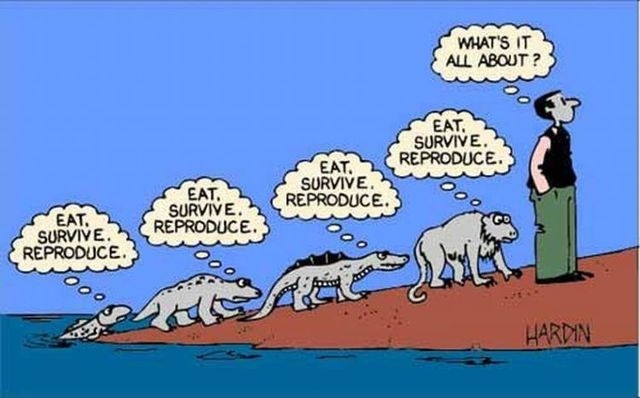
The humorous image above is actually a decent portrayal of how we humans love to complicate things. Nowhere is this more apparent than in our ‘search’ for meaning to life. This will become clear later.
A ‘Worthwhile’ Life?
I’ve always had a deep appreciation for just being here, an opportunity to experience life on this beautiful planet in our corner of the Milky Way. And even better, I was fortunate enough to be born with a normal body — spared the hardships of mental retardation, deformities, and any number of debilitating and painful diseases.
But my good fortune didn’t stop there: I was born into a stable, loving, middle-class family and thus availed the freedom to pursue opportunities of the privileged.
…Not so for many less fortunate children. Did I deserve my good fortune? If God exists, did He plan it this way — perhaps to give me the opportunity to do something worthwhile with my life?
Is this the meaning of life — to do something worthwhile with it? (Of course, this begs the question of what qualifies as “worthwhile.”)
“Is life worth living? This is a question for an embryo, not for a man.” Samuel Butler
Our Beliefs Are Real
The popularity of religion is surely one of the by-products of our apparent need for meaning to life. Some cite this need as one proof for the existence of God. But others think it’s a human psychological need, a result of higher intelligence; no God necessary.
In any case, your beliefs can provide comfort and meaning to life. Whether your beliefs are based on an objective reality matters little, because your beliefs are real.
But what about less fortunate people — do they get a ‘do-over life?’ Were young victims of the Holocaust properly compensated in an afterlife, or given another shot at biological life?
Are there an infinite number of souls ‘floating around’ somewhere,  waiting to be installed in the next developing fetus — where I was merely the beneficiary of a lucky spin of the cosmic roulette wheel? (Best wishes to the poor soul in line behind me who got plugged into a body destined to fail miserably — or a life that will turn out horribly.)
Biologists might say I was the beneficiary of a decent gene pool — thanks to my parents, their parents, and so on. Not to mention luck at having survived any number of potential life-ending and life-altering scenarios.
Nevertheless, like everyone else, I will die someday. So even the ‘blessed ones’ like myself are terminal the day we’re born. My older brother, Johnny, jokes that “Good health is nothing but a slower march to death.” He was joking, but I laughed an uneasy laugh the first time I heard it because the dim view is the words ring true.
…But surely the appropriate attitude to take about life should be positive, despite the fact it always ends in death. This was an “ah-ha” moment for me, and key to finding the answer we all seek, as you’ll see.
Gone But Not Forgotten?
Within a relatively short time after dying — less than a hundred years — all memories of me from live persons who knew me will vanish too, for obvious reasons.
 Perhaps long after my friends and family have also departed, my ‘digital self’ — photos, videos, things I’ve written — will survive to be mined and examined by a bored internet surfer. But that’s only if he or she has the time. After all, they have their own lives to live, and there will be countless other digital ghosts vying for attention.
So what’s life all about? Is it a ‘once and done’ event, never to be experienced again?
Is there a fundamental, ‘built-in’ meaning — a purpose for our being here — waiting to be discovered by someone smart enough to figure it out?
If you could answer this question in a way everyone would believe — whether it’s true or not — the world would beat a path to your door. Everyone would want to know your opinion on all esoteric or spiritual matters. (Which is surely one reason the Dalai Lama and mystics are so popular, along with the world’s religions.)
Answers From Famous Philosophers
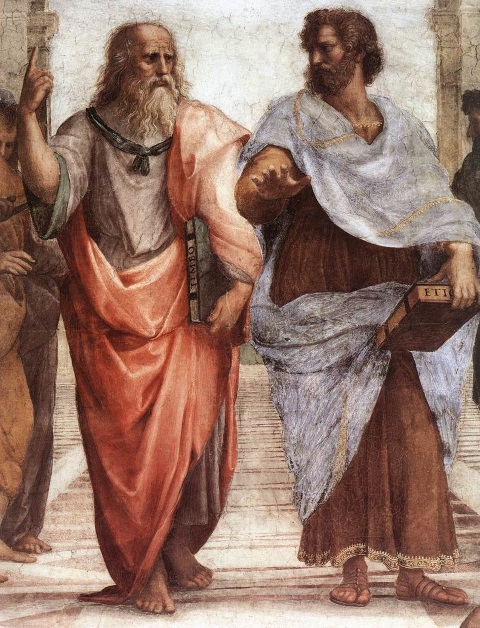
Three of the most influential persons in the history of philosophy and science were the famous ancient Greek philosophers Socrates, Plato, and Aristotle. Socrates was Plato’s teacher and Plato was Aristotle’s teacher.
Surely between the three of them we can glean a satisfying clue about the meaning of life, right?
Socrates
Let’s start with Socrates, the first and oldest of the three: He was someone who was so dedicated to his ideals that it could be said he literally gave his life in defense of his philosophy on the meaning of life.
Charged with “corrupting the minds of the Athenian youth” and “failing to acknowledge the gods that the city of Athens acknowledges,” Socrates was sentenced to death after his trial in which he refused to admit wrongdoing. He preferred to die rather than be forced to live in a world that disallowed his continued quest for knowledge stemming from unrestrained free-thinking.
Socrates is credited with having influenced the development of the scientific method — such was his dedication to ‘clear thinking.’ He was skeptical of authority, and openly opposed the status quo.
If you could distill his philosophy of life down to a single quote, it would probably be his most famous one:
“The unexamined life is not worth living and ethical virtue is the only thing that matters.” – Socrates
Plato
If any one had more influence than the others, it may have been Plato. He founded the Academy in Athens, the first institution of higher learning in the Western world.
The Stanford Encyclopedia of Philosophy describes Plato as
“…one of the most dazzling writers in the Western literary tradition and one of the most penetrating, wide-ranging, and influential authors in the history of philosophy…
Few other authors in the history of Western philosophy approximate him in depth and range: perhaps only Aristotle (who studied with him), Aquinas and Kant would be generally agreed to be of the same rank.”*
*I’m always amazed philosophers of ancient times like Plato can continue to have such influence some 2300 years later. The reason is likely because philosophy is concerned with the way people think — motivations driving their thinking. While the world changes, people remain the same; we all have the same basic needs, hopes, and desires — no matter what the current year is.
…So surely Plato could tell us the meaning of life, right? To highly paraphrase and summarize the Platoism view, the meaning of life is to attain the highest form of knowledge, from which all ‘good and just’ things are derived. (Perhaps this isn’t surprising, as his teacher was Socrates.)
Aristotle
Aristotle expanded on his two famous predecessors’ pursuits of scientific knowledge, going so far as to promote empiricism over Platoism, following Plato’s death. He is credited with making the first studies on logic, leading to the establishment of formal logic in the 19th century.
But what about his more esoteric philosophical views — his take on the meaning of life? Aristotle proposed our motivations for our thoughts and actions are based on goals — some of which are subordinate to other goals — but all can be traced to the ultimate goal of happiness.
…For example, you are motivated to complete this semester’s classes so you can enjoy a few days of vacation before the next classes start. But this goal is subordinate to your goal of finishing your education so you can get a job, which is subordinate to your ultimate goal of making a living doing what you enjoy so you can achieve a higher level of happiness.
“And of this nature Happiness is mostly thought to be, for this we choose always for its own sake, and never with a view to anything further: whereas honor, pleasure, intellect, in fact every excellence we choose for their own sakes, it is true, but we choose them also with a view to happiness, conceiving that through their instrumentality we shall be happy: but no man chooses happiness with a view to them, nor in fact with a view to any other thing whatsoever.” – Aristotle
Conditioned for a Purposeful Life
We can all identify with Aristotle’s take on the meaning of life:
From an early age, we are taught to be goal-oriented. We are funneled into a purpose-focused life from the time we can think for ourselves. Short-term goals such as getting ourselves ready for bed or homework for the next day’s classes. Middle-term goals such as school projects.
It’s the long-term goals, however, that give us a rudder to steer our lives by. Goals such as finishing school — so that we can get a job — so we can buy a car — so we can gain independence — so we can find a mate — so we can have a family — so we can contribute to life — so we can ‘be somebody’ or buy a home or become rich or become famous, or help others less fortunate than ourselves, and so on, ad infinitum…
With the ultimate goal of being happy.*
*We all want to be happy. Surely one of the main goals of a life lived with meaning and purpose is happiness, right? Aristotle’s take on the meaning of life — that happiness is merely a corollary of our choices and actions which ideally result in our feeling happy — is the same conclusion reached by modern-day philosophers and psychologists.
But the new ‘science’ of happiness (Positive Psychology) identifies precisely what actions and thoughts (‘states of mind’) result in happiness. A subsection of this chapter entitled, “Is There a Proven Recipe for Happiness?” follows. (You can find it in the Table of Contents following this chapter.)
So it’s not surprising — given our built-in-from childhood goal-oriented lives — that we find ourselves looking for an overall purpose to life. But is searching for “purpose” a realistic way to find meaning in life?

Noted author and physicist Paul Davies once said, “The Universe seems to be ‘about’ something, although I’m not sure that is the same thing as purpose.”
Paul’s quote contains another clue worth noting: Life is ‘about’ something, which could simply be living; in this viewpoint, the purpose of life would be to live.
…And Yet the Question ‘Lives On’
Even after getting opinions from authority figures since time immemorial and reading books written by people smarter than ourselves, we periodically return to the ‘meaning of life’ question, yearning for an answer that will make us say, “Ah-ha!”
But we live and die while the question lives on, because the question has yet to be answered to everyone’s satisfaction. The devoutly religious may have an advantage here, but even among them there are doubters — the result of subscribing to faith-based beliefs.
If you believe everything was created by a god, then it’s reasonable to assume God had a purpose in ‘mind’ for our creation. But what about the purpose for blue whales, cats and dogs, insects, plants, viruses, bacteria, and all other life? Was all non-human life created for our benefit or their own?
To believe the Universe — to include all life in it — was created solely for our benefit should seem inexcusably egocentric of us. It’s here another major clue to the meaning of life resides.
Three Options Only
Everyone wants to be happy. But to say the meaning of life is to seek happiness seems myopic and too shallow. The phrase, “deep happiness” makes no sense but the phrase “deep meaning” makes perfect sense.
Having no clear, universally-accepted answer to the question (the devoutly religious notwithstanding), can mean only one of three things:
- There is a fundamental truth that has yet to be discovered.
- There is no answer because the question is meaningless.
- The question has already been answered, but not everyone recognizes it.
And The Meaning of Life Is…
(Insert sound of drum roll)
After pondering the issue, it appears all three above statements are true:
The fundamental truth is that the question of the meaning of life is meaningless unless you give meaning to it, which has already been concluded by philosophers and others (perhaps even yourself)!
“Happiness depends on ourselves.” – Aristotle
It appears the best answer is that life takes on the meaning that you give it. That’s right — the answer has been developing in your head from day one, waiting to be conceived and articulated into a meaningful phrase…
Meaningful, that is, to you.
Therefore, searching for meaning to life is ‘missing the forest for the trees,’ as the saying goes. IMO the answer to the question, “What is the meaning of life?” is conveniently located in the question itself:
Life.
To help see this, you can substitute the word, “purpose” for “meaning” in lots of questions. For example:
What is the meaning/purpose of eyes? (to see)
What is the meaning/purpose of ears? (to hear)
What is the meaning/purpose of taste buds? (to taste)
…You get the idea.
So what is the meaning/purpose of life? To live!
“You will never be happy if you continue to search for what happiness consists of. You will never live if you are looking for the meaning of life.” – Albert Camus
Pursuing meaning to life is tantamount to pursuing happiness; which is to say, an effort in futility.
You Are Special and Fortunate
I think the fact we are here to marvel over our existence provides all the meaning to life anyone could ask for. It’s surely one of the reasons religions got started to begin with.
One of the best science communicators of all time (IMO) is a young theoretical physicist named Ethan Siegel. This quote is one of my all-time favorites:
“Our very existence is all we have, and while it’s minuscule compared to the entire Universe, it required the entire Universe to bring us to the point where it’s possible for us to exist.” – Ethan Siegel
Having a certain amount of enthusiasm for life — the product of positive thinking and appreciation for your opportunity to experience life — you realize that the answer to the question, “What is the meaning of life?’ makes perfect sense:
To live!
“The meaning of life is just to be alive. It is so plain and so obvious and so simple. And yet, everybody rushes around in a great panic as if it were necessary to achieve something beyond ourselves.” – Alan Watts
Alan’s above quote is really a variation of the timeless aphorism urging us to ‘stop and smell the roses.’
The End of (This?) Life
I think it’s important to not get too attached to this life, however, because we are all terminal the day we’re born. In relative terms, even a centenarian’s life is but a teeny, tiny, tidbit of time in the big scheme of things.
“If life must not be taken too seriously, then so neither must death” – Samuel Butler
So simply appreciate the time you do have, however ‘long’ or short it turns out to be, and do not dread death — not for one second. Because every second you are dreading death is another second you could be enjoying your fortuitous existence. Besides, why dread the inevitable?
“We cannot banish dangers, but we can banish fears. We must not demean life by standing in awe of death.” – David Sarnoff
If you happen to be aware ‘in’ the moment you are departing this life, go with as much enthusiasm as you can muster….ultimately like someone riding a roller coaster as it starts accelerating over a high point — like the Buddhist monks in the photo below:

…No sense fighting it, have fun!
“To the well-organized mind, death is but the next great adventure.”—J.K. Rowling, Harry Potter and the Sorcerer’s Stone