The so-called “paradox” goes something like this:
If popular Drake equation estimates are true (popular estimates hold that there are many hundreds or thousands of Earth-like planets at any one moment in the Milky Way alone), then why isn’t the Milky Way teeming with alien life? After all, at least one alien civilization would have had plenty of time by now to advance to the point of overcoming interstellar space flight, spreading out and populating some significant part of the Milky Way — if not the entire galaxy.
Enrico Fermi (1951-1954) was a brilliant, Nobel prize-winning physicist from whom the “Fermi Paradox” myth was coined. This interesting 2016 Scientific American article by Robert H. Gray titled, “The Fermi Paradox Is Not Fermi’s, and It Is Not a Paradox,” sheds some light on the backstory and illustrates how easy it is to jump to conclusions based on a creative interpretation of an overheard conversation:
Physicist Eric Jones reportedly collected written accounts from three surviving people — Edward Teller, Emil Konopinski, and Herbert York — who were all present at a lunch at Los Alamos in 1950 where the myth got started.
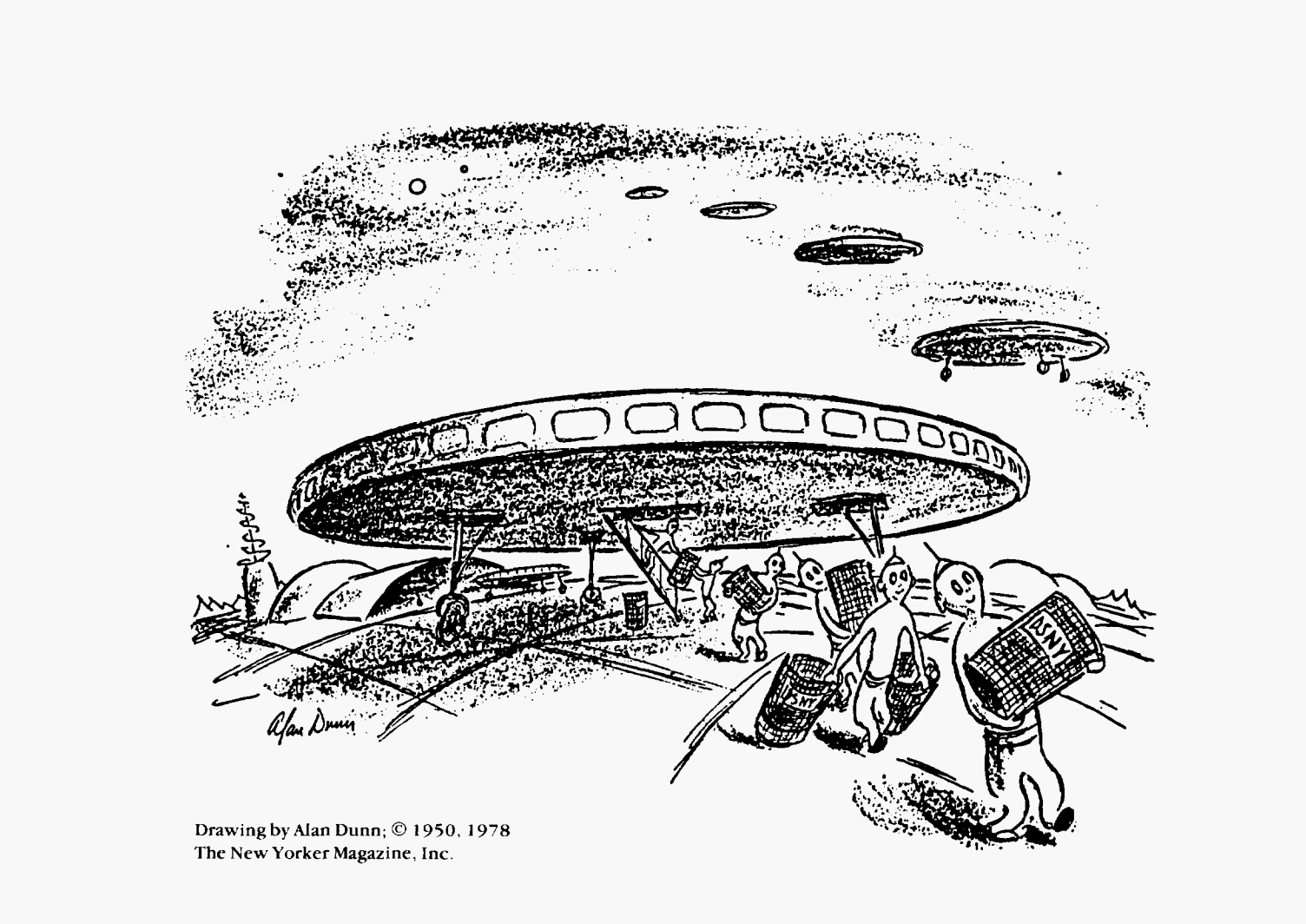
They were chatting over lunch about a cartoon in The New Yorker depicting cheerful aliens stepping off a flying saucer while carrying trash cans stolen from the streets of New York City, and Enrico Fermi asked “Where is everybody?”
By all accounts, they understood he was referring to the fact we haven’t actually seen any real alien spaceships. The conversation then turned to the feasibility of interstellar space travel. Apparently, Herbert York had the clearest memory, and recalled (about Enrico):
“… he went on to conclude that the reason that we hadn’t been visited might be that interstellar flight is impossible, or, if it is possible, always judged to be not worth the effort, or a technological civilization doesn’t last long enough for it to happen.”
So clearly, Enrico Fermi was not concluding there cannot be alien civilizations anywhere in the Milky Way or Universe (since we haven’t actually seen them) but that — if there are any — the vast distances between potentially habitable worlds might make such travel unlikely.
If the laws of physics are actually laws and not ‘bendable rules,’ then traveling at or beyond the speed of light is not only impossible for us here on Earth, but also impossible for aliens as well. Because the laws of physics — as we’ve come to understand since the early 20th century — apply not only to us but to ‘them’ too. This fact alone — the fact there is a cosmic speed limit — is likely why we have yet to be visited by aliens.
So the message is the Universe may well be teeming with life, but since the Universe is so incomprehensibly large and spread out, interworld visitation is a highly unlikely scenario.
…Which is why it’s so surprising that it appears we have, in fact, been visited by extraterrestrial beings for quite some time.