
…And Just What is Consciousness?
Introduction – Part 1
“The human brain is a complex organ with the wonderful power of enabling man to find reasons for continuing to believe whatever it is that he wants to believe.” – Voltaire
The study of human consciousness has had a resurgence in popularity lately, partly because of certain philosophers who insist they know enough about science to conclude consciousness cannot be explained by science, partly due to the public’s use of ‘creative license’ when interpreting the already-baffling science of quantum physics, partly due to the fact it has yet to be defined to everyone’s satisfaction, and partly because it’s a subject that’s fascinating to nearly everyone (for obvious reasons).
There are a few bona fide scientific efforts at studying consciousness, but these are mostly limited to philosophical discussions at conferences, such as those hosted by ASU’s “Center for Consciousness Studies.” That’s because there’s no pressing need in medicine and neuroscience to answer the (mostly) non-scientific questions about consciousness. And what could be the alternative? Until neuroscience can provide a ‘picture’ – neural wiring diagram of a thought, for example – anybody’s favorite philosophical idea is fair game.
…And there is no shortage of ideas floating around not only the blogosphere, but amongst parts of the otherwise professional science community. Ideas from “consciousness dies with its host” to “consciousness IS the Universe” and everything in between. Some of these ideas sound intuitively true, but our intuition has fooled us before.
The ideas are sometimes pitched with religious fervor, and indeed the whole effort resembles a cacophony of competing religious viewpoints; a collection of ad hoc, metaphysical ideas that are cast with liberal use of the word, “theory.”
…And as with other so-called theories* in this realm, it is my opinion that Occam’s Razor should be pulled out, dusted off (because the proponents of some of these ideas do not seem to have heard of it), and put to good use.
*We all use the word “theory” very loosely to describe pretty much any idea we propose. But science treats the word completely different: To qualify as a theory, a rigorous and time-consuming set of procedural steps called the “scientific method” are followed. It is the way science advances, and each theory is open to improvements or refutation – should a better theory be proposed. In this way, science is fundamentally different from doctrinal dogma, which discourages questioning the ‘status quo.’
Before proceeding, let’s clarify how the term “awareness” relates to consciousness, because there is some confusion on the two terms. Some people get bound up in fine-tuning the definitions of each and how they relate, but usually the result is more confusion (IMO). So for the purposes of this writing, let’s just agree when you see the word “consciousness,” it is assumed to be synonymous with “conscious awareness.”
Conscious Experience Requires the WHOLE Brain – Not Just the Neocortex (‘Thinking Part’)
I’m not sure why investigations into how conscious experience arises from brain function do not typically include ALL of our brains’ organs and glands – but focus on the ‘thinking’ part of the brain – the neocortex. Yet surely every thought gets ‘filtered’ by emotions largely generated by the limbic system (amygdala, hypothalamus, hippocampus, and thalamus). Then there’s the pituitary gland and other major brain areas like the cerebellum that surely affect – directly or indirectly – conscious thought.
Therefore, no matter how nuanced the science gets, there will always be subjective differences between otherwise identically statistical ‘thought patterns’ that get mapped and averaged across our species.* And this is a good thing (as you’ll read later)…
* IMO the total of our brains’ workings ensures that digital “beings” – future advanced LLMs and the like which have ‘achieved’ General Intelligence – will never actually be conscious as they could never truly experience emotions (which include tactile senses, hunger, pain, longing, fear, rejection, love). In fact, they could never “experience” anything for that matter; any digital equivalents that are otherwise successfully programmed would always be only simulations – like a flight simulator vs actually flying.
Introduction – Part 2
The “Introduction” section in this essay is relatively long (two parts) because the subject of consciousness necessarily involves a brief foray into epistemology, because it is about ‘thinking about thinking.’
To do this properly, we need to start by agreeing on the foundational precept of trusting our brains (as a species) to deliver adequate representations of reality. Otherwise what’s the point of even trying to analyze consciousness if we disqualify ourselves at the start? This may sound like an unnecessary effort, but some very educated folks say humans are not qualified to unravel the mysteries of consciousness because:
We’re conscious ourselves. (But does this disqualify us or make it easier to understand consciousness?)
…I think the likely answer is neither: As conscious beings ourselves we might find it more difficult — but not impossible — to fairly deconstruct consciousness.
But we shouldn’t take it for granted we’re qualified to analyze consciousness until we give the subject a good look and examine our qualifications. So this “Intro Part 2” is dedicated to doing just that. And along the way we’ll look at some of the things that allows consciousness to arise from brain function.
What is knowledge?
Answer: Information, understanding, or skill acquired from experience, association, or education.
How can we be sure we know what we think we know?
(How can we be sure our knowledge is an accurate representation of reality? For that matter, what qualifies as an accurate representation?)
…In other words, how do we know our “subjective reality” adequately matches the “objective (true) reality?” (Subjective reality could be defined as “objective reality filtered by our individual and species-unique perceptual biases” – my words, not an ‘official’ definition.)
Perhaps we’re ‘too close to the action’ to properly analyze consciousness; we can’t see the forest for the trees (to use an aphorism). A variation on this analogy is we’re like fish – completely ignorant of the world above water and therefore couldn’t possibly decipher the true reality of anything beyond our limited field of experience.
…At first the fish analogy may seem valid, but experience shows we’ve been quite successful in our efforts to understand – or at least ‘decode’ – areas of reality that are arguably farther outside our own world than solid ground is to a fish’s. For example, quantum physics baffled Einstein ’til his passing, yet we’ve since capitalized on discoveries made possible from quantum physics that have ultimately resulted in your cell phone, computer, MRI machines, and all other devices made possible by advances in microelectronics based on quantum mechanical principles.
Evolutionary benefits
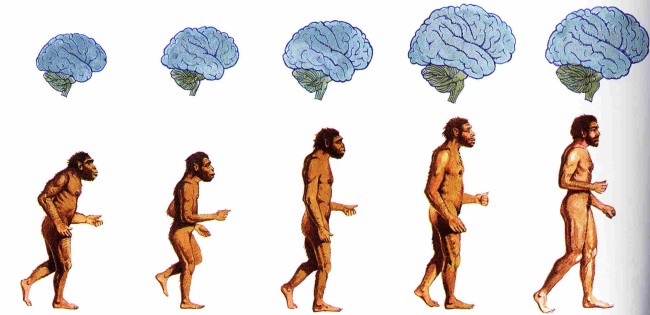
The human brain is the culmination of millions of years of evolution. As a result, its ability to process different sensory information has had millions of years to improve.
For example, our eyes are well-adapted to see in our “visual” spectrum of light because this is the main part of the Sun’s light allowed to pass through the atmosphere all the way to the ground (which is called the “optical window”).
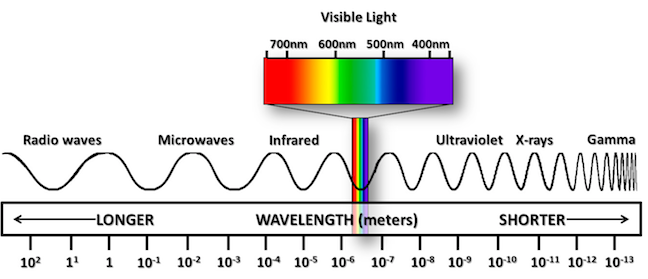
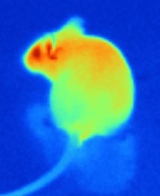
…There is, however, a small amount of light just outside each end of our visual light spectrum that makes it through the atmosphere: A bit of infrared and ultraviolet light. Although it could be helpful at times to see these parts of the light spectrum, this ability is not really needed for our survival.
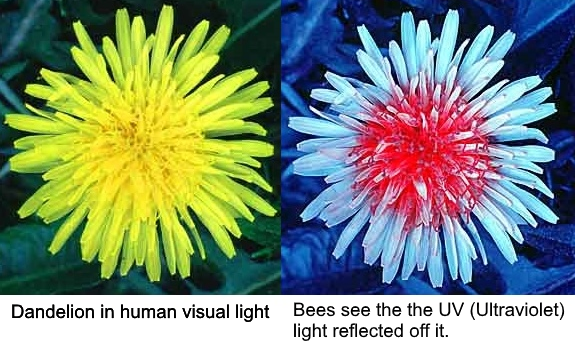
But for snakes it is – they can see this infrared light as heat emanating from otherwise invisible prey. Bees can see into the ultraviolet, which makes nectar and pollen in flowers glow marvelously for them.
 But our forward-looking, binocular-vision eyes are very well adapted for accurate depth perception and fine details. This is partly why we’ve been able to build everything from buildings, cars and airliners, to computers, spacecraft and MRI machines. But the main reason we’ve been able to accomplish these things is due to the higher, ‘thinking’ part of our brains, the neocortex.
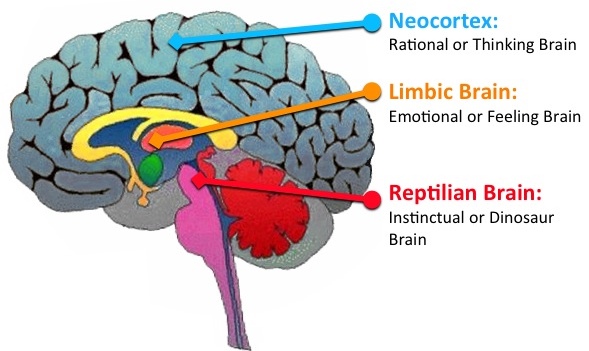
Over roughly the last two million years, the neocortex in humans evolved and grew in size at a dramatic rate compared to all other mammals. (The “neo” prefix means “new.”) The neocortex makes up about 90 percent of the cerebral cortex and about 76 percent of our total brain mass. This ‘outside layer’ of our brain is responsible for functions to include sensory perception, motor commands, language, and conscious thought.*
*There is a popular urban myth that says we humans use only about ten percent of our brains. The unspoken message is we’re too lazy to use the other ninety percent; just think of what we could accomplish if we did. To be sure, this myth was not started by neuroscientists. Besides, if true, it would be evidence of efficiency rather than otherwise: Imagine your computer having to use one hundred percent of its computational power to simply open a web browser; it would be far better if your computer was so powerful it took merely a few percent of its CPU’s resources to do that.
Our language abilities – helped in large part by our ‘new’ brains – enables the sharing of complex information, making it possible for exponential increases in our species-wide knowledge.
It appears our brains are the best on the planet, so our perceptions of reality could arguably be the best on the planet. But are our perceptions a perfect representation of reality?
Of course not…
Human Perception
Species-wide evolutionary perceptual biases
Conscious and subconscious perception isn’t created from scratch when, say, a  child is born. A child’s brain is the current culmination of many millions of years of evolution. The result is a brain with a certain amount of ‘hard wired’ predispositions for perceiving and reacting to the world in a predefined way. For example, at birth human babies are hard-wired to recognize human faces…
This built-in perceptual bias combines with the human brain’s extraordinary ability to recognize patterns to culminate in adults who ‘see’ human faces on Mars, Jesus’s face in a taco, or a face in a cloud, as examples. The brain recognizes a pattern and naturally associates it with a face, due to its hard-wired bias for human faces. From there it’s a short step to assigning a specific face to the image, triggered by psychological biases such as religious fervor or other motivation.
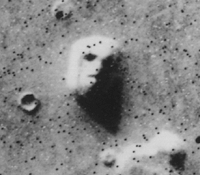
The image on the right is a “satellite photo of a region of Mars, often called the ‘Face on Mars’ and cited as evidence of extraterrestrial habitation. Subsequent higher-resolution photos from multiple viewpoints demonstrated that the “face” is in fact a natural rock formation.” – image and quote from Wikipedia.
 We see perceptual biases built-in to all mammals (and all other animals). The brains and eyes of all cats, for example, are ‘hard-wired’ to see movement. This is a species-wide, built-in perceptual trait. They quickly notice movement and determine if the moving object is potential prey. Their perception of reality is largely colored by evolution.
Perceptual biases from individual genetic family histories and personal experiences
We all process the same world slightly different, due to differences in our perceptions. Our perceptions are unique because we are each unique:
Both physically and mentally, every human is slightly different. Aside from evolutionary biases, we have varying genetic predispositions sculpted by our individual family histories.
There’s also our cultural biases along with other environmental influences from a lifetime of exposure to the world around us.

All of these biases cause us to perceive the world in a way unique to our individual personalities.
…You may describe a person as slightly overweight with brown hair and friendly. I may describe the same person as average weight with sandy-blonde hair and an introvert.
There’s also a perceptual difference in the passage of time on our recollection of events. Under stress or when time is short, we tend to see what we expect to see, and remember what we already expected – which may not match the true image or event. The experience of time itself is unique to each of us: Time flies when you’re having fun but may drag when you’re in pain or in line at the DMV (which is the same thing 😉 ).
“Normal” perception of reality
Different people perceive reality different ways, but when you throw out the extreme views, you’re left with (what could be computed as) the ‘average way’ humans perceive the world. This average could be called “normal.”
…But would this “normal” be a 100% accurate (‘perfect’) representation of reality? Of course not, because there is no such thing as a perfect representation of reality – in the same way as there is neither a genre of music or art that is perfect nor a perfect way to perceive it; “beauty is in the eye of the beholder,” as the saying goes. There is, however, an important distinction we need to acknowledge:
The “extreme views“ referenced above are ones that ‘misinterpret’ reality. But if ‘reality is in the eye of the beholder,’ how can any one interpretation be labeled a misinterpretation?
 …Here’s how: If it makes predictions that turn out false. For example, the brother of a friend and I enjoy the same classic rock ‘n roll music, but the brother believed the doomsayer prophesies associated with the Mayan calendar prediction of a 2012 Armageddon. He also firmly believes in astrology and thinks the Apollo program was a big conspiracy – no astronaut has actually set foot on the moon.
His views of reality could be considered “extreme” and thus not taken into account when figuring the “average” human’s perceptions. (Probably had something to do with his penchant for LSD, among other things.) His views of reality often make predictions that turn out to be false.
How We Can Be Sure We Know
What We Think We Know
So the obvious answer to the question, “How can we be sure we know what we think we know?” is:
We can be sure of our knowledge if our interpretations of the present (reality) make accurate predictions of the future (reality).
Obviously our interpretations of reality and the predictions we make from them will not always be accurate. We realize this and have therefore developed a formula along with a guiding principle that has proven a big help in making accurate predictions about the future: The Scientific Method and Occam’s Razor.
The image below is a diagrammatic representation of the Scientific Method:
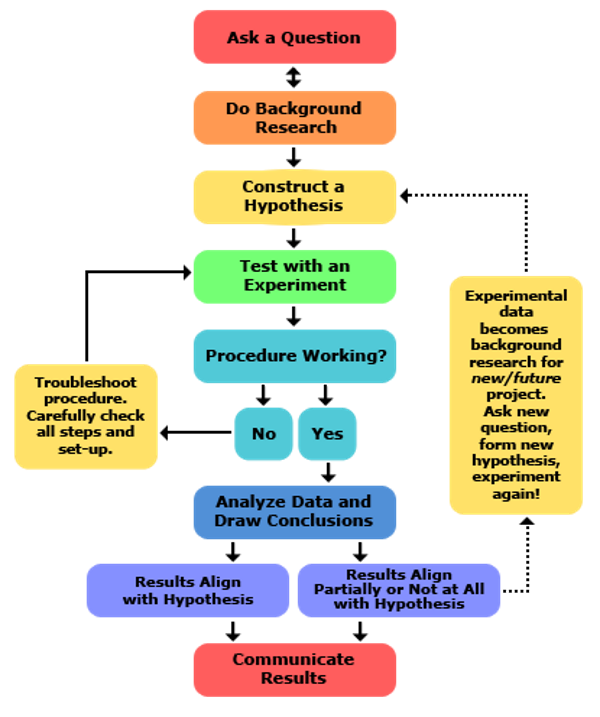
Occam’s Razor is not a ‘hard’ formula but a guiding principle that has proven useful by helping choose the correct hypothesis among competing ones developed from the scientific method. It simply suggests that if two or more hypotheses adequately explain something, the one that makes the fewest assumptions is likely the correct one. (If a more complex hypothesis better explains something, the more complex hypothesis is the better choice.)
…So even though we humans perceive reality through varying perceptual biases, we are aware of them. Because of this awareness, we’ve crafted the scientific method to compensate for these biases and in the process, discovered that how to think is every bit as important – perhaps more so – as what to think.
The following are just a few things we’ve been able to predict – in part because of our awareness of the importance of knowing how to think:
- Astronomers predict the arrival of comets and meteor showers – including other astronomical events – many years in advance to a precision of minutes.
- Medical science predicts the course of antibiotics or other drugs and the prognosis and progression of thousands of diseases.
- Engineers accurately predict the future state of complex machines.
- Meteorologists are predicting the weather with increasing accuracy farther ahead of current prediction windows.
- Cosmologists have determined the evolution of the Universe far into the future, based on astoundingly-precise mathematical descriptions of the Universe when it was a tiny fraction of one second old.
That’s your reality, dude
Occasionally you hear someone say, “…That’s your reality.” This adage — esoteric though it may sound — is actually a concise statement of how we each perceive the same world a bit differently. This perceptual uniqueness is ‘built-in’ to our brains, largely the inevitable result of our unique genetic histories and individual experiences.
…And it’s a good thing. Our unique perceptions of the world are an evolutionary gift:
No doubt mankind would make little progress if everyone perceived the world exactly alike. New ideas would be hard to come by. Resourcefulness and creativity would be rare. There would be only one type of music. Art would be a rarity and of only the same type. We would all be insufferable bores as well.
But thankfully, the complexity of our brains — along with the fundamental physics that underlies the emergence of our conscious minds — eliminates the possibility of this happening. (No need to invoke Heisenberg’s uncertainty principle; our macroscopic world explains all the differences in us we need.)
We want to believe consciousness survives our bodies
There’s one other area we need to acknowledge before we (finally) look at some of the specifics of consciousness:
Our human psychological influences and biases, such as our general aversion to the end of our consciousness. This makes us quick to adopt any ‘theory’ promising life after death (which is surely one reason for the proliferation of religions promising everlasting life).

“We fear death so profoundly, not because it means the end of our body, but because it means the end of our consciousness – better to be a spirit in Heaven than a zombie on Earth.” – Alison Gopnik
Being aware of our psychological aversion to the end of our consciousness does not mean consciousness does indeed die with our brain, but it should make you carry a bit of healthy skepticism in your ‘back pocket’ whenever confronted by any such metaphysical claim.
[Note: The article titled, “Birth-Life-Next?” includes my personal ‘theory’ on the survival (or not) of our conscious minds when we die. It’s a unique idea that hasn’t changed since I was a teen. You might find it’s a compelling argument that may sound intuitively true. Or not.]
Consciousness in animals
Famous neuroscientist David Eagleman is sometimes asked if certain animals are conscious or not. He replies that the question is wrong: It’s not whether animals are conscious or not, but rather there are degrees of consciousness. To me, this is an obvious reality of consciousness.
For example, if consciousness was quantified on a percentage scale (with 100% being humans — the ‘highest’ level — at least on Earth), viruses and bacteria would be rated at 0.00% consciousness. Insects would have perhaps less than a percent or two of consciousness. A mouse’s level of consciousness would be so far above an insect’s as to appear to come from a different planet, but would nevertheless be far less than a human’s.
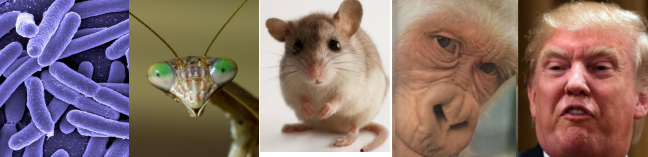
…As you move up the ladder of neural complexity, the level of consciousness increases by a proportional amount. One popular test for conscious awareness is if a creature recognizes itself in a mirror (the “MSR” or “Mirror Self-Recognition” test).
Many primates do, as well as some species of dolphins. (Humans do from about 18 months old.) The Asian elephant does, and so do some bird species — such as the Eurasian magpie and African Grey. Cats and dogs do not recognize themselves in a mirror. (Cats will typically search behind a mirror in an effort to locate the ‘other’ cat. Dogs typically show little or no interest.)
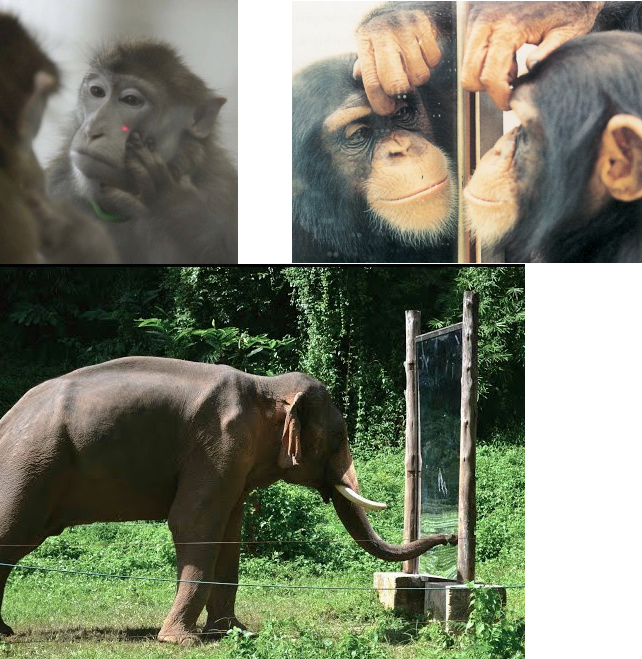
But is this test completely definitive? Likely not: Surely cats and dogs are conscious ‘beings,’ but obviously at some level below primates and certain other mammals. (I have some difficulty thinking of my cat, Milo, as a “being” — a word normally associated with us humans). But I have an important and reassuring announcement for Milo and all cats and dogs of the world:
In 2012, the subject of the Francis Crick Memorial Conference in Cambridge was “Consciousness In Human and Non-Human Animals.” There, a group of scientists concluded that most animals are indeed conscious beings and drafted a short paper titled, “The Cambridge Declaration of Consciousness.”
The first and last paragraphs are reprinted here (although the whole paper is a quick read, accessible from the above link):
“On this day of July 7, 2012, a prominent international group of cognitive neuroscientists, neuropharmacologists, neurophysiologists, neuroanatomists and computational neuroscientists gathered at The University of Cambridge to reassess the neurobiological substrates of conscious experience and related behaviors in human and non-human animals. While comparative research on this topic is naturally hampered by the inability of non-human animals, and often humans, to clearly and readily communicate about their internal states, the following observations can be stated unequivocally:
We declare the following: “The absence of a neocortex does not appear to preclude an organism from experiencing affective states. Convergent evidence indicates that non-human animals have the neuroanatomical, neurochemical, and neurophysiological substrates of conscious states along with the capacity to exhibit intentional behaviors. Consequently, the weight of evidence indicates that humans are not unique in possessing the neurological substrates that generate consciousness. Nonhuman animals, including all mammals and birds, and many other creatures, including octopuses, also possess these neurological substrates.”
After the paper was published, more than a few pet owners chimed in on blogs with statements like, “I could’ve told them that!” or “I knew my dog was a conscious being!” or “Well duh!” and so on.
“Birdbrain?”
You may have heard the disparaging term, “birdbrain” before. If it referred to Eurasian magpies or African grey parrots, it would be a compliment. According to the Cambridge Declaration on Consciousness, “near human-like levels of consciousness” have been observed in the African grey parrot.

African greys have shown impressive intelligence to the level of chimpanzees, dolphins, and even human toddlers. What’s most remarkable is their ability to use vocabularies of many hundreds of words in a way that shows they are not just ‘parroting’ the words like a tape recorder.
In 2004 Jane Goodall visited the home in New York where an African grey named “N’kisi” was kept. N’kisi greeted her with “Got a chimp?” because he had seen photos of Jane with chimpanzees in Africa.
A few minutes of online ‘research’ shows African greys to have a great sense of humor, or at least great satisfaction in playing pranks on their owners or (especially) on their fellow house pets — cats and dogs. Some of the stories seem too incredible to believe, but there are too many to discount them all.
Consciousness in Humans
From the time we are old enough to think for ourselves, our own consciousness is an intuitive part of our existence. We recognize this when we look in a mirror: It feels natural that our consciousness — the essence that is ourselves — is a separate entity from our bodies. Our eyes become windows through which our conscious ‘selves’ peer out into the world.
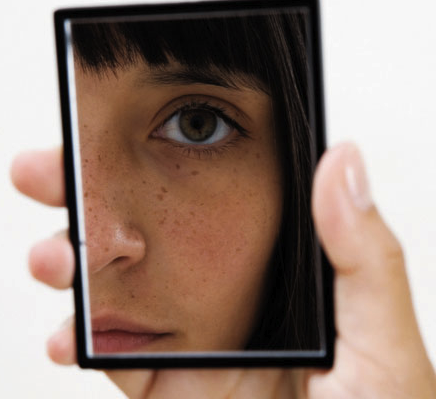
…But is this intuition an accurate representation of reality? Is your consciousness truly separate from your body (which includes, of course, your brain) or ‘merely’ the result of brain function; the sum of countless simultaneous neuron firings in your brain and no more?
Perhaps the answer is neither; perhaps consciousness is neither separate from your brain nor the sum of its operations:
Although the scientific reductionist viewpoint from neuroscience may claim consciousness to be the “sum of countless simultaneous neuron firings of your brain” (my words – not any ‘official’ neuroscientist’s that I’ve read), it seems likely that consciousness is the extreme – if not the ultimate – example of a phenomenon that is far greater than the sum of its parts.
An example:
A modern airliner is the culmination of the collaborative efforts of thousands of human brains for decades. A typical airliner is an impressive assemblage of (up to) four million high-tech, specialized parts – most of which are incredible in their individual complexity alone. Together, they form a machine that is arguably greater than the sum of its parts. After all, it can fly! Yet this ability – unique amongst man-made machines – enables much more than ‘just’ flight:
The entire world is now available for travel in times so short as to be the stuff of science fiction of years past. Aerial rescues at sea and emergency medical transport by air are now routine. Firefighting has an aerial advantage now, and dozens of geospatial applications help make our lives better while keeping an eye on our planet’s health.
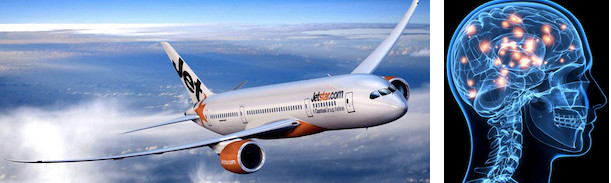
Like a single human brain, a modern aircraft is a good example of something from which the coordinated operation of its individual parts produces something greater than the sum of its parts.
Reverse Engineering (decoding) an aircraft or brain
As impressive a machine an airliner may be, a non-aviation engineering firm – staffed by people who know nothing about an airplane or aerodynamics, for example – could nevertheless analyze and figure out exactly how each of an airliner’s individual components work and how together they produce a machine capable of flight…
More to the point, they could probably do this within a few years at most. This is because the most complex aircraft has ‘only’ about four million parts. The human brain, however, is unparalleled in complexity – with trillions of connections between many billions of neurons. And that’s not even counting the (presently unknown) role subatomic (quantum) biology may have on consciousness.
…If we end up having to multiply the already astronomically-large number of (strictly mechanistic) neural connections with a number which represents a biological complexity many orders of magnitude larger, it’s difficult to see how we could ever completely ‘decode’ consciousness.
So the challenge confronting us with figuring out how consciousness arises from brain function is one of complexity – not some fundamental limit imposed by nature.*
*Nevertheless it could turn out this very complexity is a fundamental limit imposed by nature. For example, the problem may be solvable – but only if humans are still around many years from now to complete the ‘project.’ If we are extinct by then, then either the passage of time or the survival of our species is nature’s limit – take your pick.
Thus far, the human brain has defied attempts by neuroscience’s best and brightest to decode its fundamental workings. We know much of how a single neuron works, but how can we ever hope to figure out precisely how a specific thought is formed from the combined operation of billions of neurons sending and receiving signals through trillions of connections – to say nothing of possible (additional) biological complexities we haven’t even begun to figure out?
…The colossal challenges to figuring out the brain appear too daunting to overcome. Where would we even start?
Here’s how: A logical first step is mapping out the neural connections of the brain; creating a ‘wiring diagram’ of the brain. Such a diagram may be the first step toward solving…
The “Mind-Body Problem”
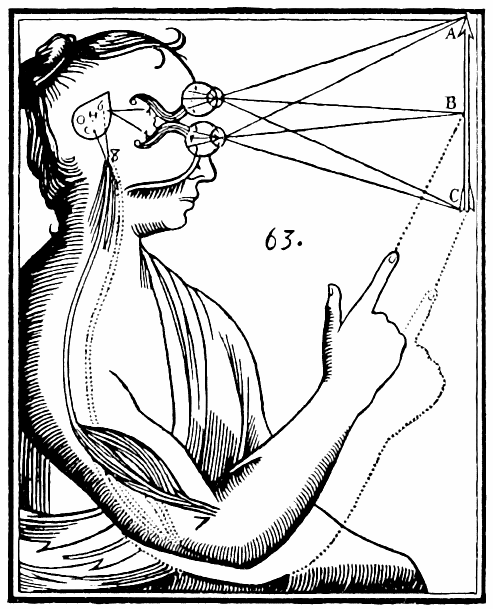
Some philosophers (such as David Chalmers) call our failure to nail down exactly what causes consciousness to “arise” from brain function the “mind-body problem.” I’ll spare you the superfluous over-intellectualizing details because the term pretty much says it all:
The mind is apparently separate from the body yet seems inextricably attached to the body nonetheless. What’s going on?
It appears the so-called “mind-body problem” is only a problem for people who find it difficult to believe that consciousness is an “emergent property” of the brain. This is understandable, because intuition tells us the essence that is our selves – our unique personalities with our ‘super’ awareness (which allows us to hold many complex ideas in mind simultaneously while being aware of our bodies and the passage of time) – is being carried around by our bodies but is not really a part of our bodies.
The “problem” is therefore a psychological one because experience teaches us our intuition is often correct. For example, we all know that ‘gut’ feeling cautioning us to stay vigilant around certain people whose actions later prove our intuition correct. Countless times we’ve said, “I had a feeling…” about any number of situations and our “feeling” turned out spot-on…
Our intuition – a great feature of our subconscious – however, is not always correct. Until science proved otherwise, our intuition confidently informed us the Earth was the center of the Universe, diseases were caused by evil spirits, and that thunder and lightning was caused by angry deities. Even Albert Einstein’s intuition failed him, most famously in his denial of a bizarre reality of quantum physics he dubbed, “spooky action at a distance.”
…So based on the history of science progress alone, a safe bet is that much of today’s aura of mystery surrounding consciousness will be adequately explained at some future time – however near or distant that date may be.
Call it what you want
Aside from missteps of our intuition, part of the mind-body problem (as noted earlier) is that consciousness is yet to be defined to everyone’s satisfaction. Since everyone experiences consciousness every waking second, you might expect it to be intuitively easy-to-define. But even though we know what it feels like, we can’t describe it.
…This should not surprise us, however, because human language is not the correct medium for defining consciousness. There’s a big difference in “defining” consciousness and actually figuring it out. Coming up with an adequate definition is more an attempt at a proper ‘label’ rather than an ambitious attempt at deciphering it.
Efforts at defining a brain’s ultimate ‘product’ – a thought – are not science efforts so much as philosophical ones. It’s like trying to answer the question, “What is the meaning of life?” The answer is a subjective one, and your answer will likely be different than mine.
No doubt some definitions make more sense than others, but there could never be one everyone agrees on; it’s not a math problem with just one answer.
Our ‘Subconscious Conscious’
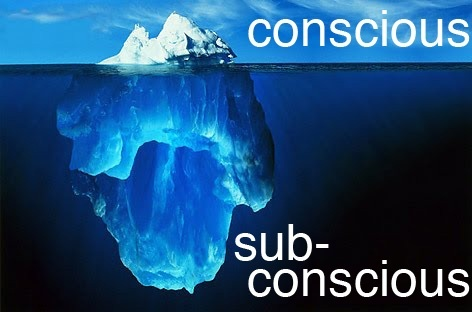
A complete and balanced (non-scientist) examination of consciousness must include subconsciousness. Ignoring this overarching key part of our mind is tantamount to ignoring the role biology – specifically the brain – has on consciousness.
Although neuroscience has yet to figure out the exact mechanics of a thought, one aspect of consciousness is undisputed:
The subconscious mind is by far the predominant ‘thinking part’ of our brains. Our conscious minds are privy to only a teeny, tiny tidbit of the total amount of information processing occurring in the brain, and this is as it should be. This is because we would go nuts if we were allowed access to all the goings-on of every sensory input and all extraneous thoughts (whether related to our current conscious focus or not).
…Giving your conscious mind access to all of your brain’s activity would overload it; you would be unable to focus on anything to the degree necessary to accomplish even the most simple task or complete an intentional thought.
One definition of focus is “A central point of attention.” There could be no central point of focus with the ‘noise’ of a cacophony of thoughts competing for the central point. Nevertheless our subconscious mind is always present, just beyond our conscious mind’s focus, as if some semipermeable membrane separated the two.
We’ve all experienced times when we’re in a conversation with someone and suddenly a name or phone number ‘pops’ into our conscious awareness, seemingly out of the blue. An earlier attempt at recalling the name or number was unsuccessful, but the subconscious mind continues searching for the answer – long after we’ve shifted our conscious focus elsewhere…
It’s as if a staff of ‘memory specialists’ in our brains finally found the answer to serve up to the CEO – our conscious minds – and thought it prudent to interrupt the CEO’s conversation to proudly deliver the elusive answer.
Our subconscious minds work round-the-clock, even when we sleep:
It’s no secret a good night’s sleep is great for your brain. “Better sleep on it” is sage advice because it’s based on established neuroscience:
During your waking hours, your brain has to process lots of information – names, numbers, places, plans, thoughts and experiences. Each ‘item’ needs to be correctly processed for you to keep track of them. To use an office analogy, if each item was a paper with relevant info on it, then each paper needs to be filed in the appropriate ‘filing cabinet’ for easy retrieval.
…Much of the filing process happens when you sleep. One or more poor nights’ sleep results in lots of ‘papers’ remaining scattered about. Before long, there’s a backlog. Your attention span drops and your mind cannot focus on anything but the present, ‘here and now.’ You can’t get anything done until you get a good night’s sleep and each “scattered paper” is filed in its appropriate place in your brain.*
*The science is obviously more complex, but this in one way to look at it. One study reports that dreaming clears junk data in the brain.
…Other than getting a good night’s sleep, one way to help yourself stay organized is by (just before bed) writing down the most important issue you need to address the next day. Thomas Edison supposedly once said, “Never go to sleep without a request to your subconscious.”
Heightened levels of awareness
When you intentionally attempt to figure out something mysterious or confusing, you can put yourself into heightened levels of conscious awareness.
You could say a heightened level of awareness = ‘normal’ conscious awareness + a certain (additional) amount of (ordinarily inaccessible) subconscious awareness.
 Thinking ‘creatively’ can involve several seemingly unrelated ideas that are used to solve one problem. In doing so, you can hold – to varying degrees – many ideas in mind simultaneously. Some of these thoughts can be very complex.
…Although some of those thoughts are being steered by your conscious mind, the lion’s share are being fleshed out more thoroughly in your subconscious mind:
As these moments of heightened awareness continue, varying degrees of these subconscious thoughts may ‘drift’ in and out of the periphery of the spotlight of your conscious focus. They may be only subtly available for direct observation at any one moment, otherwise you would lose focus on the original goal of your venture into your state of heightened awareness…
Nevertheless, you might keep them from straying too far from the “spotlight” – in case you need to bring them into direct focus, replacing the idea currently occupying your mind’s ‘hot seat of focus.’
The experience of conscious awareness – whether ‘deep’ (as in creative thinking) or shallow (as in impassive, relaxed quietude) – can include a purely physical component as well: Simultaneous with any and all thoughts can be an awareness of your body – its tactile feelings and position in three-dimensional space.
You may also be aware of the passage of time. But when you’re deeply absorbed in creative thinking – perhaps “in the flow” – the passage of time can seem to vanish, and even awareness of your body can take a back seat to your focus:
For example, you may suddenly notice your shirt is on inside out and you haven’t eaten breakfast by 2 pm. The ability to ignore distractions – beeping message notifications, construction noise, your hunger – allows you to accomplish your goal most efficiently, in less time.
…It’s obvious the brain can handle only so much at one time. But distraction-free focus is an evolutionary survival benefit that allows otherwise overly-complex tasks to be conquered in a short time.

The movie, “All Is Lost,” starring Robert Redford,* is a testament to being able to tap into the subconscious mind’s capacity for empowering creative thinking. A brain’s own survival can be dependent on its ability to overcome complex riddles in seconds while ignoring imminent doom (with its attendant tendency to shut down the brain with panic).
*Redford’s character is sailing a small vessel through the open ocean when he collides with a mostly-submerged, floating shipping container. The collision breaches the hull and destroys his radios and navigation equipment. Dealing with these problems over the next day or so puts him in the path of a deadly storm.
Consciousness: An emergent property ‘separate’ from your body
The combined effect of all this brain activity comprises the sense that your mind is separate from your body. And in this sense, it IS separate from your body – at least when it is awake and alert. Thus the term, “emergent property” to describe consciousness.
…But like an aircraft parked with engines idling, your brain is mostly “idling” when you are in a deep sleep. Its emergent property potential – consciousness – is temporarily on hold, awaiting wakefulness like an airplane’s potential for flight awaiting fuel and proper manipulation of its controls by human pilot or automation.
Millions of parts must work together — with or without human intervention — for an airliner to get successfully into the air and safely back on the ground. Billions of parts with trillions of connections must successfully work together for a human brain to produce consciousness. The complexity of both enterprises means sometimes things go wrong: Airplanes sometimes crash due to subtle manufacturing defects that aren’t obvious until it’s too late, and brains are sometimes ‘miswired’ from birth. But both are susceptible to degradation and diminished capabilities over time.
Neither an aircraft’s flight nor consciousness can be held in your hand or produced by a computer alone. They are not themselves physical things but actions; energy directed and controlled by complex mechanical and biological ‘machines.’
…Although mostly a philosophical distinction, in this sense consciousness is indeed separate from your body.
The ‘two mirrors’ way to envision consciousness

One way to envision consciousness is to take two mirrors and face them towards each other while looking into one of them. See how the reflections continue on indefinitely?
Each reflection could represent one thought. In this way, heightened awareness could be thought of as ‘reflecting on a thought or thoughts many reflections deep.’
Since it appears there are degrees of consciousness, a dog’s level of consciousness may be (using the double-mirrors analogy) ‘three reflections deep,’ for example. A dolphin’s – ten reflections deep, and humans – maybe twenty or a hundred or more. The idea here is a brain’s ability – its degree of consciousness – is determined by the number of reflections (thoughts) a brain can handle at any one moment.
The solution to the “Mind-Body Problem” is coming…eventually
We still do not know precisely how consciousness is produced from a brain as we do, say, insulin is produced by a pancreas. But the difficulty lies in the complexity of the organ, nothing more.
To be sure, there has been great progress in brain research since the 18th century, but we are no further along in knowing how a thought is generated. This is much more difficult to figure out than ‘simply’ locating the area of a brain that’s causing seizures, for example.
But we are finally making productive steps toward that unbelievably ambitious goal. I mean, just the idea of figuring out exactly how a thought is generated – how it would look on a magnified computer-generated wiring diagram, for example – seems inexcusably over-zealous of us. It’s almost as if we would be guilty of breaking some law of nature by even trying…
Nevertheless, we are now trying. And our efforts are finally going about this grandiose proposition the ‘right’ way:
The Human Connectome Project (HCP)
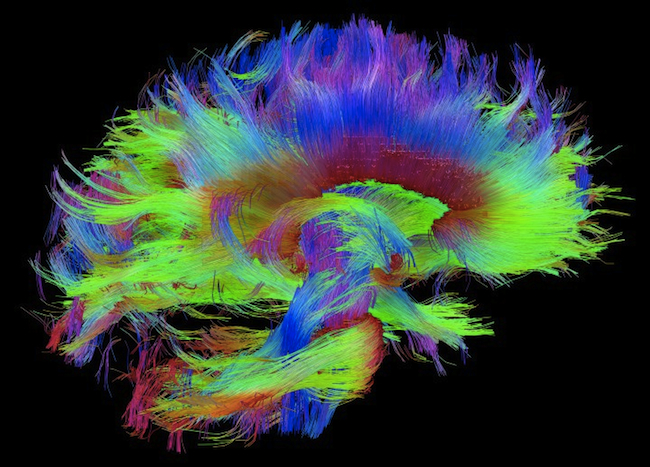
We are starting to create a ‘wiring diagram’ of the human brain. The research and the project that it sparked has been officially called, the “Human Connectome Project (HCP),” inspired by the successful gene sequencing project by a similar name, the “Human Genome Project (HGP).” It was launched in 2012 and has been quietly making advances towards a very lofty goal. A goal so lofty, in fact, that it will likely take many years to complete…
After all, the HGP took fifteen years to complete, cataloging (“sequencing”) about three billion chemical base pairs which make up human DNA. I’d like to highlight two significant points to be taken from the genome project (HGP) compared to the recently-launched “Connectome” project:
First, just going by the numbers, 3 billion is a much smaller number than 100 trillion – which is the latest estimate of the number of neural connections in a human brain. (The number of neurons is estimated to be 100 billion.) And these numbers could be just the start of far greater complexity due to a quantum mechanical component unique to consciousness.
And second, the Human Genome Project – although successful in its original goal – has not succeeded in providing something akin to a ‘troubleshootable wiring diagram’ from which all human diseases could be reverse engineered or otherwise decoded and eliminated. Although hopes were high that this might be the case once the human genome was finally sequenced, it was found that the genetic component to most diseases is far more complex than originally thought.
…To be sure, completion of the Genome Project was a huge accomplishment for medical science and provided an essential blueprint of the ‘major players’ involved in human traits and diseases – a crucial starting point from which to move forward with further research. But it turned out to be just another step in what looks to be a long road to fully understanding and treating – or better still – ‘engineering out’ human diseases.
So it is with these facts in mind that we may want to temper our otherwise justified excitement in the Human Connectome Project with cautious enthusiasm. Like the HGP, the so-called “completion” of the HCP could turn out to be just another step – essential and ground-breaking though it may be – to fully understanding how we feel love or how the color red makes us feel, as examples.
One final (encouraging) note on the HCP: The tools of science have dramatically improved since the start of the genome project, most notably computer hardware and software technology. How many years such continuing improvements will shave off completion time for the connectome project remains to be seen, but it’s likely to be significant.*
*If or when quantum computing becomes practical, surely the “mind-body problem” will become a humorous artifact of our ancient naivety.
The ‘Right’ Attitude
At this point I think it important to highlight a human psychological frailty that sometimes ‘rears its ugly head.’ I’m referring to the tendency for some people to view science discoveries in a negative light — specifically that science may somehow take the fun out of previously-mysterious and fascinating phenomena by exposing the ‘real’ cause of things.
Let’s imagine the future completion of the Human Connectome Project has arrived. Let’s also imagine that the project was so successful that even many philosophers’ greatest expectations were exceeded — to say nothing of the neuroscientists’: Science has completely figured out how the brain works — but more importantly — how consciousness arises from brain function.
…Computers can now run a simulation based on the project’s ‘wiring diagram’ of the brain and can digitally reproduce a human thought for everyone to see — in real time — on a big computer screen. A slow-motion playback of the thought can be analyzed and broken down into its most fundamental parts.
How would you feel about this? Would it take away your enthusiasm for neuroscience or nature (science) in general? Likely not:
Figuring out precisely how the brain works would no more reduce the feeling of awe and wonder at its amazing existence and capabilities than would knowing that, for example, our Universe was ‘just’ one of many. Think back to when, in grade school, you learned all (normal) matter was made of atoms. It’s likely this new information did not change your attitude about the world.
…Besides, it turns out the atom is just the ‘tip of the submicroscopic iceberg,’ so-to-speak. Discovering ever finer details of our existence actually enhances our fascination than otherwise.
The message here is:
Truth is stranger (and far more interesting) than fiction!
In the end, no matter how detailed the information on consciousness gets – even if it gets quantified down to the quantum field level – it would be just another representative reality; it would be no closer to describing experientially how a rose smells or music sounds or a sunset looks. And after all, consciousness is really an experiential phenomena, which is why there’s a “problem” in the “mind-body problem” to begin with!
Much of the Universe can be mathematically described with a precision that only mathematics can provide. Math is an unerring representation of reality; in some sense it is a language ‘built-in’ to the Universe. But it is an incomplete representation of reality. You can’t see and experience a sunset from a set of equations that otherwise accurately describe the light waves reaching your eyes.