
paranormal par-uh–nawr–muhl
adjective
– denoting events or phenomena such as telekinesis or clairvoyance that are beyond the scope of normal scientific understanding
parapsychology par-uh-sahy-kol–uh-jee
noun
– the study of mental phenomena which are excluded from or inexplicable by orthodox scientific psychology (such as hypnosis, telepathy, etc.).
“Extraordinary claims require extraordinary evidence.” – Carl Sagan
The Séance
By the time we are adults, practically every one of us can think of a personal paranormal story to tell — if not involving ourselves, about someone we know — similar to miracle stories. Here’s (one of) my paranormal stories:
When I was ten, my older sisters, Laurie and Karen, enthusiastically agreed to hold a séance at my request. Normally I would have been excluded from such an event — being a lowly kid, not having yet attained their lofty status as teenager. It didn’t help that I’d made a mockery of their Ouija board session the one time they did allow me to participate: With feigned seriousness, I’d spelled, “f-a-r-t.” They hadn’t noticed anything remiss until the final letter, “t.”
But I held in my hands a ‘fancy’ candle holder adorned with translucent blue and silver marbles, a craft project from my cub scout pack. It even included a nice candle inside.
Since the candle holder was my creation, I was “in,” and even allowed to light the candle and hold the séance upstairs in my bedroom (which I shared with my younger brother). With candle burning, I turned off the bedroom light. The marbles were glowing marvelously. I stared at them, entranced and proud of my handiwork.
Suddenly I realized Laurie and Karen were looking expectantly at me, their eyes reflecting light from the glowing marbles. Oh crap, what should I say? So far they were apparently impressed, but what came out of my mouth next would seal my fate if I screwed it up.
I was on the spot.
With as much solemnity as a ten year old can muster, I bowed my head and looked into the gaudy candle holder for inspiration. My mother’s father had recently died, so perhaps he would be willing to help. So I said, “Granddaddy Carter, can you hear me?”
Silence. Nothing.
Not surprising, I didn’t really expect his ghost to sweep into the room, although I hoped his spirit would at least make the candle flicker somehow. At this point it was clear I’d have to do or say something more impressive. So in my most commanding, squeaky voice, I said, “Granddaddy, if you are with us, let us know by making the lights go out.”
But what I had really meant to say was for him to make the candle go out. I felt stupid because the lights were already turned off. Oh well, my sisters remained quiet. And then — just a few seconds later — we heard our older brother, Johnny, holler from just outside the closed door of the room. Directing his voice down the stairs, he said, “Hey Daddy, the lights went out up here.”
Had Johnny listened with his ear to the door, playing along with the séance, I thought? But he’d been studying in his bedroom with his door shut. Checking light switches upstairs revealed the electricity was indeed off. Hmmm…it wasn’t that uncommon for a fuse to blow in our old stucco house.
My Dad went down to the basement fuse box and found just the fuse for the upstairs blew — despite only a few lights being on (and none in my bedroom, of course). A circuit overload was unlikely.
I’ll never know if Granddaddy Carter actually made the lights go out or if it was a coincidence. All I know for sure is that my status with my sisters was quickly elevated after that séance. Thank you, Granddaddy!
“The first principle is that you must not fool yourself and you are the easiest person to fool.” – Richard P. Feynman
The Repeatability (a.k.a. “reproducibility” or “replicability”) Challenge
One of the hallmarks of evidentiary proof in science is repeatability. Can the unusual thing that happened be replicated with clever tests?
“clever” — meaning using proven test procedures known to science that effectively removes bias and ambiguity. An example is the double-blind placebo-controlled technique known as a “clinical trial” used in medicine to see if a particular drug works as hoped or advertised — the same technique used to evaluate the efficacy of the covid-19 vaccine candidates in 2019-22.
What if I had held the same séance night after night for a month, for example? If we setup the same conditions under which the strange event occurred, we should get the same result, right?
Not necessarily. Perhaps the ongoing failure in parapsychology to consistently reproduce claimed paranormal events is due to the inconsistency of the ‘events’:
Paranormal experiences — even if they actually occur as their proponents claim — are not physical events you can always count on happening the same way every time, unlike processes involving gravity, light, or fire, as examples. (Granddaddy Carter’s spirit — like when he was alive — can’t be everywhere at once. Also, he comes and goes as he pleases.)
The same is true of “miracles.” From the perspective of science, both miracles and paranormal experiences fall under the category of metaphysics, where ‘evidence’ is typically anecdotal — personal stories. But personal stories or not, the assumption is the events are inexplicable by today’s science.
This is why parapsychology is (effectually) universally regarded as pseudoscience by the science community; the failure of parapsychology to meet the ‘repeatability challenge.’ The difficulty of gathering extraordinary evidence to explain extraordinary claims makes the paranormal a tough nut to crack.
Known Physics
We know the laws of physics — as we’ve understood them since the early twentieth century — are indeed “laws,” in that they are permanent, changeless, and unalterable. Are paranormal events restrained by these same immutable laws? If they are, does this mean they don’t happen as described?
If we think science simply cannot explain the mechanism(s) behind paranormal experiences yet, then in principle we’re stuck in the unenviable position of someone who believes in “magic,” because the (currently known) laws of physics become useless.
It seems there are three main possibilities:
- Paranormal events can indeed be explained by future science, but our current knowledge of physics is inadequate.
- Paranormal events could never be explained by the conventional tools of science; the reason for the term, “paranormal.”
- Paranormal events are merely illusory products of human psychology, the result of confirmation bias stemming from fear, wishful thinking, or credulousness.
Our Powerful Subconscious
Recently I met a person who said she is a clairvoyant — has a “special gift” for communicating with spirits of the departed and ‘seeing’ the future. The first time she realized she had this “gift,” she said, was when she was in her early twenties: A fellow asked her on a date, but even though she’d just met him, she suspected the guy wanted more than just a date. Against her better judgement (her ‘intuition‘), she accepted his request. Turns out he tried to rape her, and she was barely able to escape…
Although “intuition” is sometimes used as another word for clairvoyance or precognition, IMO it’s a better description of the communiqués issued by our subconscious minds to our conscious minds. Our subconscious — as noted in the article, “Is Consciousness Separate From Your Body?” — is where nearly all our mental processes occur. We are only (consciously) privy to a teeny, tiny, tidbit of all the goings-on in our brains, and this is as it should be.
…Otherwise the ‘noise’ of gazillions of cerebral and autonomic neural processes would overwhelm our minds, making it impossible to focus on any one thing; we’d go nuts. Think of your subconscious as Grand Central Station on a busy day, and your conscious mind as just one train (of thought) exiting a platform at any one point in time.
Clairvoyance or intuition? Instinct is another word we use to describe how we just know if a situation or person is dangerous. When you meet someone for the first time, your brain is on high alert, processing a myriad of things ‘under the hood’ about the stranger to see if there’s anything in your brain’s database to compare him or her to. Your subconscious is making lightning-fast logical deductions, ‘sniffing’ the situation out.
We are not consciously aware of all this ‘behind the scenes’ activity unless our subconscious determines there’s sufficient reason to be wary about this new person. At this point our subconscious interrupts our conscious thoughts with something akin to, “stay vigilant around this person — we have reason to believe he may be dangerous.”*
*A Time magazine article, “Why You’re Pretty Much Unconscious All the Time,” attempts to summarize this study by Cambridge University on human consciousness.
Who Doesn’t Love ‘Magic?’
Perhaps like yourself, I am endlessly fascinated by magnetism — a seemingly ‘magical’ connecting force between (metallic) items without strings or wires between them. What could be more intriguing than an invisible, mysterious force?
One only has to think of every blockbuster fantasy movie ever made (Lord of the Rings, Harry Potter, all Marvel Comic movies, etc.) to realize we are always fascinated by invisible forces.
For thousands of years, magnetism has maintained a grip on our imaginations, no doubt because of its invisibility. Even though we realize there’s legitimate, solid science behind it — we know there’s nothing truly magical about it — our fascination is fueled as if it is truly supernatural.
The very existence of magnetism suggests there may be other invisible forces we have yet to figure out. And yet we take for granted the invisible forces enabling our Wi-Fi, cell phones, radios and televisions, x-rays, etc…
The difference between these ‘boring’ electromagnetic waves and magnetism, however, is seeing a physical object moved — as made possible with magnets. Yet the entire electromagnetic spectrum (which includes magnetism, visible light, Wi-Fi, your car key fob signal, cell phone signals, radio, television, x-rays, gamma rays) is made of the same thing — light waves (with its ‘individual’ or quantum force carrier being the photon).
It may be helpful to acknowledge the following (otherwise obvious) philosophical distinctions:
If paranormal events actually happen as their proponents claim — if they, like magnetism, are based on decipherable laws of physics — then of course the word “paranormal” would never have been created; they’d be “normal” but fascinating like magnetism.
Same with “magic”: There would be no such thing as “magic” if the tricks magicians performed were not tricks but demonstrations — done without props, gimmicks, and special techniques (such as audience distraction and so forth).
In this view, the fact we’ve labeled certain things “magic” or “paranormal” is telling: The choice of words suggests it’s all ‘sleight of hand’ — or in the case of something paranormal — “pseudoscience.”
Types of Psychic Phenomena:
Is there any solid proof of even one of them?
There is another possibility we should acknowledge: Perhaps only a certain specific category of paranormal events are actually possible — some tiny percentage of all that is claimed.*
*Similar IMO to the “free will argument” in that most people believe only one of two possibilities: Either there’s no such thing as “free will” or that all humans have 100 percent free will. But perhaps humans have some (likely unknowable) percentage of free will.
Parapsychology has identified the following main types of psychic phenomena (as paraphrased from Psychology Today):
- Precognition – perceiving info about the future; “time-reversed causality”
- Clairvoyance – perceiving info about distant locations
- Telepathy – communicating mind-to-mind
Note: The above three phenomena are collectively known as “ESP” – Extra Sensory Perception, more recently known as “psi.”
- Psychokinesis a.k.a. telekinesis – moving material objects with the mind
- Out of Body Experiences (OBE) – departing one’s own body, typically seeing one’s own body from above
- Ghosts, hauntings – (self explanatory)
Precognition
Of all the types of paranormal experiences, only precognition has raised the eyebrows of inveterate skeptics lately — due to a 2011 published study by a peer-respected psychologist, Dr. Daryl Bem, Cornell University.
Before we take a brief look at this one (compelling by itself) study that claims to have found evidence of precognition, let me tell you about my personal experience…
2007, I was guiding my skydiving student, Lise, to the jump airplane, which was waiting with engine running about 50 yards away. I was annoyed that my student had caused us to be late for the airplane, which is frowned upon by everyone involved: Every minute a turbine aircraft sits with engine(s) running costs money, and the other jumpers and pilot were baking inside the cramped aircraft in the summer heat.
Suddenly I was overwhelmed by the realization I would be spending the rest of my life with this Lise — despite not knowing her well and not being attracted to her (at least not consciously).
With wide eyes, I turned around and looked at her for a moment as we walked at a brisk pace toward the waiting aircraft. Had I been ignoring subtle advances she was making on me — sending pheromones perhaps? But she was obviously distracted by the upcoming jump and appeared stressed, unaware of my presence except as her assigned jumpmaster/instructor.
The feeling was shocking because it was a totally unexpected foreknowledge, seemingly ‘forced’ into my conscious awareness. It lasted maybe a few seconds at most but I somehow knew it was true. I’d always considered myself thoroughly introspective. How could I not see this coming? I shook the feeling off and re-focused on the upcoming jump.
Long story short, we’ve been happily married fifteen years as of 2022!
Dr. Bem’s precognition study, “Feeling the Future: Experimental Evidence for Anomalous Retroactive Influences on Cognition and Affect” was widely lauded as a solid academic study. Unfortunately, however, it suffered the common problem with ALL (so far) studies of the paranormal that produce controversial, incredible results:
It failed the ‘replicability challenge‘: Similar results have not been found from unbiased studies modeled after Dr. Bem’s. (To his credit, Bem requested other Universities undertake the same study, and sent them detailed instructions along with the software he used to run the study.)
Some issues with Dr. Bem’s original study have been identified that (likely) biased the results to favor findings of precognition. Attempts to replicate his findings with studies designed to remove these biases found no evidence of precognition.
This opinion piece by respected psychology academics does a good job explaining both sides of the argument and is an interesting read, ultimately emphasizing the need for more research to bridge the gap between skeptics and proponents.
Professional Magicians Who Became
Professional Paranormal ‘Debunkers’
In the history of stage magic, a few notable magicians and escape artists switched their focus from performing for audiences to debunking and otherwise exposing as frauds spiritualists and other purveyors of the paranormal. They dislike people hijacking the art of stage magic for their own gain — taking advantage of gullible people for money by claiming to be truly capable of supernatural powers.
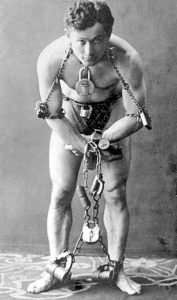
The first and perhaps most famous of these ‘paranormal debunkers’ was none other than Erik Weisz, better known as Harry Houdini. His legendary escapes from straitjacket, sealed containers underwater, and sealed containers full of water made “Houdini” a household name even today — nearly a hundred years after his death.
But in the latter part of his career, he dedicated his life to ‘ghostbusting;’ Houdini realized he was uniquely qualified to debunk and expose as frauds certain mystics and mediums who had successfully fooled many academics and scientists. He would attend seances in disguise, accompanied by a reporter and police officer.
“He was a member of a Scientific American committee that offered a cash prize to any medium who could successfully demonstrate supernatural abilities. None was able to do so, and the prize was never collected.” – Wikipedia
Interesting side-note:
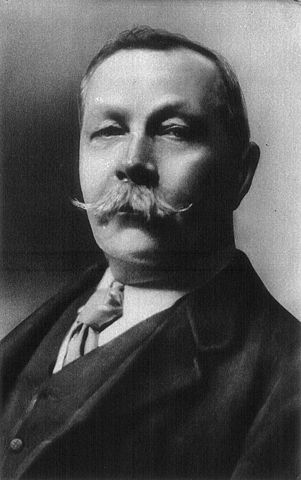
Sir Arthur Conan Doyle (creator of Sherlock Holmes and the book series) was a dear friend of Houdini’s until Houdini published a book, “A Magician Among the Spirits.” Houdini’s book chronicled his debunking exploits. Doyle, however, became a fervent believer in spiritualism in his later years and resented Houdini’s campaign to expose spiritualists as frauds.
Eventually, Conan Doyle believed Houdini was truly a powerful spiritualist medium who actually possessed paranormal abilities which enabled him to perform his amazing stunts. Doyle also believed Houdini was using these abilities to “block” the mediums he was debunking. Their disagreements went public and Doyle came to view Houdini as a dangerous enemy!
The Million Dollar Challenge
James Randi was a professional stage magician (“The Amazing Randi“) and escape artist, starting in the late 1940s. As a youngster, Randi idolized Harry Houdini and later modeled some of his own gutsy escape acts after Houdini’s. Randi even broke Houdini’s record of remaining in a sealed casket underwater by ten minutes.
In 1998 Randi told the Associated Press, “I see people being swindled every day by medical quackery, frauds of every sort, psychics and their hotlines, people who claim to be able to find lost children or to help them invest their money. I know they are being swindled because I know the methods being used.”
“The One Million Dollar Paranormal Challenge was an offer by the James Randi Educational Foundation (JREF) to pay out one million U.S. dollars to anyone who could demonstrate a supernatural or paranormal ability under agreed-upon scientific testing criteria. A version of the challenge was first issued in 1964. Over a thousand people applied to take it, but none were successful. The challenge was terminated in 2015.” – Wikipedia
Penn and Teller: Bullshit!

Since the late ’70s, Penn Jillette and Raymond Teller have been entertaining audiences with their unique combination of stage magic and comedy. Their show, Penn and Teller: Bullshit! (2003-2010) was created in part to ‘blow the whistle’ on paranormal claims and was nominated for 11 Emmy awards.
The following paragraph succinctly covers their show and was copied from this page on Wikipedia:
At the beginning of the first episode of the first season, Penn points out that the series will contain more obscenity and profanity than one would expect in a series dealing with scientific and critical inquiry, but explained that this was a legal tactic because “if one calls people liars and quacks one can be sued… but ‘assholes’ is pretty safe. If we said it was all scams we could also be in trouble, but ‘bullshit,’ oddly, is safe. So forgive all the ‘bullshit language’, but we’re trying to talk about the truth without spending the rest of our lives in court.” – Wikipedia, this page.
BBC’s take on the Paranormal
In typical BBC style, this BBC Future article, “The Truth About the Paranormal” purports to answer this Biggest Question in one comprehensive but short, informative, and highly entertaining read.