The good news is, yes, there is indeed a proven recipe for happiness. But before we go into the ingredients, we need an idea of what happiness is and what it isn’t.
Like some subjects in philosophy and psychology, there’s ambiguity in the definition. Just look at the number of edits Wikipedia has made to their page on “Happiness” — over 6300 total edits (as of 2020). Compare that to the Wikipedia page on “Dreaming” — 151 total edits.
Despite the fact we can’t agree on a concise definition of happiness, we all know the feeling of being happy. The question is, how can we experience this feeling more often?
Happiness is:
An emotion — a pleasurable state of mind and body resulting from whatever it is that makes you happy. Just like other emotions, it’s a ‘side effect’ of whatever causes that emotion. For example, fear, which results from being afraid of something or sadness, which results from an event that makes you feel sad.
Therefore, Happiness is not:
A feeling you can get by itself.* And it’s not an emotion you can experience all day (although it sounds fantastic on the surface), because it’s unrealistic. For example, we all love to laugh, but no one has ever laughed continuously from sunrise to sunset.
*Sometimes you might feel happy for no particular reason(s). But it’s likely there are no big stressful events you must immediately deal with at these times.
A church pastor, Dave Patterson, once said, “If you are not experiencing a tragedy in your life now, then you are simply in between tragedies.” So in this view, you might feel happy because you appreciate these peaceful times. In a sense, you’re happy because you’re not unhappy — not for any other reason.**
**IMO this is a great reason to be happy.
If you can consistently pull this attitude off — staying cheerful during otherwise ‘boring, non-tragedy times’ — your default happiness level is very likely ‘higher’ than those folks who allow themselves to get stuck on the hedonic treadmill…
What Makes You Happy?
(Don’t Fool Yourself)
“Samuel Johnson called it the vanity of human wishes, and Buddhists talk about the endless cycle of desire. Social psychologists say we get trapped on a hedonic treadmill. What they all mean is that we wish, plan and work for things that we think will make us happy, but when we finally get them, we aren’t nearly as happy as we thought we’d be.” – Alison Gopnik

“It’s good to have money and the things that money can buy, but it’s good, too, to check up once in a while and make sure that you haven’t lost the things that money can’t buy.” —George Lorimer
It stands to reason you will be happy more often if you can get whatever it is that makes you happy. What usually comes to mind is money and the things money can buy, because we’ve been taught to believe these lies from an early age.
When we finally get that new house, car, motorcycle, boat, promotion, jewelry — whatever — we are happier….for a surprisingly short time. Then, inevitably, we drop back to our default happiness level. Every. Single. Time.
What’s going on here?!
Cleverly-designed television and magazine ads show alluring models driving fancy cars and living in swanky homes. Blockbuster movies where a happy ending always means getting the money and the girl (or guy). Alcohol is promoted with the same enthusiasm.
Years of this ‘subliminal programming’ have taught us we cannot be happy with anything less. Social media hasn’t helped: We compare our lives to the more fun and successful lives of others. Increasing evidence shows time spent on social media can lead to depression.
“It is not the man who has too little, but the man who craves more, that is poor.” – Seneca the Younger
‘Default Happiness Levels’
Your “default happiness level” is just another phrase for “your normal state of mind.” It’s how you perceive and process your world moment-to-moment, day-to-day. Like other aspects of your personality, it’s partly inherited and partly developed as you grow. It’s not quantifiable.
So there’s no specific happiness level we can all point to and say, “Now there’s the perfect (default) happiness level!” So it’s probably better to view happiness levels as being healthy or unhealthy rather than high or low. Healthy or unhealthy states of mind.
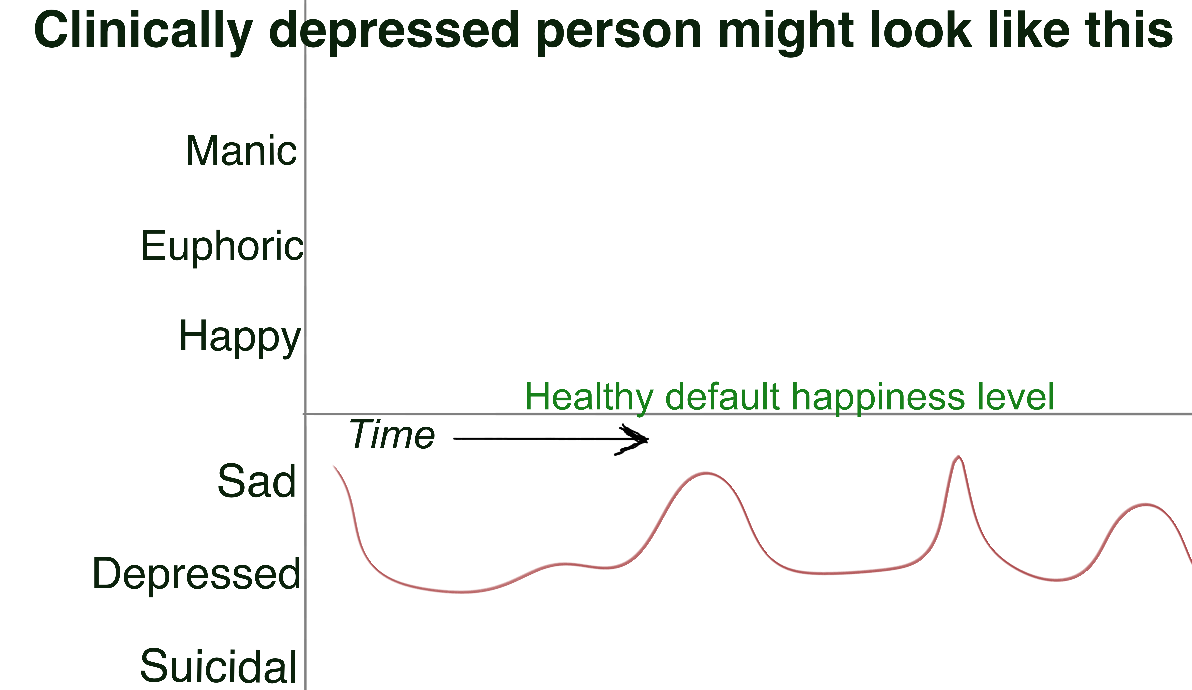
Below are some examples of how a healthy default happiness level might look relative to various ‘actual’ happiness levels — which naturally oscillate over time in everyone:
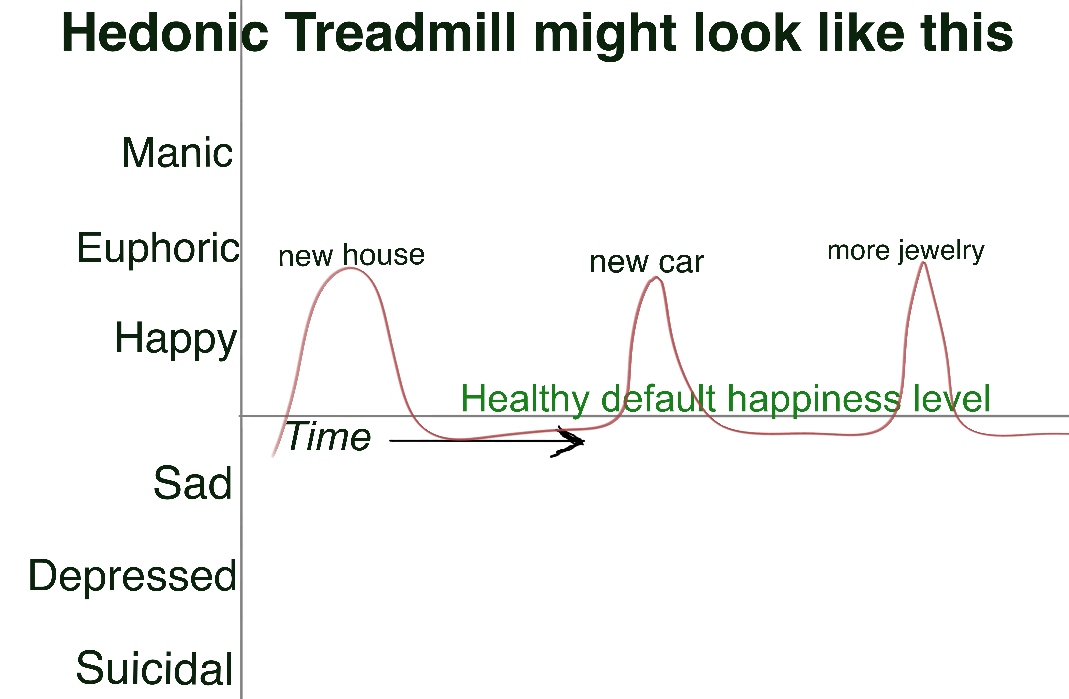
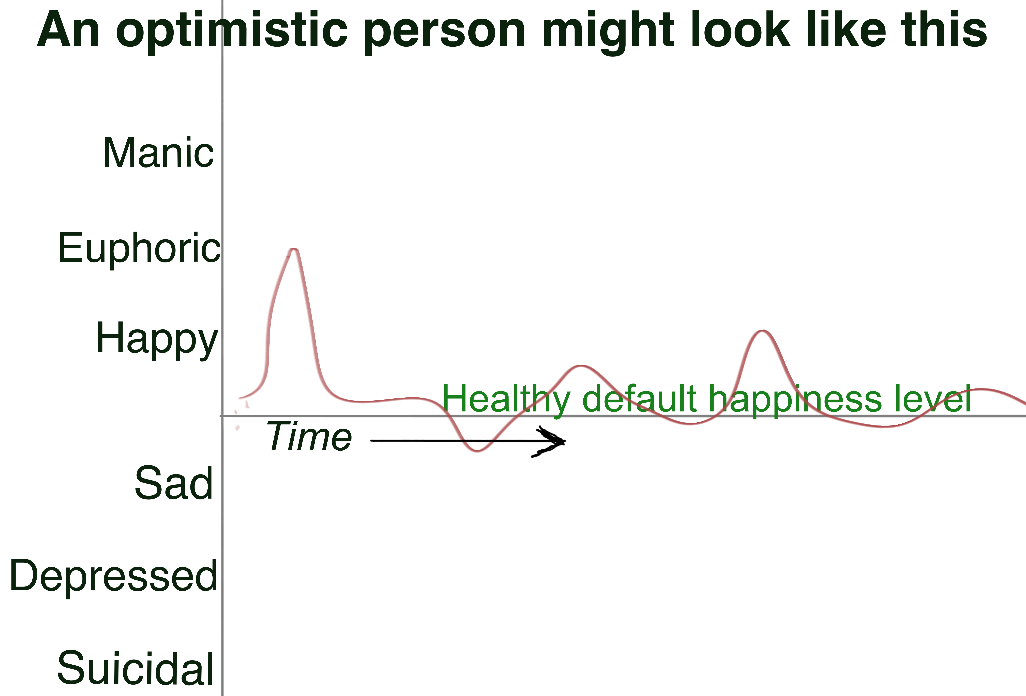
People who manage to consistently maintain healthy default happiness levels rarely get on the hedonic treadmill. But it’s important to note (as depicted in my crude ‘sine wave’ graph above) occasional periods of sadness are a natural and healthy part of even optimists’ lives…
Life has its ups and downs. We can’t always dance in a colorful field of wildflowers while singing ‘zippity-do-da.’ So the question becomes, how can you raise your default happiness level if it is often unhealthy (or ‘low’)?*
*It’s not surprising why the field of psychology has historically been about treating problems; if you’re not unhappy, there’s nothing to fix, right? True, but life can be a far richer, more fulfilling experience with help from Positive Psychology (discussed below).
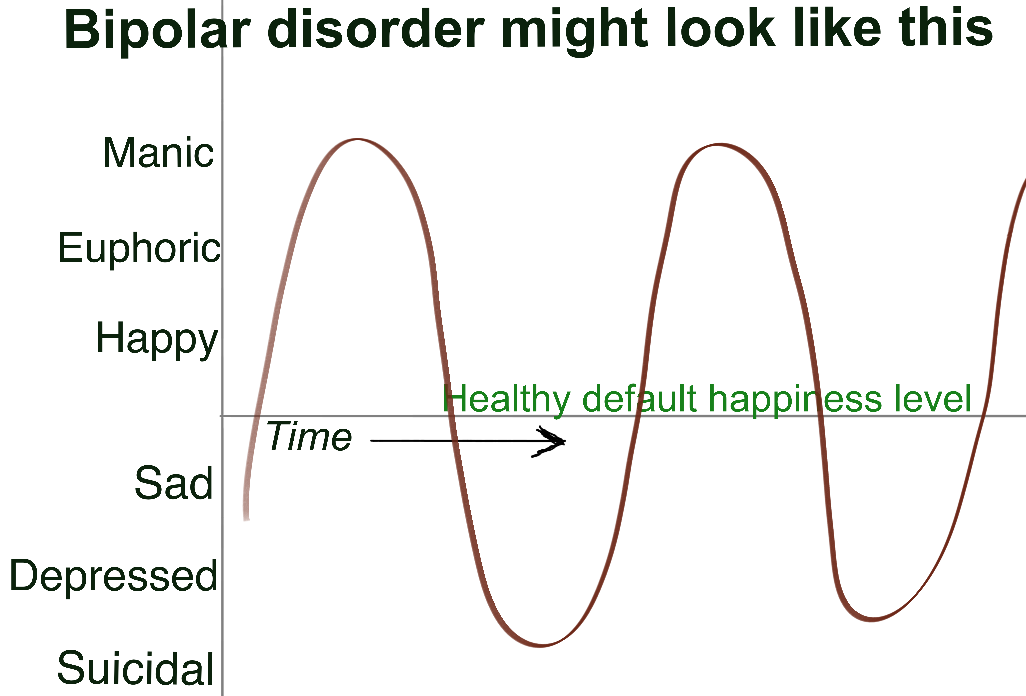
No two people process their world exactly alike, but the field of Positive Psychology has identified the features common to the happiest people.
“No one can create anger or stress within you. Only you can do that, by virtue of how you process your world.” – Wayne Dyer
The New ‘Science’ of Happiness
Years past, psychology was linked to weird people with weird issues. People wrongly assumed you were crazy if you went to a psychologist. Today, however, people practically brag about seeing a therapist. But then as now, the field of psychology has been mostly about fixing what’s broken — not about building a happy, meaningful life.

Happily (pun intended), a new field of study called “Positive Psychology” is gaining momentum, thanks in large part to Martin Seligman, who recognized the need for identifying the specific things common to the happiest people — instead of focusing on treating psychological ailments.
Superman and Superwoman
There are always certain special people who appear to have life completely figured out. In the same situation where the rest of us are struggling, they seem to flow along effortlessly, laughing at adversity.
…Where we see a crisis, they see only a challenge. The word, “failure” is not in their vocabulary, only “opportunity.” When one door closes, another opens.
These super people are only ‘super’ in our heads, though. In truth they must face reality like the rest of us. The difference is the way they act and react to the world.
“Loving people live in a loving world. Hostile people live in a hostile world. Same world.” – Wayne Dyer
This new field of study builds on what was already intuitively known about the causes of happiness.
Here are some interesting facts discovered about happiness in general:
1. Some of Your Happiness is Inherited
We all know people who appear happy no matter the circumstances or depressed for the same reasons. So there seems to be a genetic predisposition to one’s overall level of happiness. A study of identical twins found they also shared identical ‘happiness levels,’ regardless of whether they were separated from birth or not.*
*A short article titled, “Is Happiness Hiding in our Genes?” discusses this twins’ happiness study.
But like some other inherited traits, we are not stuck one hundred percent with the cards we’re dealt. We can make smart choices that will likely result in a healthier default happiness level.
2. Happiness and Meaningfulness are Different
The happiest people maintain a sense of deep meaning in their lives. But some people are generally happy without feeling their lives have deep meaning:
One example is someone who goes from party to party (and is not necessarily overindulgent), hanging out with similarly-minded folks where friendships are shallow — everyone ‘keeps it light.’ Some early retirement folks come to mind here. These people may be happy but admit their lives have little deep meaning.
On the other hand, some people report feeling their lives have plenty of meaning but are not particularly happy. Take military or law enforcement careers:
These demanding fields are more than ‘just’ jobs and can be stressful and emotionally draining. Some people with such careers may not be particularly happy, but they push themselves forward, driven in large part by a feeling of obligation.
…A life lived this way can be rife with unhappy moments and — at worst — depression. These people often feel their lives have plenty of meaning but that happiness nevertheless eludes them.
Of course, some people feel happiest because their otherwise stressful careers provide a satisfying sense of accomplishment and meaning. Healthcare positions come to mind here, but meaning can come from any job or other activity. Depends on the person (personality).
…Like other areas of psychology and philosophy, there’s overlap in areas. Happiness is fluid because our emotions are fluid, but we tend to act and react in habitual ways, making us predictable to spouses or old friends. And like all habits, some are good, some not-so-good.
3. Money Can Buy a Certain Amount of Happiness
“Money often costs too much.” – Ralph Waldo Emerson
How much money, you ask? Good question, but it’s not the amount — it’s what you want to do with it. People in developed countries such as the U.S. — where money is required for basic life needs such as a roof over their head and food — will be much happier than poor people who cannot afford these basic needs.
But here’s the catch:
After basic needs are met, additional money has little or no impact on happiness. You might remember the famous “Maslow’s Hierarchy of Needs” pyramid:
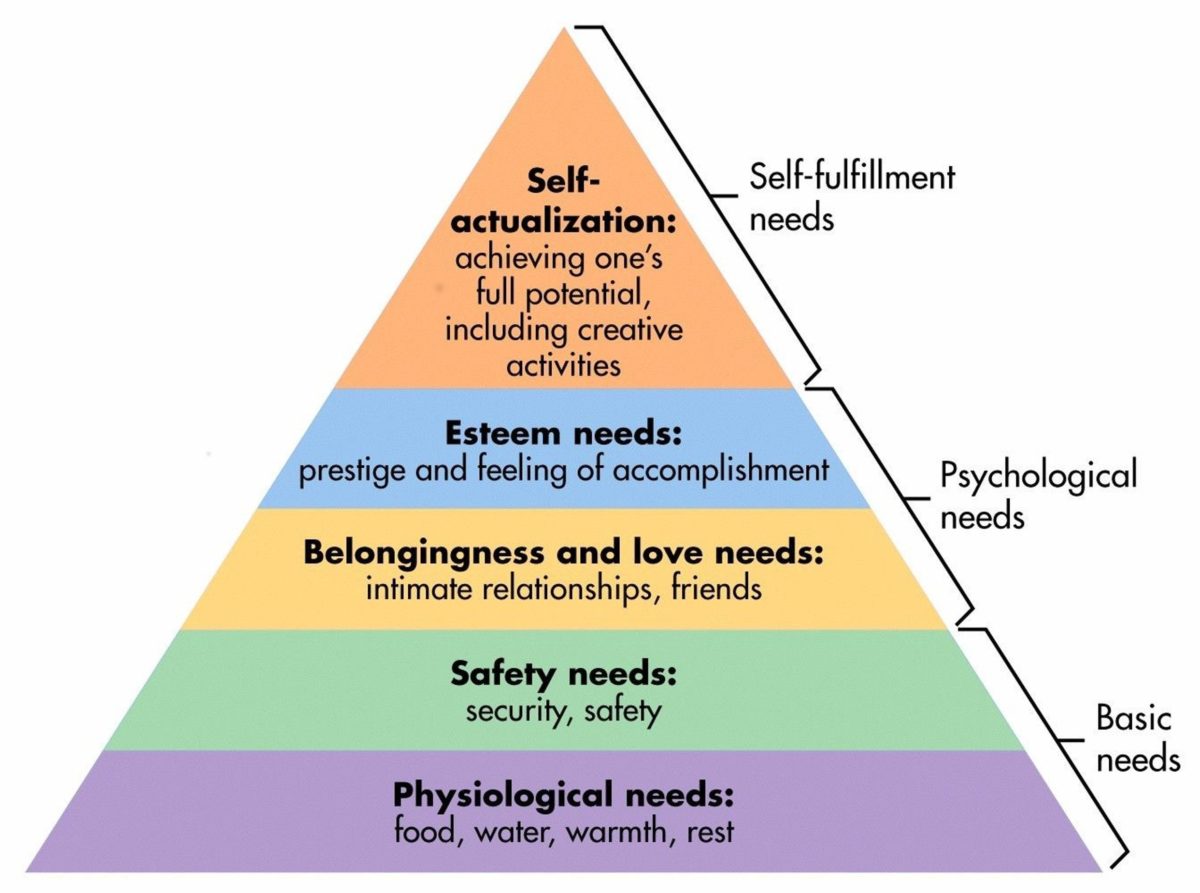
Abraham Maslow’s 1943 pyramid idea is still relevant today, and will likely remain so because it rings true. Psychological and self-fulfillment needs are up to each of us — but only after we take care of our basic needs — which usually do cost money.
However, money can also buy certain amounts of (short-term) happiness in the “Psychological needs” and “Self-fulfillment needs” parts of the pyramid:
- Spending money to buy time instead of ‘things.’ Taxi instead of public transport, order pizza instead of cook, cleaning service for your place instead of cleaning it yourself, etc.
- Spending money to help others instead of yourself. “Tis better to give than to receive.”
- Spending money on experiences rather than on stuff.* Reminiscing about an interesting time with a partner or friend allows you to ‘re-experience’ it again and again. You can also relive that fun trip, kayak outing, etc. with the help of photos and video. Experiences are almost always more meaningful and rewarding than items bought, and can provide repeated positive emotions that can raise your overall happiness level.
*Perhaps you, like myself, buy certain ‘things’ from which you indirectly get happy experiences, such as a bicycle, SCUBA gear, skydiving gear, kayak, etc. The purchase of sporting goods becomes a means to an end — the experiences from using them — rather than an end in themselves. So in this sense, money can help you achieve some psychological and self-fulfillment needs.
“Wealth is the ability to fully experience life.” –Henry David Thoreau
“The real measure of your wealth is how much you’d be worth if you lost all your money”. –Anonymous
4. Optimism

Not surprisingly, optimism is a character trait common to the happiest people.
“Life is ten percent what happens to you and ninety percent how you react to it.” – Charles Swindle
As I mentioned in the book Intro, we can’t change reality but we can control our reactions and attitude towards reality — but only if we choose to!
“Peace is the result of re-training your mind to process life as it is, rather than as you think it should be.” – Wayne Dyer
Positive Psychology has found that there is such thing as being overly optimistic: It’s an unrealistic attitude that is counter-productive. Goals are not met or are unattainable to begin with. Most of us aren’t burdened with such an outlook though!
Martin Seligman concluded there are five elements to “well-being”, which fall under the mnemonic PERMA:
Positive emotion—Can only be assessed subjectively
Engagement—Contentedly focused on an activity. Related to “flow“; ‘in the zone’
Relationships—The presence of friends, family, intimacy, or social connection
Meaning—Belonging to and serving something bigger than one’s self
Achievement—Accomplishment pursued even when it brings no positive emotion, no meaning
In a nutshell, the happiest people feel their lives have deep meaning but they also routinely enjoy ‘selfish’ pleasures (but not at the expense of someone else’s happiness).
4. Can Love Make You Happy?
Love certainly can go a long way in helping you to be happy more often. After all, to love and be loved is arguably one of the best experiences in life for those of us fortunate enough to find it.
…But depending on a relationship with another human — ‘soul mate’ or not — for your happiness is setting yourself up for disappointment. A good test of whether you can be happy with another person (‘not alone’) is if you can be truly happy when you are alone.
“You cannot be lonely if you like the person you’re alone with.” – Wayne Dyer
5. Gratitude
“Normalization” in social psychology refers to ‘taking things for granted.’ Example: After some research, you buy a new car (or at least new to you). For the first month or so, you are grateful for your reliable, comfortable transportation. Later, however, you take it for granted. You see scores of the same model every day – some in better condition.
The “hedonic treadmill” (discussed above) is an example of how the normalization of your last purchase or acquisition can blind you to an otherwise healthy “attitude of gratitude.” This same tendency applies to relationships as well…
Couples can take their spouse for granted after a certain amount of time; everything positive the spouse brought to a relationship becomes normalized, taken for granted.
The following is a snippet taken from an August 14, 2021 Harvard Health Publishing article, titled, “Giving Thanks Can Make You Happier”
Research on gratitude
Two psychologists, Dr. Robert A. Emmons of the University of California, Davis, and Dr. Michael E. McCullough of the University of Miami, have done much of the research on gratitude. In one study, they asked all participants to write a few sentences each week, focusing on particular topics.
One group wrote about things they were grateful for that had occurred during the week. A second group wrote about daily irritations or things that had displeased them, and the third wrote about events that had affected them (with no emphasis on them being positive or negative). After 10 weeks, those who wrote about gratitude were more optimistic and felt better about their lives. Surprisingly, they also exercised more and had fewer visits to physicians than those who focused on sources of aggravation.
Another leading researcher in this field, Dr. Martin E. P. Seligman, a psychologist at the University of Pennsylvania, tested the impact of various positive psychology interventions on 411 people, each compared with a control assignment of writing about early memories. When their week’s assignment was to write and personally deliver a letter of gratitude to someone who had never been properly thanked for his or her kindness, participants immediately exhibited a huge increase in happiness scores. This impact was greater than that from any other intervention, with benefits lasting for a month.
Of course, studies such as this one cannot prove cause and effect. But most of the studies published on this topic support an association between gratitude and an individual’s well-being.
Other studies have looked at how being grateful can improve relationships. For example, a study of couples found that individuals who took time to express gratitude for their partner not only felt more positive toward the other person but also felt more comfortable expressing concerns about their relationship.
Managers who remember to say “thank you” to people who work for them may find that those employees feel motivated to work harder. Researchers at the Wharton School at the University of Pennsylvania randomly divided university fund-raisers into two groups. One group made phone calls to solicit alumni donations in the same way they always had. The second group — assigned to work on a different day — received a pep talk from the director of annual giving, who told the fund-raisers she was grateful for their efforts. During the following week, the university employees who heard her message of gratitude made 50% more fund-raising calls than those who did not. – Copied from Harvard Health Publishing
6. Spirituality and Religion: The best predictor of happiness
Religions are the single biggest influence for providing people meaning and an overall purpose to life — a ‘rudder’ to steer their lives by. But the happiest churchgoers do not merely attend Sunday services but are also active volunteers in their church as well. Religion ‘done right’ (IMO) checks all the boxes Positive Psychology has identified as common to the happiest people.*
*It should be noted that religious involvement — church attendance or not — is not the only way to achieve lasting happiness and meaning. But your life must be structured so as to check all the boxes some religious organizations ‘automatically’ take care of.
Here are the main benefits of religious organization involvement, in no particular order:
-
-
Satisfying Sense of Belonging
-
Everyone wants to be accepted by their peers and other groups they identify with. With acceptance comes a satisfying feeling of security and safety in numbers.
Tribalism is a well-documented evolutionary survival trait common to ALL primates, including of course, humans. The lives of our ancient ancestors literally depended on their acceptance in a tribe — no different from our primate cousins today — such as chimpanzees, apes, and gorillas.
In the wild, our primate cousins will literally starve or be killed if they are not accepted in a group. Safety and security is found only in a tribe. You can see tribalism at work in today’s humans: Political party divisiveness, racial prejudice, churches that shun outsiders, wars — religious or otherwise, etc. ad nauseam.
Tribalism may be an inherited evolutionary survival relic, but its practice is alive and well today — usually with bad consequences.
Religions ‘done right’ provide this basic human social (primate social) need of belonging — but without the negativity of shunning outsiders.
-
-
Built-in Support Network
-
A big component to lasting happiness involves staying ‘connected’ with others. The psychological benefits include validation of one’s thoughts and feelings, and sharing the inevitable crises which arise in everyone’s life. “Misery loves company” is an applicable truism here.
Sharing life’s ups and downs with others is better (for most people) than going it alone, and most religions take care of this human social need.
-
-
Fear of death mitigated
-
Fear of death is lessened. “TMT,” which is short for “Terror Management Theory,” says everybody experiences some level of anxiety when they’re reminded of their inevitable death.*
*IMO it’s somewhat of an exaggeration of what we experience, but it seems partially true, or at least true at certain times.
The result is everyone is motivated (to varying degrees) to seek comforting alternative outlooks for their looming fates. Religious beliefs provide alternative solutions to the otherwise unacceptable reality of death, significantly lessening ‘death anxiety.’
“No one wants to die. Even people who want to go to heaven don’t want to die to get there. And yet death is the destination we all share. No one has ever escaped it…” – Steve Jobs
-
-
The Promise of “Everlasting Life”…in Paradise
-
Even better still, the most popular religions promise everlasting life in paradise after death. This is no trivial bonus: One of the biggest reasons we fear death has little to do with the fear our bodies will die, but that our conscious selves will cease to exist.
“We fear death so profoundly, not because it means the end of our body, but because it means the end of our consciousness – better to be a spirit in Heaven than a zombie on Earth.” – Alison Gopnik
The promise is not ‘merely’ everlasting life: Not only are believers promised a way to avoid the end of their conscious selves, but their post-Earthly life is also promised to be in some sort of enigmatic, perfect existence — “heaven.”*
*It’s interesting to note that any promise of ‘everlasting life’ could not be anything other than some ultimate paradise. Anything even slightly less attractive would be unacceptable. After all, the idea of any existence stretching on forever would be appalling: Even a decent, peaceful existence that never ended could get insanely boring…
Imagine having to be conscious or even slightly aware through millennia. (The idea of being trapped in any existence for eternity, with no hope of change, seems a grim prospect IMO.)
The ‘big picture’ of most religious faiths: Helping others
The Christian faith holds that our primary purpose in life is to worship God and try to be like Jesus — selflessly helping others. Helping your fellow man and woman is a core tenet of many other religions and religious philosophies.
Philanthropy has proven to ‘help the helper’ more than the helped. ‘‘Tis better to give than to receive.” This adage has proven true since time immemorial. People get more of a ‘kick’ out of helping others than being helped themselves.
This is why being active in church missionary programs or other altruistic church activities makes people happier than those who don’t attend church, and even happier than their church-going peers who merely attend church services only.
Regardless, if you cannot find satisfactory meaning to your life through religion, then either you’re missing the point or your religion (or church) just isn’t doing it for you. After all, it’s your life we’re talking about — not your church congregation’s (and their expectations & judgments about you).
Although religious faith can be a surefire way to happiness (if done right), lots of non-religious people also report being happy. How do they ‘do’ it?
In 2014, the British National Health Service began recommending its own five-step plan for living a happy, meaningful life. I think it nicely summarizes the most important parts of a happy life:
- Connect with community and family.
- Physical exercise.
- Lifelong learning.
- Giving to others.
- Mindfulness of the world around you.
Let’s unpack numbers 3 and 4 from their five-step plan, starting with…
Learning New Things
There is no limit to the fascinating things to discover about our world, our Universe. When you realize the entire world’s accumulated knowledge is immediately available — quite literally — at our fingertips, it becomes difficult to imagine how anyone could be bored.
Formal education is great for those of us lucky enough to get it. But with today’s internet you don’t need to be enrolled at a college or university to continually learn new and interesting things. Besides, formal education can reduce the learning process to a chore: You can become goal-oriented — to finish that class and pass the exam — instead of learning-oriented.
In any case, learning new things has been shown to be one of the best antidotes to apathy, boredom, or worse — depression.

Just like people, intelligent pet birds such as the the parrot will become depressed if not mentally stimulated with challenging tasks, learning new things. Many people get these birds thinking they can stick them in a cage and simply feed them and interact with them when they have the time…
In reality, however, these birds will quite literally go nuts if they are bored. They will become mentally ill and may pluck their own feathers out — just like the one in the photo above. Many new owners of these sorts of intelligent birds do not know what they are getting themselves into.
I once knew a person whose full-time job was babysitting and training African Grays and other highly-intelligent birds. He said they can be as time-consuming to properly care for — from a mental stimulation standpoint — as a human toddler.
…The more intelligent the creature, the more important discovering new things is to its overall happiness.
Creativity and “Flow”
A great antidote to boredom and depression, creativity involves connecting two or more unrelated ideas in order to solve a puzzle. And it doesn’t have to be about any ‘big’ project.
Organizing your garage or even just a desk so that, amazingly, everything fits, or a special repair job. Regardless, if you had to get creative to complete the project, you found yourself immersed for some period and unaware of the passage of time.
Creativity can be purely mental, such as creative writing or software design. Theoretical physicists or mathematicians working on a theorem or differential equations can be so engrossed in their ‘work’ that it’s not work at all…

When you are completely focused and engaged in making your vision become reality, you are in the “flow.” Time can seem to stand still — in a good, surreal way. The only thing in your sphere of awareness is your project in which you are ‘flowing along’ with. Perhaps this is true happiness. Painters and other artists know this feeling intuitively all the time.
But anyone doing nearly anything can get their ‘creative juices’ flowing. This is great mental stimulation, in the same vein as learning new things. The result? Time flies when you’re having fun.
Giving to Others
“If you want happiness for an hour, take a nap. If you want happiness for a day, go fishing. If you want happiness for a year, inherit a fortune. If you want happiness for a life time, help someone else.” – Chinese proverb
We all know how good it feels to make someone smile. We know how much better it feels when we see someone overjoyed at a favor we’ve done for them or from a gift we’ve given. How much better would we feel if our actions made someone’s life better?
Now there’s evidence from neuroscience showing how a human brain processes thoughts involving generosity. In a nutshell, a study showed a test subject’s brain released pleasure neurotransmitters when thinking about giving money to a charity. This article nicely summarizes the results of this brain research – the only serious study of its kind (that I’m aware of).
It should be pointed out that, in reality, ‘merely’ donating money to a charity may give someone a good feeling, but giving one’s time (“volunteerism” – a form of altruism) will likely reap more feelings leading to happiness in the long run.
The way I see it, helping others works so well for the helper due to two main features:
1. Gets your mind off your own stress.
As the helper, removes the focus off your own stress and worries; you ‘get outside of yourself’ and see things from the other person’s perspective.
Feelings of compassion and kindness cannot coexist with with anxiety or depression; the mind cannot hold both simultaneously.
2. Instant positive feedback.
For a person being helped, often just the fact that someone cares enough to be concerned for their happiness and well-being makes them happy. They usually reflect their appreciation and gratefulness back to the helper.
Volunteer ‘work’ results in seeing other people happy. The volunteer has chosen to see their own happiness vicariously through the eyes if those being helped; if they are happy, the helper is happy.
“In seeking happiness for others, you will find it in yourself.” – Unknown
This is why donating money each month anonymously is likely not as rewarding as taking elderly folks on errands or helping build a house for the underprivileged, as examples.
Side Note: You may have heard it pointed out that — from a certain philosophical standpoint — there’s no such thing as “selflessly” giving or doing anything. The reason given is such actions are, at their core, selfishly-motivated to receive the ‘good feelings’ in return for the good deeds. In this view, even good-deed-doers are selfish people.
But I think this is skewed reasoning because all of our decisions and actions could be alleged to be selfishly-motivated. After all, every single action you take in life is in anticipation of a desired result — a result which often includes a feeling of accomplishment or fulfillment — a feeling which could be described as “good.”
…For example, you go to the store to get food so you (and perhaps) your family can eat. You get a good feeling from doing this and you also enjoy eating the types of food you bought. Was this “selfish?” You may exercise for your health but exercising is good insurance against early death and leaving your family behind. Is it selfish that you exercise? Are people who do not exercise unselfish or lazy?
The key difference with volunteering is it’s something you do not have to do to continue your normal, ‘selfish’ lifestyle. In fact, such altruistic work is often work, entailing getting out of your ‘comfort zone’ and traveling to places you wouldn’t ordinarily enjoy traveling to. (Underprivileged people tend to live in sub-standard neighborhoods and/or in third-world countries.)
Even if the volunteer work doesn’t take you out of your hometown, it puts your schedule on hold; football games get missed, parties with friends, or other leisure time activities get canceled or put off until later.
Alleging that helping others is ‘selfish’ is a short-sighted philosophical viewpoint, a fallacious argument that ignores common sense.
“Happiness consists more of small conveniences or pleasures that occur every day, rather than in great pieces of good fortune that happen but seldom.” – Benjamin Franklin
“If plan A fails, remember there are 25 more letters.” –Chris Guillebeau
“True happiness is… to enjoy the present, without anxious dependence upon the future.” – Lucius Annaeus Seneca (“Seneca the Younger”)