
Introduction
It would be arrogant to even pretend to know the answer to this Biggest of Questions. After all, theists and atheists alike – representing the brightest minds in the world from all disciplines including philosophers, psychologists, neuroscientists, physicists, theologians and biologists – maintain resolute disagreement on the subject.
The reason for this centuries-long epic failure to arrive at a consensus on the existence or not of a god or gods comes down to a simple fact:
Except for a brief period during the days of ancient times written about in Holy Books – when there existed no technology to record events – our five senses are of no help in arriving at a consensus. It is evident that any gods have gone ‘undercover’ and have effectively maintained enigmatic anonymity since.
Most believers, however, hold that the existence of a God is a self-evident truth without using the ‘classic’ five human senses; that one only needs to keep an appropriately open and faithful mind to ‘see’ God in everything and ‘hear’ God speak to them.
Looking at the wonders of life and all of nature, it’s easy to agree:
How can one stand outside on a clear night – with a sky full of stars – and not be filled with a sense of awe and wonder? How can one look at a beautiful sunrise or sunset, magnificent ocean or mountains, majestic forest or river and not ‘feel’ it was all planned? How can one listen to stirring music or be in love or watch your own child and not “see” God?
And scientific scrutiny of all these wonderful things can make this feeling even stronger:
Particle accelerators like the huge LHC allow us to collide protons from the nucleus of atoms together to see what happened less than a second after the Big Bang. On the opposite end of the scale, with huge telescopes we can see youthful galaxies formed not long after the Big Bang. How can one peer through the eyepiece of a microscope or a telescope or appreciate elegant mathematics like Maxwell’s equations and not see the ‘hand of God’ in such unlikely ingenious order?
But do these powerful feelings of awe and wonder necessarily mean that a Creator God was behind it all?
…Or is the Universe a ‘brute fact’; the result of a series of natural (but amazing to us humans) unplanned events — an inevitable result of the evolution of a Universe such as ours?
Brief History of Deity Belief: What Can We Learn?
Gods have always been a fundamental part of cultures throughout all of recorded history, starting with the invention of writing about 5200 years ago. But belief in deities could go as far back as 300,000 years, according to archeologists.
Since then, it appears things haven’t changed much…
“Worldwide, more than eight-in-ten people identify with a religious group. A comprehensive demographic study of more than 230 countries and territories conducted by the Pew Research Center’s Forum on Religion & Public Life estimates that there are 5.8 billion religiously-affiliated adults and children around the globe, representing 84% of the 2010 world population of 6.9 billion.” – Pew Research Center 2010
Clearly, more people believe in God(s) than do not. If the Pew Research Center findings are correct, a whopping 84% of the world’s population are “religiously affiliated.” So it’s likely nearly 84% of the world’s population believe in the existence of a god or gods.
As of 2016, there are approximately 4200 active different religions in the world, most with their own god. A 2012 Pew Research Center poll showed 31.5% of the world’s population claimed to follow some branch of Christianity. Islam was second, with 22.3%, followed by Hinduism at 13.95%.
The last significant chunks of the world’s population (from the same poll) follow Buddhism (7.1%), and Ethnic (or Folk) religions (5.9%).
Why So Many Gods?
If you didn’t know anything else about religion but these statistics, you might make the following commonsense observation:
If the existence of any one god was a fundamental reality, then you would expect unanimous agreement amongst a minimum of 84% of the world’s population (the “religiously affiliated”) by now…
“Would the real God please stand up.” (An admittedly lame reference to the television game show, “Truth or Consequences,” which reached its largest audience when Bob Barker hosted it in the ‘70s.)
There Are Two Categories of God(s)
As large and complex as the list of gods currently cited by today’s religions may be, we can put them all into one of two categories, thereby drastically simplifying our analysis:
Category 1
Gods that intervene in the affairs of humans – whether in response to prayer, meditation, or not.
Category 2
Gods that do not intervene in the affairs of humans.
The Abrahamic religions (Islam, Judaism, Christianity) fall under Category 1 and represent not only the majority of the world’s religious population, but the majority of the world population overall – at a combined total of about 54%.
…While all three are technically monotheistic – claiming the existence of one God – Muslims hold that Christianity is polytheistic, due to the Holy Trinity. In any case, they differ on key details of how their God rules ‘His’ Universe. But they all share the belief that their God is inherently good, although ready and willing to punish the non-compliants.
The Category 2 God is the type recognized by a larger percentage of the scientists who do believe in a God. From the standpoint of human intervention, their God appears more intelligent than the Category 1 God. (In this view, the Category 2 god designed the Universe so ingeniously that the need for continuous intervention in the affairs of man was unnecessary.)
The Most Popular God
Clearly, there is a powerful urge to believe in a deity, but not ‘just any’ deity: The Category 1 God is the most popular – one that can be appealed to for help and offers everlasting life. If the Pew Research Center findings are correct, about 54% of the world’s population believe in such a God.
This means if the existence of any one god could be decided by a majority vote (of the world’s population), then “God of Abraham” would be the winner. That statistic might sound like a compelling argument for the existence of a God if it weren’t for the fact this fifty-four percent is sharply divided on basic beliefs about this God. (31.5% Christians, 22.3% Muslims, 0.23% Jews)
I was born and raised in the United States in the 1960s. At that time in U.S. history, there was a high probability – a 93% chance (69% Protestant plus 24% Catholic) – I would be indoctrinated into my culture’s religion – Christianity. (By the way, 2015 statistics show an overall drop from 93% to 61%.)
One tenet of the Abrahamic religions (54% of the world’s population) is that “Satan” exists. While the idea of a benevolent, creator God has its own challenges to logical consistency that must be overcome to be acceptable (“leap of faith”), the addition of a ‘devil’ raises logical conundrums to a level that can threaten the validity of the whole enterprise to the rational mind.
Santa Claus: A ‘Kid’s Deity’
Ever since I was a kid,  I wanted to believe in God. (This fact alone made me a bit skeptical.) More to the point, I wanted the God of the Christian Bible to truly exist – the gentle, protective fatherly type of God that emerges in the New Testament.
 Like Santa Claus, such a God can be quite attractive to a youngster. The cultural norm in the 1960’s U.S. taught that both characters (or ‘entities’) are very good but are nevertheless capable of meting out punishment as well as reward.
…All of which is based on not only our behavior, but also our belief in them. As I noted in “A Nine-year Old Skeptic’s Search For God,” the Santa story did not help me to accept on blind faith the existence of the Biblical God, because adults had already proven their willingness to fool me about Santa and his punishment-reward system.
Both Santa and the Biblical God have human-like traits, with human-like emotions. We’re not sure about Santa, but the Biblical God is documented to be capable of jealousy as well as anger and love. A visitor from another world or one from our own – but ignorant of the Santa and God stories – might understandably conclude both entities to be concoctions of the humans on which they’re apparently based.
This is not to say I think Intelligent Design untrue or that an intervening, benevolent God doesn’t exist. I am saying, however, that since all religions are by definition faith-based, the existence of such a Being with these personality traits seems unlikely. Regardless, it’s impossible to know with factual certainty.
…But you already knew this. The reason I am emphasizing this is because I think it’s important to acknowledge the limits of our knowledge and admit that much of our self-proclaimed religious beliefs may well be – at their core – otherwise innocent human wishful thinking.
“Now faith is the substance of things hoped for, the evidence of things not seen.” – Hebrews 11:1 (KJV)
(One of the main synonyms of hope is wish.)
Wishful thinking = hopeful, optimistic thinking

As undignified as it may sound on the surface, in reality this “wishful thinking” is the same as hopeful, optimistic thinking. And everyone likes to be around optimistic people. Genuinely content, non-judgmental people of faith are very positive; just happy to be here and (among other things) wanting to properly thank ‘Whomever’ is responsible for their good fortune. (I’m happy to report this describes my experience with most mainstream Christians.)
For many people raised in Christianity like myself, ‘Sunday school’ and church attendance was as much a cultural norm as finishing high school, indoctrinated since birth. Some may have adopted the Christian faith on their own — the result of a life-changing experience — such as recovering from an addiction, recovering from a nasty divorce, a climb out of poverty, death in the family, a medical event, and so on.
…But even most of these latecomers to Christianity were also born and raised in the U.S.
The Internet: Limitless sources to confirm any bias
As a youngster, I don’t remember anyone who seriously questioned the legitimacy of Christianity or the Bible. Anyone, that is, except me. Surely there were others, but I only remember my own little world. (“A Nine-year-old Skeptic’s Search For God.”) But I was just a kid, so what could I know? Shouldn’t I have just trusted everything adults told me? After all, it’s not like I had much else to go on.
…Today, however, is far different:
The internet has resulted in the “information age” and a growing, unquenchable thirst for the ‘instant information’ it enables. No longer do inquiries about science, religion, or anything else mean a trip to the local library or mining an Encyclopedia for outdated information. No more flipping through “card catalogues” to find relevant books, patiently reading each book’s ‘Table of Contents” for pertinent chapter titles — only to find the corresponding chapter contains irrelevant or outdated info.
Today’s internet, along with fast connections and smartphones, enables you to sift through an astonishing amount of precisely-targeted and up-to-date information instantly and painlessly. And it’s all available at our fingertips, arriving in multiple formats — audio (podcasts), video, and text from books, magazines, newspaper articles, reports, and documentaries.
It can truly seem like a ‘fire hose spray’ of information. Whereas once information was hard to come by, now there can be too much. Therefore, the sheer volume of information means it’s more important than ever to judiciously consider each source and be acutely aware of confirmation bias in the source and in yourself.
The upshot of all this is we are empowered with the ability to quickly get a well-rounded view on any and all subjects (providing, of course, we read alternative viewpoints, as applicable). Questions about anything and everything are now fair game and even encouraged…
Whereas asking probing questions about God or religion was once an inconceivable breach of etiquette, now any and all questions can be asked without raising an eyebrow; information sits idly by in plain view, whether you digest it or not. Like truth, information just is. (But they’re not necessarily the same, of course!)
Ignoring logical fallacies and ‘Going With the Flow’
I have no official statistics on this, but I suspect some significant percentage of today’s mainstream Christians are too busy, too distracted to seriously question the foundational precepts on which Christianity is based. They just want to get through the week while doing as good a job raising a family or making ends meet as they can.
Since church goers are generally honest, hard-working people, raising kids in such an environment is a safe and prudent choice. But the benefits aren’t just for young families and include:
- Emotional support and uplifting social interaction with like-minded people.
- Alleviation of guilt and remorse through forgiveness.
- The promises of everlasting life in paradise.
…This is just a partial list. So it’s no wonder people accept without question the Christian faith. Why run the risk of eroding the very foundation on which it is based by questioning its ancient doctrines?
Why It’s Important to Acknowledge the Limits of Our Knowledge and Think Critically
But blaming bad things on demons or ‘evil forces’ (such as satan) assumes an erroneous connection between cause and effect. This does little or nothing to help troubleshoot and fix whatever is truly causing the bad things. But not all Christians believe in demons, and many of those who do are not 100% convinced of their existence.* (But then, how could they be?)
*It’s what does exist that’s the problem: The accepted convention of blaming ‘the devil.’
…The Christians who have managed to convince themselves that evil can exist in the form of supernatural beings (such as “satan”) are unknowingly contributing to religious superstition – with its attendant potential for mass hysteria, fear of the dark, and everything associated with irrational fears stemming from such superstitious beliefs.
Where knowledge ends, superstition once reigned
Today, practically all widely-held superstitious beliefs are perpetuated by the doctrines of religions. They are relics from ancient times, outmoded ways of thinking – when diseases were believed to be caused by evil spirits and earthquakes caused by angry gods (as just a couple of examples). How did these bogus explanations ever get widespread acceptance by the creatures on Earth with the most advanced brains and highest intelligence in the first place?
…Here’s how:
The human brain does not like gaps in its understanding and in its vision of the outside world. Once just an intuitive reality of the way our minds work, now there’s support from neuroscience that this intuition has a basis in biology.
The people in early times had little choice but fill in the gaps* of their innocent ignorance with stories that offered explanations for the otherwise unexplainable. Some of these stories were handed down by word-of-mouth for generations. A few fictional accounts were more attractive than others, making them easier to adopt as ‘fact’ in the long run.
*“God of the gaps” is a derisive phrase used by the secular and religious alike that alludes to this human tendency to ‘fill in’ our gaps in understanding with the existence of a benevolent, creator God.
…Critical thinking was not part of the ancients’ daily lives. No doubt a big part of this was because no alternative explanations based on good science were forthcoming. They had no telescopes, microscopes, or other tools of science to help them make sense of what was often a terrifying, dangerous world.
It’s no wonder stories in Holy Books were accepted on faith as literally true. Prior to the wide distribution of these texts, the ancients had already proven their willingness to believe in gods and their god-like powers…
It was much easier to appeal to a human-like personality such as Poseidon (God of the sea in early Greek & Roman times), for example, for safe passage across the ocean – rather than to the otherwise unpredictable and uncontrollable ocean and weather.
‘Looking the other way’ in modern religions
The ancients’ feeble understanding of cause-and-effect was a result of the times in which they lived. They had little choice.
Today we know better. We understand the real cause of many things, yet many of us choose to look the other way when our Holy Books describe events that flat-out defy established science – to say nothing of common sense. This could be viewed as an otherwise harmless, respectable deference toward traditions – similar to perpetuating the Santa Claus story as true to our kids.
…But here’s the key difference:
With the Santa story, in a few years – usually without our help – kids figure out the Santa narrative to be merely fun tradition. But if for some reason a child still believed in Santa beyond a certain age, we’d feel it prudent to enlighten the child with the truth. We realize a world with adults walking around who sincerely believe in magic to be silly at best, scary at worst.
It’s one thing to believe in a benevolent God or Gods, an entirely different thing to imagine your God giving preferential treatment to a race or country. Or believing a “demon” can take over a human or that a “devil” is responsible for bad things happening.
The Mr. Lucifer Story
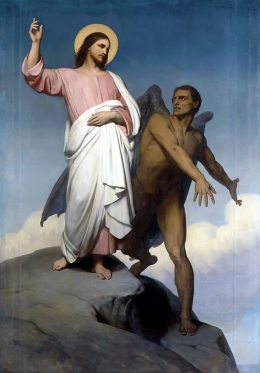
Satan, Lucifer, Beelzebub, the Serpent, and the devil all refer to the same prominent character in the Christian Bible. As the story goes, Satan was a ‘teacher’s pet’ of sorts to God; a favored understudy who took advantage of his privileged position as God’s ‘right-hand man.’ Satan became defiant and wanted the throne and kingdom for himself.
…Eventually, Mr. Lucifer fell so far from grace that he became the embodiment of evil forces. He came to command an ‘army’ of demons to do his bidding.
On the surface, this highly-paraphrased description of events might seem preposterous to the sober mind. But if you look deeper, hopefully you’ll see it this way:
They could be allegorical accounts meant to teach the astute reader about the downfalls of turning away from the God of the Bible.
Like certain other Biblical stories, to believe the “Mr. Lucifer Story” to be literally true is to take leave of one’s senses and short-circuit the commonsense areas of the brain. The words ludicrous, absurd, and even laughable come to mind.*
*After all, how is it possible to fool an omniscient and omnipotent God; how would God not see this coming? Why would God need or want a ‘right-hand’ helper or student or angel to begin with? After all, He is, well, “God.” (God: “C’mon, give me a break — I’m only one God — I can’t be everywhere at once, I need some help!”)
These questions only begin to scratch the surface of what is preposterously absurd about the literal version of this story. Nevertheless, scores of people accept it as true. But their credulousness is the result of blind acceptance of the words of authority figures and claims of divine revelations and dreams (in print or otherwise) – not any personal investigation into the likely reality. ‘Don’t question, just believe’ is the message driven home by years of doctrinal dogma.
“When we blindly adopt a religion, a political system, a literary dogma, we become automatons.”
― Anaïs Nin, The Diary of Anaïs Nin, Vol. 4: 1944-1947
Perhaps it IS smart to believe in ‘the devil’
Perhaps I’m being too hasty in my disapproval of the whole ‘devil’ idea. Belief in a devil may make good sense. Here’s a list covering some of the pros and cons of blaming ‘the devil’ or ‘satan’ for bad things:
Some Pros
- Offers luxury of not having to do any deep thinking to figure out alternative, more complex explanations for bad things; just blame the devil. (What do psychologists know? Certainly not enough to help in areas outside of their expertise – which is where ‘good ‘n evil’ reside. So higher education can’t be of help, right?)
- Maintains our innocence. Shifts the blame for our poor decisions. “The devil made me do it!”
- Safe alternative to blaming a real, live human. Devil can’t sue for slander or retaliate in any other way. Besides, it’s generally accepted that such a character would enjoy being responsible for bad things happening. A ‘win-win’ situation!
Some Cons
- Likely real cause of negative event is not addressed, or not addressed correctly; problem is not solved but deferred.
- Irrational fear is instilled in people at a young age, making it more difficult to deal with adversity later.
- Critical thinking is suppressed; don’t question, just believe. Validating this type of thinking trivializes the significance of evidence-based information – definitely not a good way to run a life, a home, or a country.
We know that lots of good, life-affirming things can result from ‘religion done right.’ But we’re all painfully aware that ‘religion done wrong’ does more harm than good.
A Short List of the Downfalls of Religious Superstition
“Men never do evil so completely and cheerfully as when they do it from religious conviction.” – Blaise Pascal
For hundreds of years in Europe – mostly during the 15th through early 18th centuries – politicians, bureaucrats, intellectuals, and most of the general population believed in magic. And this means believing the laws of nature (physics) are not actually immutable. So for people who believe in magic, it’s easy to believe that evil can exist as some sort of unseen and otherwise undetectable force.
Fundamentalist Christianity was alive and well during this period, practiced by the same people who believed in magic. To them, there was no question that a ‘being’ called Satan existed and that Satan was active in the world, corrupting those with weak minds or spirits.
…Therefore, it stood to reason Satan would recruit human allies. So it made perfect sense that those allies should be located and killed with extreme prejudice. As a result, many innocent women (40-50,000) were killed for being “witches.” Thankfully, that practice is history — a very dark chapter in history.

Today of course — superstitious or not — we see that time in history as barbaric. We realize the doomed victims were the result of — quite literally — witch hunts. This practice could never happen today because we know better. But do we?
If you believe that ‘evil’ can exist in the form of “the devil” or demons, you share the underlying mindset of the people of the Middle Ages. This mindset ultimately led to the Salem witch trials and all other damning religious legalism leading to the brutal murders of thousands of ‘demon-possessed’ witches.
“Those who can make you believe absurdities can make you commit atrocities.” — Voltaire
The following things have happened and some will continue to happen until if and when religious superstition is replaced by critical thinking. (There is a good reason the word “healthy” is often paired with “skepticism.”)
- There have been countless “exorcisms” in place of proper medical and psychiatric care. The result? Many unnecessary deaths (which often just serve to fuel superstitions).
- There has been a disturbing and ongoing practice amongst some Biblical fundamentalists of denying medical care for their loved ones in favor of “faith healing.” The reason given? They “trust God’s will” over ‘artificial,’ secular medical intervention that circumvents God’s plan for the sick. As a result, many unnecessary deaths of children who have no choice but to trust their parents to do the right thing.
- Spiritual abuse in Fundamental religious cults operating under the guise of accepted mainstream church practices. Such churches highlight the dichotomy between “good” and “evil.” They encourage their entire congregations to “shun” and “scorn” any non-compliants amongst their members to a degree reminiscent of witch hunts. Except for the direct physical harm, this comparison is actually a frightfully close approximation of what happens to their “sinners.”*
*My wife has personal experience with this: She is not allowed to see her grandchildren from a son who is a member of such a church. The reason? Her divorce from a man who is a member of this church. Since then, no contact whatsoever has been allowed with her grandchildren (and her son). The only way she could ‘fix’ this is if she repents of her sin of leaving her husband and the church (in front of the lead pastor and elders) and admits wrongdoing, earnestly requesting to be reinstated into the church. Direct references to “satan” or “the devil” may or may not be a part of such a reinstatement, but it is always a psychological weapon ready to be brandished by the authorities in such a church. (For example, “You are siding with the evil one,” or “Your evil ways testify to your allegiance,” and so forth.)
Her’s is not an isolated case but is the ‘tip of an iceberg’ of spiritual abuse going on in that church (corroborated, by the way, by eleven other former members I’ve gotten to know personally). The congregation of this church is largely highly-educated. (Which proves that higher education does not guarantee a person will become more intelligent – only more educated.)
- Religious wars continue today – in part a result of the belief that evil forces can exist on their own outside a human brain, and that a jealous and angry God either condones or causes such conflicts on behalf of one side.
“Acting” evil vs “being” evil
Witch hunters and some modern religious sects have one thing in common: They believe people can be evil — not just ‘act’ evil. There is a big difference, and this belief is based on the superstitious assumption that evil forces can exist outside a human brain.
It’s not clear (but then how could it be), but this is a close approximation of how it works:
An unseen and undetectable ‘evil force’ or ‘ghost’ somehow encounters a weak-minded or otherwise vulnerable person. The ‘evil ghost or force’ finds easy entry ‘inside’ such a person, whereby it can then ‘take over’ or, at minimum, affect the person’s decisions and actions.
If you think the above paragraph seems vague, unscientific, and an unlikely description of reality, it’s a safe bet you’re thinking clearer than otherwise. Of course, I could be wrong about the above paragraph. But remember Richard Feynman’s humorous lecture snippet about “flying saucers” (reprinted in the Introduction), which illustrates the wisdom of using common sense when no proof is available.
…That “common sense” simply means identifying what is more likely than not when confronted with an unprovable idea — an idea for which solid evidence is lacking. (After all, you can always change your mind if and when better information comes available, right?)
An evil child?
When a male child is cruel to his younger brother, as parents we would never say he is mean or evil. We would admonish him to stop acting evil or mean to his little brother. Even the person who is arguably the most evil in history — Adolf Hitler — was very likely acting evil and not possessed by some unseen and otherwise undetectable evil force…
A ‘demon’ in Adolph Hitler?

Imagine Hitler survived to be taken into custody and brought to Nuhremburg for his trial. Now also imagine while awaiting his trial, powerful religious fundamentalists from the Allied Forces proclaimed Hitler innocent following an “exorcism” they performed on him:
The evil force was expelled and Hitler’s persona was therefore restored to his early, ‘pre-meglaomaniac’ self. To be consistent with the belief that evil can exist as a force by itself means excusing him from even showing up to trial, releasing him from custody. (Hitler: “Phew, I’m glad that’s all over! Now I can reorganize my party to be nice and fair to everyone – if you’d just step aside and let me through, thanks.”)
…The point here is that people can decide to act evil on their own – no devil necessary.
“The belief in a supernatural source of evil is not necessary; men alone are quite capable of every wickedness.” – Joseph Conrad
Would no devil mean no God?
Some mainstream Christians do not believe in “Satan” but believe in the Biblical God nonetheless. Others claim you can’t have one without the other. And then there are some who aren’t sure what to believe.
The confusion is likely a result of the logical inconsistencies implicit in reconciling a “devil” with a deity having the following attributes*:
- Omnipotence – Limitless power.
- Omniscience – Limitless knowledge, including simultaneous knowledge of all past, present, and future events – including human thoughts.
- Omnipresence – Always present everywhere.
- Omnibenevolence – Limitless goodness; infinite benevolence.
*Some philosophers have suggested the Biblical God to be constrained by certain laws of physics like we are. As such, God’s attributes in the above list would be somewhat of an exaggeration. For example, even God could not make it rain and not rain at the same place and time, or create a cubic sphere. So in this view, God’s powers may be great but would be limited by the laws of physics. So even God could not change the past. Therefore, even God could not predict the future either. This view has the benefit of explaining God’s apparent failure to predict man’s choices, evil, and His once favorite angel’s future rebellion (“Satan”).
How about asking an Authority Figure,
“Does a God exist?”
Socrates, Plato, and Aristotle were Greek philosophers who – like other philosophers of ancient times – were continually questioned on their views on gods and religions. Then as today, they were considered authorities on religious philosophy.
But getting advice from authority figures is often dangerous. That’s because authorities are not only often wrong, but many use their authority status to further their own agenda. Yet most people take on face value as true anything and everything they say – because they’re “authorities.”
Not that all authority figures are to be distrusted. More to the point, automatically accepting advice from authority figures closes your mind, making it difficult to think for yourself or consider other options.

Albert Einstein was just such an authority figure (a trustworthy one) who was continually asked for his opinion on God and religion. He is often quoted today, largely because of his unique philosophical views stemming from his knowledge of science. But he was often misquoted on his religious views, depending on what viewpoint needed corroboration – theist or atheist. (This annoyed him and he often felt it necessary to clarify, defend, or revise his earlier statements.)
Neil DeGrasse Tyson has become famous in the last twenty or so years not because he is a brilliant astrophysicist (although he is a brilliant astrophysicist) but because of his unique and engaging way of communicating otherwise complex science in a fun way that everyone can understand. (I’ve read six of his books.)
…Tyson says every speech he gives (and he’s given hundreds) ends up the same: The question and answer period starts with a few audience questions about the specific subject of that particular speech. But if there’s enough time, inevitably the audience asks him about his views on God and religion.
Clearly – from the time of Plato & Aristotle thru Einstein and Neil Tyson today – many people are not convinced about doctrinal ‘God and religion’ stories. They recognize culturally-indoctrinated dogma to be dubious and yearn for opinions of authority figures other than the ones in their church, synagogue, or temple, for example.
“Don’t be trapped by dogma – which is living with the results of other people’s thinking.” – Steve Jobs
Summary
Since the beginning of recorded history, most of the world’s population profess belief in at least one God. Another significant percentage believe there is no God whatsoever, and another group is unsure what to believe. This appears to have remained unchanged.
Theists and atheists – representing some of the brightest minds in the world – have maintained resolute disagreement for centuries on the existence of a God or Gods.
There are thousands of active religions in the world today. Perhaps more tellingly, there is wide disagreement within even the most popular ones. (For example, Christianity has various denominations and branches.) If there was one fundamentally truthful religion, you would think it would have risen to the top to become the universal standard by now.
…If you didn’t know anything else about God(s) and religions, common sense would dictate the reason for this continuum of disagreement to be a simple case of “nobody knows because the answer is unknowable.”
Despite the fact the existence of God(s) can be neither proven nor disproven, most people clearly want or need to believe. It doesn’t take a degree in psychology to recognize the benefits that come with belief in a caring deity. Surely the “placebo effect” and confirmation bias should be at least considered before rejecting them.
If the existence of a God or gods was a fundamental reality like the existence of our spherical-shaped Earth, there would be no disagreement. (Nowadays, few people dispute the Earth is spherical as opposed to flat.) So the question is whether Gods are a fundamental reality – like our spherical planet – or if mankind invented Gods.
All In Our Heads?
It is clear that Gods have always existed in the minds of believers. What’s not clear is if a God or gods exist outside the minds of believers. You don’t have to get into a debate on theology to see how this is true – from a quick look at the epistemological nature of the types of information involved:
When reading fact-based information, there is usually only one way to interpret the text – because facts are non-negotiable and unambiguous. For example, the sentence, “The temperature is 75 degrees Fahrenheit” can be interpreted in only one way.
Faith-based information, on the other hand, is ambiguous – at least to an outside observer. To the truly faithful, however, it can be crystal clear. For example, the sentence, “God is always with you, watching over you, trying to help you if you would only listen with a faithful heart” has meaning only if:
- You have faith in your own mind in the existence of a benevolent God to begin with.
- You must take an additional leap of faith to imagine (or allow) this God with you, in you, around you.
- Depending on how successful you are at convincing yourself of #1 and #2, it’s but a small step (small additional leap of faith) to imagine (or faithfully listen for) your God communicating with you.
…Nobody can do this for you. Nobody can have faith for you. Faith is a personal experience, a personal ‘journey.’ So nobody can determine if you are truly successful in your faith but yourself. You may have every outward appearance of someone who is genuinely faithful, but only you can know in your heart your level of faith.
…Therefore, it’s not clear that a God exists outside of the faithfuls’ minds.
Evidence For, Evidence Against
Is there any evidence either way? Like most metaphysical questions, it depends on how you look at it:
For example, the “Argument from Design,” a.k.a. “Teleological Argument,” a.k.a. “Intelligent Design Argument” posits our very existence – with the (apparently) finely-tuned physical laws necessary for our existence – is clear and obvious evidence for a Creator God.
On the other hand, such an argument depends on science being consistent. Therefore, one could not also hold the literal interpretation of the Bible and other Holy Books as true. Otherwise it can be argued there is a certain amount of ‘evidence’ against the existence of the Biblical God because the literal version of certain events and stories in the Bible are inconsistent with science; inconsistent with reality.*
*This is one reason I’ve always recommended the “big picture” view of some of the Bible’s otherwise great teachings. See “Can Science and Religion Be Reconciled?” for more on this.
Regardless, although there is no hard evidence disproving the existence of a God or gods, there is likewise no hard evidence disproving the existence of unicorns or genies. Because unless you have a complete knowledge of the Universe, who’s to say they don’t exist somewhere in the Universe as well?
So it is crystal clear that a God or gods have always existed, at minimum, in the minds of believers. What’s not crystal clear is if a God or gods exist outside the minds of believers. At least for now, we’re going to have to live with that uncertainty.
…That uncertainty is the reason for the word, “faith.”
Opinion
My opinion? (Glad you asked. 😉 )
I am unsure about how our Universe came into existence. This uncertainty is echoed by today’s science knowledge. But this uncertainty does not mean I will accept on faith culturally-indoctrinated religious narratives. It also does not mean I will outright reject them. The way my brain works, I will ponder only what may be likely or unlikely, based on what I do know – not what I wish to be true or feel pressure to accept.
We live on a planet orbiting its host star, the Sun, one of some 100 to 400 billion stars in our host galaxy, the Milky Way – itself one of some hundreds of billions of galaxies in the visible Universe. On October 13, 2016, NASA announced, “The Hubble Space Telescope Reveals Observable Universe Contains 10 Times More Galaxies Than Previously Thought.”
It is clear the observable Universe is astoundingly immense and (for all we know) may even be infinite – whether part of a ‘multiverse of universes’ or not. Regardless, it appears there are countless chances for life elsewhere in the known Universe alone. But we may never know for sure, due to the vast distances between potentially-habitable worlds. (For more on this, see “Are We Alone?”)*
*Amusing side-note:
To think life is either allowed or possible only on Earth seems absurd. To use a gardening analogy, a Creator God would be a terribly unsuccessful gardener if ‘He’ was only able to get one ‘seed’ to sprout out of untold billions in the tremendously-large wasted plot of ‘soil’ known as the Universe.
There could well be a God behind all of time and existence. Or not. Here are the possibilities, as I see it. Decide for yourself which scenario(s) seems more or less likely:
- The Universe was created by a God for no particular reason(s).
- The Universe was created by a God specifically for humans.*
- The Universe was created by a God for life, humans are just one result.
- The Universe has existed in some form or another forever, no God necessary.
- God is the Universe; the Universe is God.
*The most popular religion in the world (about 32 percent of the world’s population), Christianity, holds that a deity – the Creator of the Universe – sent his ‘son’ (virtually Himself) to Earth to get brutally murdered by some Romans as an atonement for human ‘sins.’ To believe this to be literally true requires one to believe Earth is not only the center of our Milky Way galaxy but also the center of our unimaginably-large Universe. I find that to be naively narcissistic.
I suspect the truth is likely far more intriguing and wonderful than anything currently in mankind’s demonstrably-feeble repertoire of explanations offered in theologies and science.
“The universe is incredibly wondrous, incredibly beautiful, and it fills me with a sense that there is some underlying explanation that we have yet to fully understand. If someone wants to place the word God on those collections of words, it’s OK with me.” – Best selling author, physicist and string theorist Brian Greene