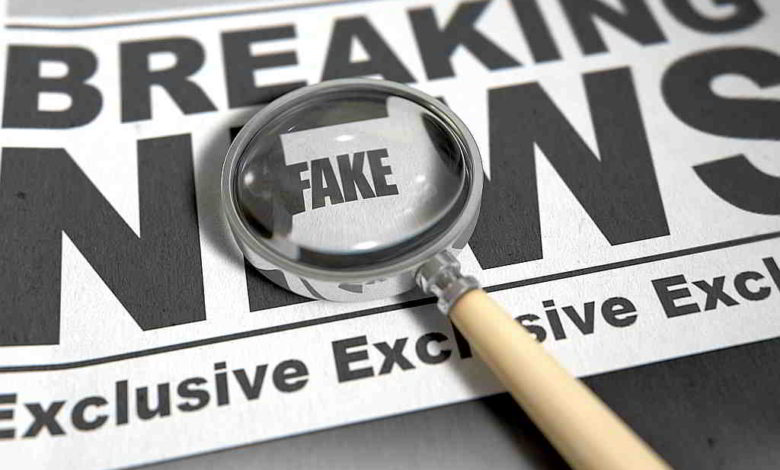
“Fake news is false or misleading information presented as news.” – Wikipedia
…That definition is about as clear and concise as it gets. “Fake news” is nothing new, having been around since the first deceitful email landed in someone’s inbox. But social media platforms — Facebook, Twitter, etc. — enable bogus ‘news’ to spread faster than a gasoline-fueled fire.
Unlike ‘simple’ bad journalism — when lazy journalists neglect to adequately fact-check a story before posting error-filled news pieces, fake news is deliberately deceptive. It’s like the difference between manslaughter and pre-meditated murder.
More troubling than the existence of fake news, however, is the public’s unwillingness to use critical thinking skills to recognize and filter fake news.
But even more troubling is fake news got a big boost from the most powerful, influential source in the world…
“Fake News” Gets a Presidential Boost
We’d be sticking our heads in the sand to ignore the role the 2016 thru 2020 U.S. President himself had on “fake news.” The position of Commander-In-Chief of the most powerful country in the world has great influence — especially on its own people. It’s the ultimate “loose lips sink ships” position. It comes with the responsibility to communicate carefully and eloquently like no other.
Yet despite this obligation — implied though it may be — it’s no secret this President has sown a dangerous distrust and discord amongst the citizens of the very country he was sworn to serve and protect:
From late-night Tweets that read more like something an immature, snarky teen would write rather than a grownup — much less a sitting U.S. President — to off-the-cuff remarks that any educated person would recognize as an affront to critical thinking, this President also mocked American institutions previously considered trustworthy.
These include a general distrust in the agencies of the DOJ (Department of Justice — which includes the FBI) and the news media (“truly the enemy of the people“). Perhaps worst of all, an ongoing campaign of sowing distrust in the same system of democracy that got himself elected…
His issue was allowing mail-in votes to count — because it swayed the election to his opponent. Yet this is the common voting method all military service members (such as myself) have used every election, starting with the American Revolution in 1775.)*
*Here’s a snippet of an interesting article in Time Magazine on the history of voting by mail…
“…In 17th-century Massachusetts, men could vote from home if their homes were “vulnerable to Indian attack,” according to historian Alex Keyssar’s book The Right to Vote: The Contested History of Democracy in the United States, and the votes of some Continental Army soldiers were presented in writing “as if the men were present themselves” in Hollis, N.H., in 1775 during the American Revolution.
But it was during the Civil War that America first experimented with absentee voting on a large scale, as so many of the men who were eligible to vote were away from home fighting. During the 1864 presidential election—in which Republican incumbent President Abraham Lincoln defeated Democratic candidate George McClellan—Union soldiers voted in camps and field hospitals, under the supervision of clerks or state officials.
Excuse-required absentee voting started during the Civil War—a product of the competition between Abraham Lincoln and George McClellan,” Paul Gronke, a professor of political science at Reed College and founder of the non-partisan Early Voting Information Center, told TIME in 2016. “Lincoln wanted to assure that he got the votes of the soldiers who were serving away from home…”
When efforts to disqualify the legitimacy of any and all mail-in voting failed, the President claimed millions of these votes were fraudulently cast for his opponent. Despite no evidence to back up this claim, he continued to emphatically proclaim, “the election was stolen from me!”
…And the rest, as they say, is history — a very dark chapter in United States history. By his actions and inactions, this President created one of the biggest and most dangerous conspiracy theories of all time. This was fake news at its worst, ironically promoted by someone who constantly complained of its use against himself.
Its potential for damage is incalculable, as it was started and forcefully maintained from the Oval Office. A U.S. President’s insistence that an election was a total fraud has divided the country like nothing else since the Civil War. Not surprisingly, many of the citizens who voted for him feel they — along with their President — were victims of the other political party’s criminal actions.
Past U.S. Presidents of both parties have complained that mainstream news outlets are biased, slanting stories against them. But the 2016 President went much further, claiming journalists made up stories and information about him from scratch — implying the public could not trust anything from big news outlets previously considered (for decades) trustworthy…
The fact a U.S. President would publicly use the word “fake” hundreds of times in just one year to describe any news that paints him in a bad light might seem downright scary (“fake news,” “fake stories,” “fake polls,” etc.). But if you take a look at this list of derogatory, juvenile names this U.S. President has actually called his detractors, you shouldn’t be surprised.
Another Problem: ‘Normalization’ of fake news
One consequence of a U.S. President’s daily use of the term “fake news” is that it emboldened social media ‘fake news propagandists.’ After all, if nothing in the media could be trusted, why not just ‘throw anything at the wall’ and see what sticks? Freedom of speech, right?
Social psychologist Troy Campbell, PhD, said “…the recent focus on fake news might be doing more harm than good. Now that we have this idea that there is fake news, we can credibly attribute anything we dislike to fake news.”
Another social psychologist, Peter Ditto, PhD, said “In the past, climate-change skeptics might have tried to pick apart the details of a study or demonstrate a researcher’s conflict of interest to cast doubt on the evidence. Now, they can simply allege that the media can’t be trusted to report the truth, and wipe away inconvenient facts with a single stroke. Mistrust of the media is a powerful tool for Motivated Reasoning.”*
*(“Motivated Reasoning” is explained in its own section below.)
Daniel Kahan, JD, professor of law and psychology at Yale, said “License to ignore reality is a dangerous path to travel, regardless of your political leanings. It’s a good thing in our political culture that facts have been the currency of our discourse on disputed issues. If facts are somehow devalued as a currency, it’ll be a lot harder to achieve our common goals.”
Obviously the 2016 – 2020 U.S. President was not solely responsible for fake news, but his actions (and lack thereof) as the ‘CEO of the United States’ did not help. It’s the social media companies that are largely to blame.
Social Media: Not Created for Fact-based News
Unlike professional network news corporations, companies like Facebook have no vested interest in the veracity of the information their users produce and/or forward. Computer scientist Tristan Harris,* former high-level Google employee (“design ethicist”) and co-founder of the Center for Humane Technology once said, “Social media is about affirmation, not information.”
*Tristan Harris was the lead star in the docudrama, “The Social Dilemma.” The film explores the damage and potential damage social media has done through its algorithms designed to manipulate its users for financial gain. It also examines its effect on teen suicides.
Since one of the biggest motives for fake news is profit through advertising, Facebook, Google, and Twitter updated their policies to include blocking ads from appearing on such sites. This NBC News interview of a professional fake news producer shows why these policies are sorely needed…
Here’s a snippet of the well-done article and interview, titled “Fake News: How a Partying Macedonian Teen Earns Thousands Publishing Lies”:
“…Dimitri — who asked NBC News not to use his real name — is one of dozens of teenagers in the Macedonian town of Veles who got rich during the U.S. presidential election producing fake news for millions on social media.
The articles, sensationalist and often baseless, were posted to Facebook, drawing in armies of readers and earning fake-news writers money from penny-per-click advertising.
Dimitri says he’s earned at least $60,000 in the past six months — far outstripping his parents’ income and transforming his prospects in a town where the average annual wage is $4,800. He is one of the more successful fake news pushers in the area…”
— snippet from this NBC News article of interview
A more insidious problem:
Some Hackers and Fake News Producers do it just for fun
Easy money is not the only motive for producing fake news. One only has to think of necessity for virus checking software for your computers to realize that — like malicious hackers — many vandalism-minded fake news perpetrators create nutty ‘news’ stories just for the sadistic fun of it. In fact, some of the stories are so crazy you’d think ‘fake news alarm bells’ would go off in anybody’s head who reads them.
One might understandably conclude people who believe insane fake news stories are insane themselves, or at least gullible, uneducated sorts who just don’t know any better. The reality, however, is troubling…
Maybe the BIGGEST PROBLEM:
Personal Bias, a.k.a. Confirmation Bias
Since our biases are mostly driven by our emotions, any news having an emotional element — fake or not — goes right past our BS filters. Critical thinking skills are bypassed and ignored. This is because our emotions don’t require any solid reasoning whatsoever; if it just ‘feels’ a certain way, that’s the way it is.
Our emotions are involved in nearly every daily decision, whether we’re aware of it or not. For example, the decision whether to go to the store to get milk and eggs should be straightforward; you need milk and eggs. But subconsciously, you ask yourself, ‘how do I feel about going to the store right now?’
It’s OK for you to talk bad about your own child, but it’s definitely NOT ok for someone else to even imply something negative about your kid. Reading negative ‘press’ about someone you like, such as your political candidate, only makes you become more deeply entrenched in defense of your political party’s views, for example…
Unfortunately, we too often allow our emotions to rule much of our thinking.
Why Educated People Believe Fake News (or inaccurate mainstream media news)
“Motivated Reasoning”:
The confirmation bias technique for intellectuals
“The human brain is a complex organ with the wonderful power of enabling man to find reasons for continuing to believe whatever it is that he wants to believe.” – Voltaire
The American Psychology Association did a feature on why smart people believe ‘alternative facts’ and found they would simply use more complex reasoning for continuing to believe whatever it is they want to believe. They named it “motivated reasoning.”
Here’s a snippet from their feature article:
“People often dismiss those who hold opposing views as idiots (or worse). Yet highly educated people are just as likely to make biased judgments—and they might actually do it more often.
It’s almost as though the sophisticated approach to science gives people more tools to curate their own sense of reality,” says Matthew Hornsey, PhD, a professor of psychology at the University of Queensland who studies the processes that influence people to accept or reject scientific messages.
Unfortunately, our modern media landscape seems to be amplifying the retreat from facts. These are wonderful times for motivated reasoners. The internet provides an almost infinite number of sources of information from which to choose your preferred reality, says Hornsey. There’s an echo chamber out there for everyone.”
“Motivated reasoning is a pervasive tendency of human cognition,” says Peter Ditto, PhD, a social psychologist at the University of California, Irvine, who studies how motivation, emotion and intuition influence judgment. “People are capable of being thoughtful and rational, but our wishes, hopes, fears and motivations often tip the scales to make us more likely to accept something as true if it supports what we want to believe.”
Other Reasons Our ‘BS Filters’ Don’t Catch Fake News
- Authentic-looking major news sites
Fake news producers have gotten creative, producing realistic, trustworthy-looking webpages and articles that flow through our BS filters without raising an eyebrow. Research by Alison Escalante, MD, contributing author of Forbes, found social media users are more likely to believe fake news.
Surveys show people are far more gullible than they think when it comes to determining whether something on Facebook is legit or bogus — regardless of education level. A study published in the journal MIS Quarterly showed only 44 percent of the time did people correctly assess whether headlines on social media were true or false.
- Not enough time for proper research
Sifting through news and other info nowadays is like trying to drink water from a fire hose. Life is busy. No time for trying to figure out if the piece is true or a fabrication. We scan through headlines and click on only the ones that resonate with us — which often just serves to reinforce our personal biases. So we’re only getting one side of news, which can be exaggerated or altogether false without our knowing.
Co-founder of the myth-busting site Snopes, David Mikkelson, said “The bilge is rising faster than you can pump.”
- It must be true because it’s in ‘print’
We subconsciously value the printed word — digital though it may be — rather than the spoken word. “They went to the trouble to write it down, so it must be true” is the unspoken assumption we tend to make.
Related to this (and to the lack of time) is that we tend to accept things as true that were forwarded by trusted friends. But did anyone bother to actually fact-check the piece before forwarding?
- ‘There’s no such thing as bad publicity’
This maxim describes a feature of fake news (and human brains) that is troubling: When we hear or read a statement often enough, eventually our brains make us think the statement is true. For example, President Obama was accused (by Donald Trump and his supporters) of being Muslim and a citizen of Kenya (“birther theory“) so often and for so long that much of the U.S. population started thinking these accusations were true.
An Ongoing Problem:
Poorly-researched ‘Normal’ News
“The founder of Snopes.com, David Mikkelson, said “Fake news” is part of a larger problem of poorly-researched and reported information. The fictions and fabrications that comprise fake news are but a subset of the larger bad news phenomenon, which also encompasses many forms of shoddy, unresearched, error-filled, and deliberately misleading reporting that do a disservice to everyone.” – (from this FactCheck.org article)
What Can be Legally Done to Limit or Stop Fake News? (Hint: Very little).
The FCC
The FCC (Federal Communications Commission) is the only federal regulatory agency empowered to legally shut down fake news producers. However, they are mostly hamstrung by the Constitutional right to free speech…
From their webpage titled, “Complaints About Broadcast Journalism,” you’ll find this statement:
“Broadcasters may not intentionally distort the news. Rigging or slanting the news is a most heinous act against the public interest.”
Yet shortly after this statement, they write:
“The FCC’s authority to respond to these complaints is narrow in scope, and the agency is prohibited by law from engaging in censorship or infringing on First Amendment rights of the press. Moreover, the FCC cannot interfere with a broadcaster’s selection and presentation of news or commentary.”
The Most Effective Antidote to Fake News: Yourself
Most of the progress to curb fake news comes from smarter search engine algorithms and upgraded social media publishing policies. But it will remain the duty of you, yourself, to be the best defender of truth. The only way to accomplish this is with critical thinking.
Critical thinking skills are called “skills” because they are definitely learned. It’s not something you’re naturally born with. But if you practice using the “clear thinking tools” outlined in the chapter, “How Can We be Sure Something is Actually True? you will have no problem identifying the truth amongst the profit-driven, ego-driven, and hacker-vandal-infested world of internet media.