*Note: This ‘miracle list’ started out as just a few that immediately came to mind. I would get to the end of one and remember another close brush with death that qualified as a ‘miracle’ — at least in the opinion of some people. This process repeated until there was thirteen – I did not plan it this way.
Regardless, I’ve been careful to avoid exaggeration and most incidents have been understated. I hold myself to a high standard of accuracy, only writing what I know to have happened precisely the way described. Adjectives are used mostly to keep the stories from being too boring, but I think hyperbole should be minimized.
They are listed from earliest to most recent…
Miracle #1:
The Spherical hard candy
The first was in the late ’60s when I was about 7, give or take a year. It was a warm, clear day and I was the only person in the house at that time. I was sitting on our old green couch in the den of our two-story stucco house, facing the television – which was turned off – and I put a piece of hard candy in my mouth.
Evidently I had taken a breath at the wrong time and the spherical shaped hard candy got lodged tightly in my trachea. I could not breathe in or out; it had completely shut off my ability to breathe. Trying to cough it out didn’t work.
Without knowing why and without any real fear that I can recall, instinctively I somehow knew to exit the den, turn right, and run up the stairs to the second floor and continue running straight through the open door of the bathroom. On the opposite wall was the sink. Without slowing down, I ran into the sink, my abdomen and chest hitting the front edge of the sink with force.
The candy shot out of my mouth into the sink. I can still see that green ball of hard candy going round and round the sink basin, my face very close to it because of my height.
I don’t remember being scared before it came out, only focused. And afterwards I wasn’t particularly relieved. After being momentarily mesmerized by the green hard candy going around the sink basin, it was on to the next thing. I truly was on autopilot through the scenario and only thought about it later.
The height of the sink’s edge to my chest and stomach put the sink at the perfect area for a Heimlich maneuver. In retrospect it was the best course of action that saved my own life but I was truly on autopilot; I didn’t have time to think. Of course that scenario could’ve turned out drastically differently.
Miracle #2:
The Mustang Crash
The second was when I lost control of my ’67 Mustang while speeding down a two-lane Virginia highway one winter night in 1976. My speed was increasing as I went downhill, last speedometer check showed passing 90 mph. Ice had accumulated at the bottom of the hill, I lost control and plowed into a grove of trees to my right. The car split into two halves – firewall forward. I was not wearing a seat belt and was thrown from the car. My 16 year-young body sustained only a sprained ankle.
I called my parents and they picked me up from a local hospital. I downplayed the accident, and my minor injury helped make my story believable. It was days later before they saw the car. My mother exclaimed that if she would’ve seen the (nearly unrecognizable) car chunks before seeing me, she would’ve fainted.
My older brother, Johnny, drove me to the service station where the remnants of my car were taken. I took two photos of it with an instant-print Polaroid camera, popular in those days. After hanging on to those prints for a couple years (until I was eighteen), I finally had to throw them away. Nothing positive came from looking at them from time to time.
Miracle #3:
The Quarry Dive

Third miracle was on a spring morning in ’77, less than a year after the Mustang crash. I plummeted to the bottom of a flooded quarry in my new SCUBA gear, not long after finishing a “PADI Basic SCUBA diver” course. I was over-weighted with twin aluminum 80 cubic foot cylinders and had but a measly ‘horse collar’ type BC (Buoyancy Compensator).
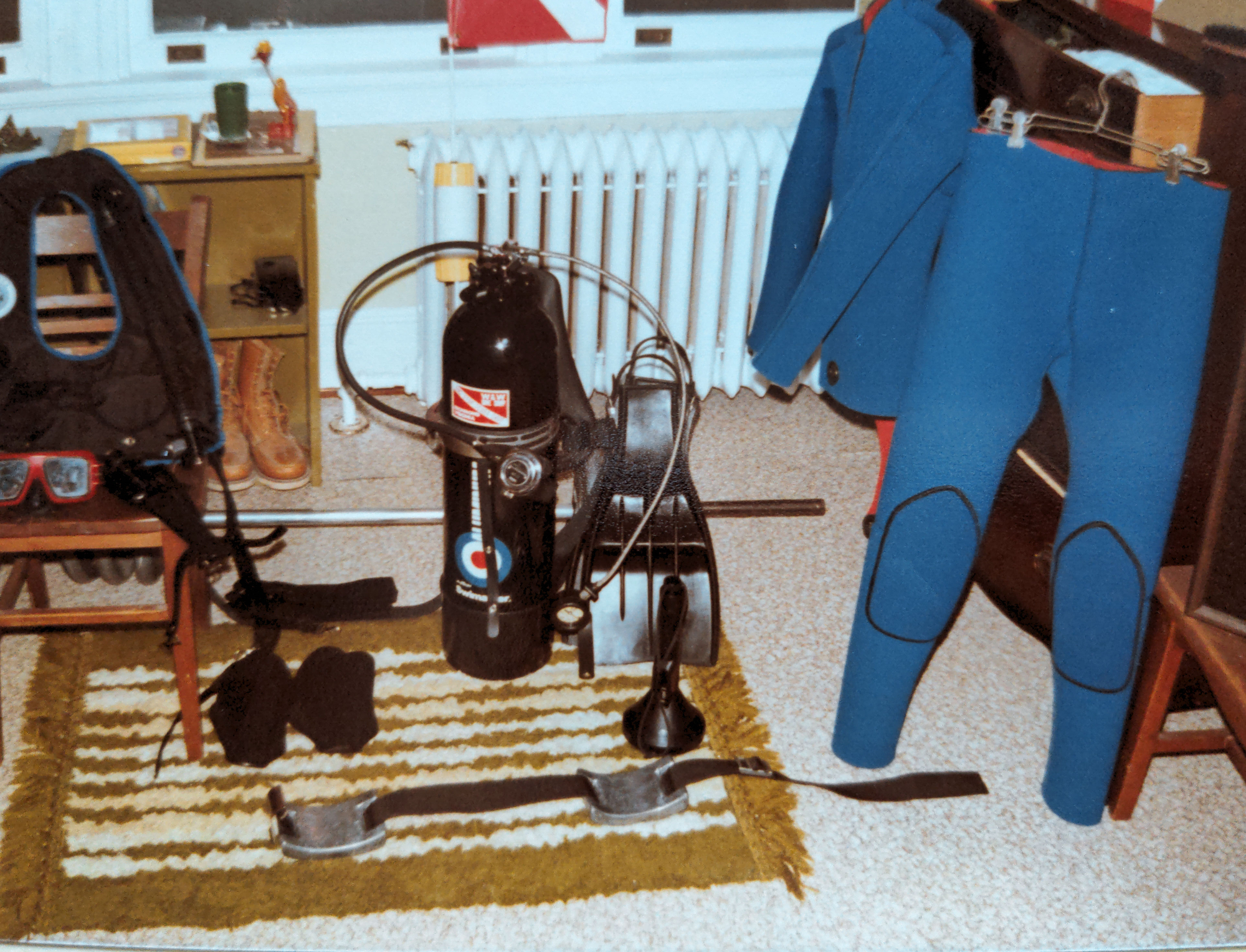
I’ll never forget how fast I was falling through the water column. It all started when I’d become overheated in my new wetsuit while waiting for the other divers to gear up. My plan was to descend alone to about twenty feet deep, where I knew the water temp was significantly colder below a thermocline. This would also be a good test of the new wetsuit’s insulation effectiveness.
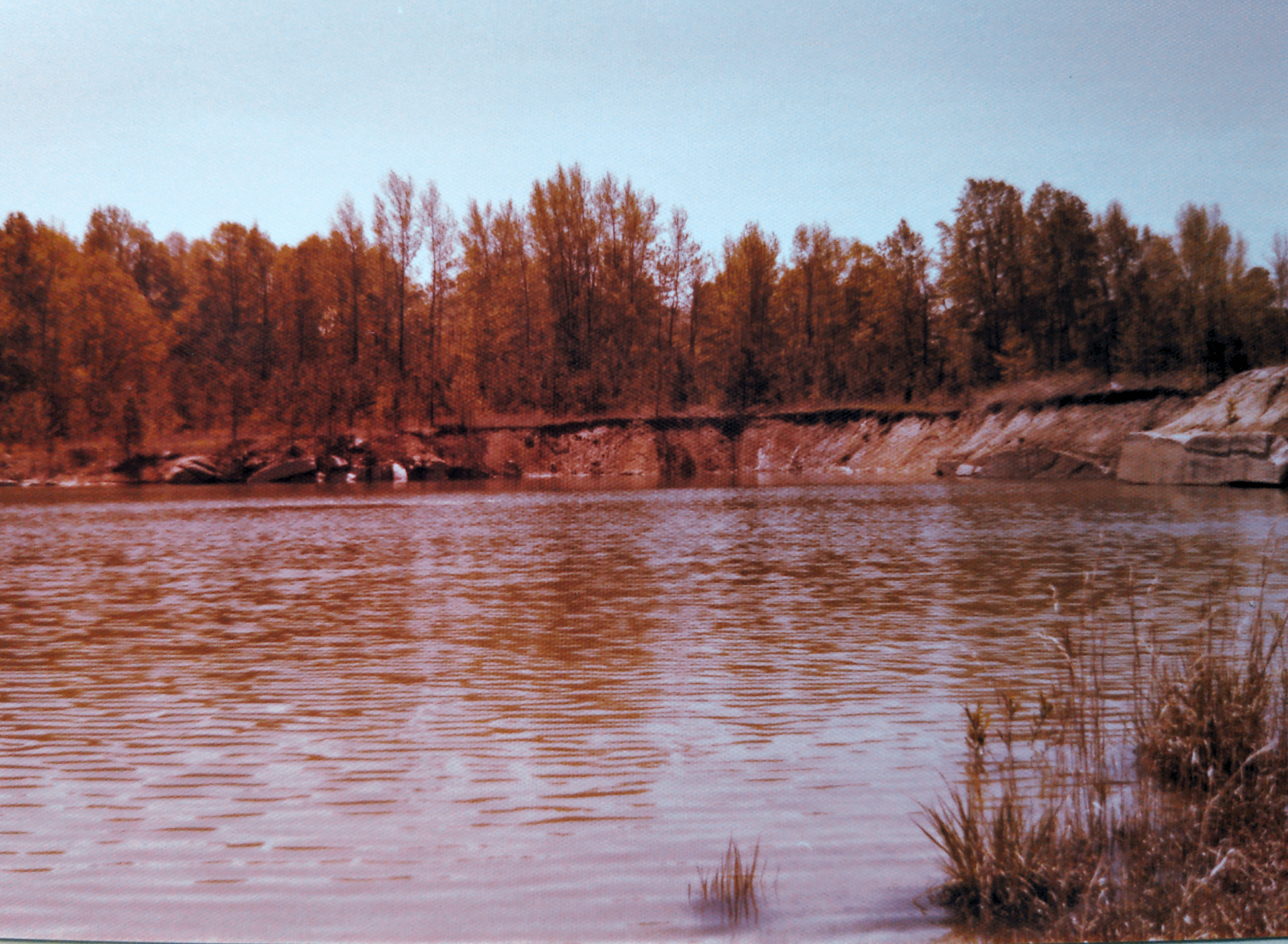
At first the cold water was a relief, but pressure started building in my ears so fast I had to keep one hand pinching my nose closed to continually ‘equalize’ (relieve increasing water pressure against eardrums). Despite my thick wetsuit, I started to become chilled to the bone and became disoriented in the pitch darkness, unable to figure out up from down. At this point it was clear I was in an uncontrolled descent, yet stopping it was a challenge.
I needed to find and activate the BC inflator button before falling to some scary depth — where I knew life-threatening problems arrive in a hurry. Fortunately, my right hand held a flashlight. which I’d brought to look at the vertical walls of the quarry, but was needed now to find the inflator button — which I’d never practiced finding by feel. Besides, I was wearing thick neoprene gloves, another mistake — because just turning on the flashlight became a time-consuming challenge.
Anxiously aware I’m picking up speed with each passing second, I finally get to the inflator button and hold it down. The horse collar BC fills loudly with air, and my descent slows. Suddenly both feet land with some momentum on the edge of what feels like a large steel object. I bend my knees to help absorb the impact and sense I’m standing on the top edge of a large bulldozer bucket, but it could be anything from the flooded strip mining operation.
At least my descent has stopped — if only from a crash landing — and my weight is only a fraction of what it was a few moments earlier, making it easy to balance on whatever it is I’m standing on. I take a moment to check my depth gauge (cheap capillary type, co-located on the pressure gauge) and see it reads roughly 120 feet.
I resume inflation of the BC and it reaches max capacity in only a few seconds, becoming tight as a drum, nearly choking me in the process. I gradually start to lift off my perch and start up. I make it back to the surface without any ill effects.
This is the only ‘miracle’ incident I experienced with no witnesses, which would have sealed my fate had I been unable to surface; the other divers hadn’t noticed me get in the water. This was just one of many SCUBA no-nos I did that day. Nevertheless, I didn’t even know enough to feel much stress, but my confidence was bolstered a bit by the knowledge I had plenty of air.
I was sixteen and, in retrospect, felt ‘bulletproof.’ This bold naivety is likely one reason young people willingly fight wars.
Perhaps I would’ve had the presence of mind to release my weights, had the buoyancy compensator been insufficient to lift me off the bottom. Or not, I’ll never know. But if I had dropped the weights, my ascent would likely have been dangerously fast near the surface. (I was wearing a buoyant .25″ thick, full neoprene wetsuit and hood with gloves and a vest underneath as well.)
Regardless, if the quarry was much deeper, and/or I didn’t bring a flashlight, I could’ve been in big trouble. Much deeper it’s likely I would’ve experienced gas narcosis, which could’ve seriously eroded my ability to think clearly. Without a flashlight, it’s unclear how I would’ve handled the situation — I was completely disoriented without it. Orally inflating the BC wasn’t even on my mind.
Miracle #4:
The Cuttaway
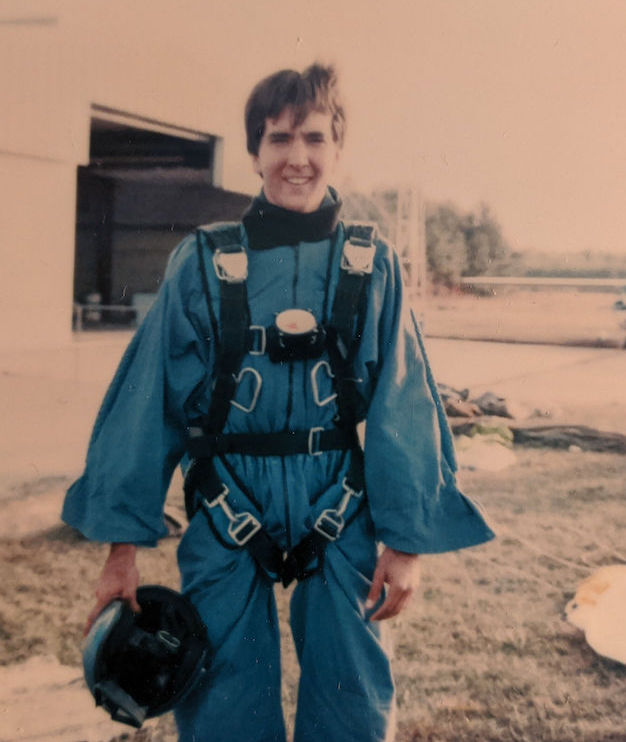
Not quite a year after the diving incident, I’d taken up sport parachuting at a drop zone closest to where I lived with my parents in Richmond, Virginia. It was 1978 and this particular jump was my 37th. My main parachute was a PC (“ParaCommander”), and it opened with its now-familiar “opening shock” after a free fall from 7,500 feet AGL (Above Ground Level).
My altimeter showed 3,500 feet after the parachute opened. All good except I felt a steady wind from below — maybe 30 mph or so. Looking up, I was surprised to see what appeared to be a hot-air balloon above me and not a parachute. The parachute’s suspension lines rose straight up from my shoulders — not splayed out like normal — to the bottom of the closed-off parachute. Yet it was inflated like a balloon due to air flowing into the seamed cutouts* in the fabric above the entangled, closed-off bottom.
*Prior to common use of wing-type gliding parachutes, paracommanders were based on a military round parachute design, but with extensive modifications to the fabric for extra forward speed and steering control. These modifications included lots of strategically-placed slits in the fabric which — in this case — allowed air to inflate it like a balloon during such a malfunction.
No problem, I was absolutely calm because I knew exactly what to do. After going through the steps to release the malfunctioning parachute (“cutaway” – except nothing is actually cut), I was returned to free fall below the now-released paracommander.
So far so good. Now all I had to do was pull my reserve parachute’s ripcord. This is when the real problem started: My extra baggy jumpsuit covered up the ripcord from view, and groping for it resulted in nothing but jumpsuit folds in my hand. This was when my calm confidence started to crack…
But still no problem, I will continue to follow my emergency training. In this case I need to see the ripcord so I can get my hand on it. Since the ripcord was located on my lower left chest area, I bent forward at the waist while craning my neck down to the left to see exactly what the hell was going on.
This resulted in a slanted, head-down free fall position. The effect was a rapid increase in speed. Stay calm, I told myself.* I didn’t want to waste precious time and altitude checking my altimeter, but I was reasonably assured I was still plenty high above the ground to handle this emergency before it was too late.
*Stay calm, I told myself, because panic usually spells the end. Once panic starts it’s difficult to stop. The brain shuts down — controlled conscious thinking anyway. Purposeful, carefully controlled muscle movements are not possible. Panic has spelled the end of millions of people (and hundreds of skydivers) since time immemorial.
This is when the problem went from bad to worse: The effect of bending forward and to the left (in an attempt to see the ripcord) introduced slack in the strap that held the ripcord in place. The angle of my body caused the now 120 mph or faster wind to hit the strap at a ninety degree angle, making it flutter. Slowly at first, then rapidly picking up speed…
Since the ripcord was secured to this strap, it was fluttering too — maybe five inches or so back ‘n forth. The fluttering was so fast it became more a ‘buzzing.’ My view of the chrome-plated ripcord was therefore nothing but a silvery flash. Again and again I tried to grab it to no avail!
Panic
Enter the first stages of panic, accelerated by the knowledge I’d been in free fall much longer than I should have from 3,500 feet. This was the first and, so far, the only time I’ve ever been in a true panic. A better description would be “seized” by panic. In retrospect it was amazing how fast it debilitated me. I clearly remember a warm ‘rush’ — like a paralyzing drug — sweeping into my body, and my repeated grasps for the ripcord became increasingly clumsy and out of control.
In fact, the awful feeling of helplessness and panic itself started becoming worse than the thought of death. For a brief moment I was tempted to curl up in a fetal position and await the end. After all, I was unable to get to the damn ripcord anyway. It was right after this I became dimly aware that I still had an unopened parachute on my back, if only I could get it out…
Suddenly the obvious solution was clear (the ‘miracle’): Simply use my left open hand to press (slap) the crazy fluttering webbing onto my chest, pinning it down. At the same time, I reached over and grabbed the now stationary and visible ripcord with my right hand…
As I yanked it out, I closed my eyes and mentally prepared myself for impact. I recalled the scores of skydiving accident reports (printed in the back of the monthly Parachutist magazine) that ended with some variation of, “Jumper was killed on impact before the reserve parachute had fully opened.”
Surely I was a perfect candidate for such a scenario. I was actually surprised when the reserve parachute opened so abruptly it was like whiplash. For a moment I was afraid to look down because I expected the ground to be rushing up for a hard landing. Instead what I saw was the airfield far below. With a huge sigh of relief I looked at my altimeter and saw it read 1500 feet; I was sure I would have been much lower.
Never underestimate the debilitating effects of panic. Training, rehearsals, and practice are the only ways to avoid this killer. I was lucky my initial opening altitude was much higher than normal; if I had pulled my first ripcord at the normal 2500 feet (normal for a jumper of my experience at that time in skydiving history), you might not be reading this.
Miracle #5:
The First Mountain Flight
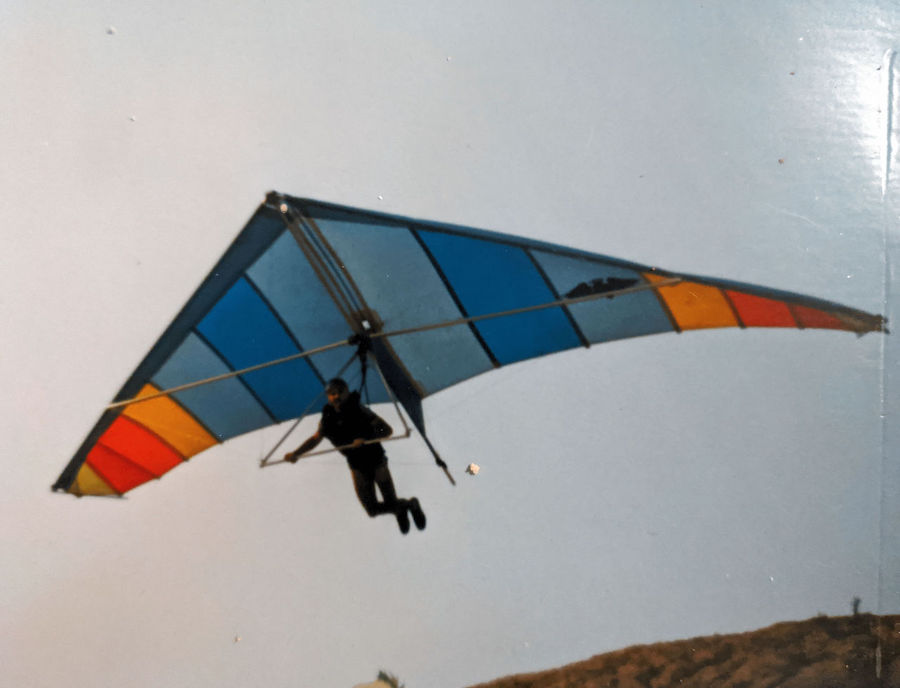
This event was the first time I would foot-launch a hang glider off a mountain. The glider was a relatively low performance, single-surface wing called a “Phoenix 6D,” and the launch site was located on Dan’s Mountain in Allegany County, Maryland.
With me was my hang gliding friend, Bob Hibbard of Williamsburg.
I met Bob in 1980 at the Aerodium, in Saint-Simon, near Montreal, Canada.
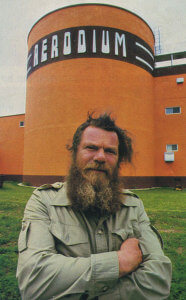
The Aerodium was the first civilian vertical wind tunnel designed for ‘indoor skydiving.’ My early skydiving buddy, Lex Nuckols, and I had driven up from our hometown of Richmond, Virginia. I had already made nearly 800 free fall parachute jumps out of airplanes, but I was intrigued with the idea of being suspended in mid-air inside a building by nothing but wind blowing from below.
I noticed Bob because he was the only other person who spoke English in the Aerodium building. Bob was there because his wife, Louise, was French-Canadian, and they had driven up from Virginia as well. After chatting it was clear Bob was into hang gliding and I was into skydiving but we both wanted to experience the other guy’s aviation sport. So we exchanged phone numbers and made a pact that I would teach him skydiving if he would teach me hang gliding.
After a good launch I decided to make a 360 degree turn. This turned out to be a mistake because I did not yet know about downwind stalls and how to avoid them. (I never took a hang gliding course and Bob was neither an instructor nor an expert pilot.) Since there was a light wind blowing towards the mountain, I should’ve pulled in the control bar to maintain my airspeed during the portion of my 360 when I was facing the mountain — downwind.
Although my intention was to make a 360, my glider turned only 180 degrees, despite my body being completely to one side of the control bar. No problem I thought, I’ll just move quickly to the other side in an effort to ‘force’ the glider to turn back the direction I’d come. Uh-oh! The glider seemed intent on flying directly into the trees on the side of the mountain no matter what I did!
There is nothing particularly dangerous about ‘landing’ in trees with a hang glider, and my closing speed with the trees did not appear very fast. Nevertheless I was concerned the glider would not get stuck in the trees and would instead plummet straight down — which would likely result in some sort of injury or worse.
Suddenly the solution hit me: Pull in the control bar to get some airspeed, dummy!
This would be the only way to get control authority for turning away from the mountain. So I centered myself in the control frame while pulling the control bar (“base tube”) all the way to my belly. I was now diving at the trees and they were coming up at me fast…
After holding this position probably longer than I needed, I threw myself to the left side. The glider immediately responded by banking to the left. Only then did I push the bar out to stop the dive and get the glider around the turn without spiraling into the trees.
Phew, success! I was now flying directly away from the mountain. Unfortunately, however, I’d lost a significant chunk of my altitude during the downwind stall and rookie maneuvering. This would not be a problem if it weren’t for the fact I still had a long way to fly to get to the landing field. My position was just above the tree-covered, gradual slope of the lower part of the mountain.
Unlike the younger Rocky mountains in the west, the older mountains in the southeast rise gradually for the first half or more of their total height, becoming steep only near their summits. It was the altitude on this steep part I’d lost. The result was my glider’s lift-to-drag ratio (L/D ratio) — my ‘glide angle’ — exactly matched the downward angle of the mountain from that point on.
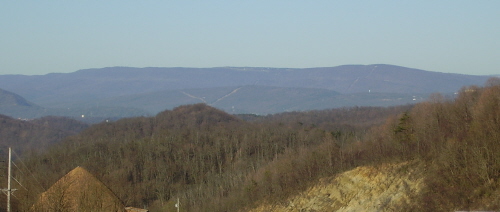
…As a result, I was gliding just above the treetops, unable to gain any altitude. The treetops dropped away at exactly my glider’s best glide angle capability. The slope of the tree-covered mountain looked almost flat for eternity. I was so low, so close to the trees that I couldn’t discern where the trees ended and the landing field began.
So far, although very worrisome, there is nothing particularly dangerous about my situation. As noted earlier, a tree landing does not necessarily spell disaster. But a landing in power lines is a different story.
Fast forward to the point when I could just make out the end of the treeline in the distance. I knew that just beyond was the landing field. Was I going to make it? All during the white-knuckle glide, there were times I’d experience loss of lift and resigned myself to a tree landing…
But then I’d get some welcome lift — if only momentarily — that would get me over a particularly tall set of trees. This happened over and over, with the taller trees passing just under my belly – less than five feet below. There were times I literally scraped the tops of those taller trees with my base tube (control bar).
The end of the treeline was now clearly visible, but what was this?! OMG, a nearly invisible, small set of power lines were between me and the landing field, perpendicular to my flight path! Worse, they rose above the last line of trees along the road they paralleled by maybe ten feet, give or take.
What should I do?! I knew a collision with power lines would likely spell death: The glider’s stainless steel cables and aluminum frame — with me holding onto part of it — would be perfect conductors of electricity. But maybe I’d get some welcome lift at the last second and fly over them??
No, I shouldn’t count on getting any lift. While there was still time, I should turn parallel to the power lines and attempt the best tree landing I could — it was the only prudent option. But I was getting so tantalizingly close to the landing field — maybe I could wait and see if I would get lift and if I didn’t, I could turn away at the last moment??
Thankfully, at this point the power lines appeared almost level with me, maybe a few feet higher at most. Jeez, it’s getting closer and my glide path will clearly take me into the power lines if I can’t somehow gain altitude!
Do something, dummy! It was as if I was frozen, unable to do anything but fly straight ahead. Here they are — push out now to climb over them!!
Everything went silent as my speed instantly slowed in the low-performance glider. But I DID climb just enough to clear the power lines. Yesss! I made it!
…Or had I?
I was now practically motionless, stopped just above the last wire — less than two feet above it. I could’ve reached down and touched it.
I still needed to move forward a bit to completely clear the wires. Luckily, the glider retained just a smidgen of forward movement, although it was clearly in a stall.
Looking down, I was directly over the middle of a narrow county road — power lines lining one side with me barely over them — and a low barbed wire fence along the other side, just twenty or so horizontal feet ahead. Beyond this fence was the landing field.
I pulled in just enough to keep from falling backwards into the wires. But pull in or not — there was only one direction I could go now — and that direction was down. I pulled my feet up and hoped the back area of my glider did not hang up on that last wire.
To give you an idea of how close I’d come to disaster (from not having adequate altitude and airspeed to clear the wires):
The glider remained obediently wings level, but gravity took over as my airspeed was now effectively zero. The glider literally fell until perhaps ten feet off the ground, when it started flying again — just in time to flare the nose up for landing, clearing the low (maybe 4′ tall) barbed wire fence by inches.
If my speed was even slightly slower or my altitude slightly lower when I approached the power lines…
Miracle #6:
The Broken Control Yoke
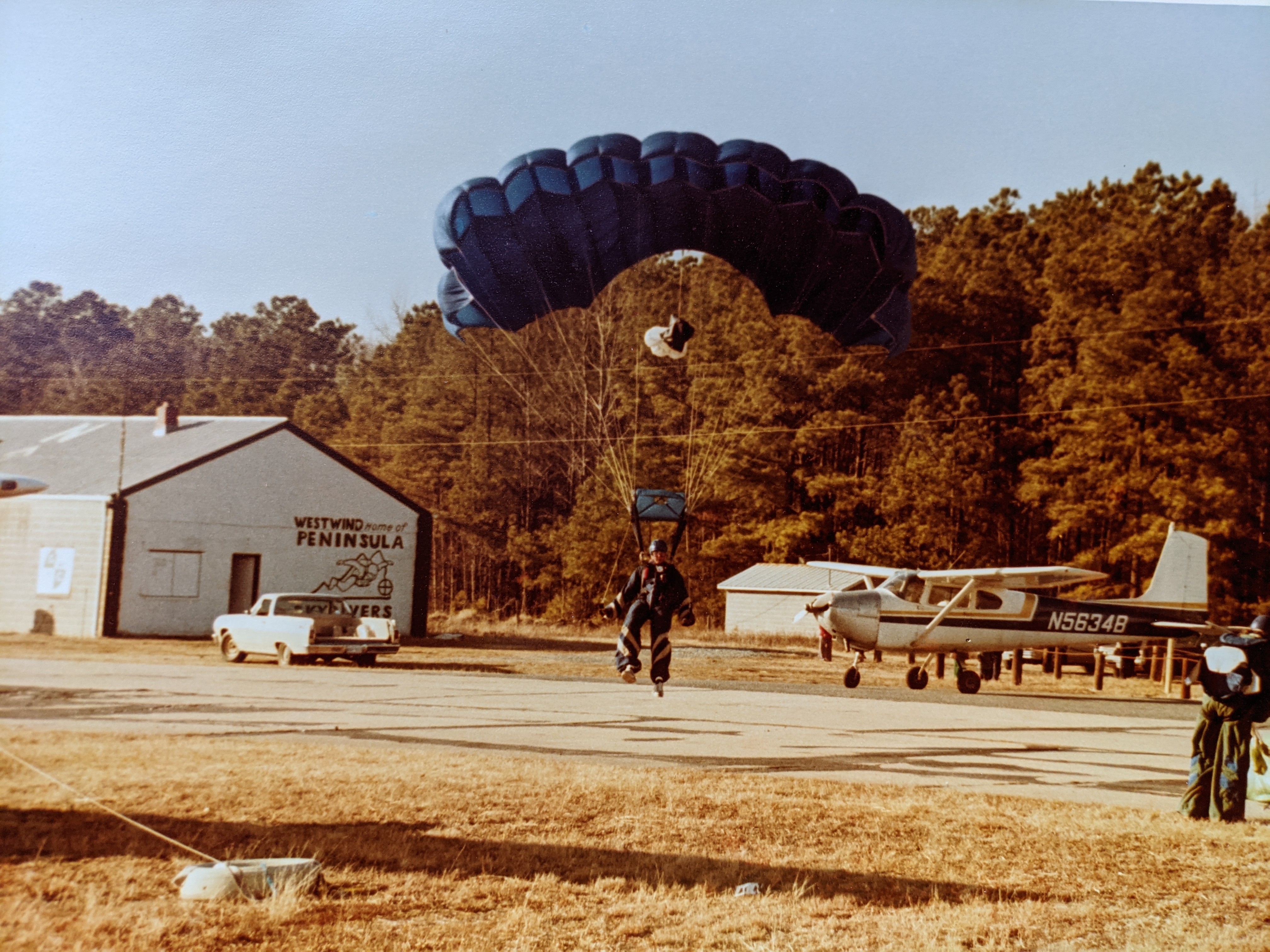
Winter 1980 or ’81, I had three student parachutists loaded into my home drop zone’s (West Point, Virginia) Cessna 182 for their short ride to 2,800 feet. I was their young jumpmaster who would get them out on their first jumps. The airplane was a wide-body C-182, a rare model that was in great shape for a jump aircraft at that time. The pilot was Hale Castleman and the plane was owned by his friend, Hugh Bergeron.
Hale and I knew the weather forecast called for 100 percent chance of snow and the temp was well below freezing. Yet the 3,500’ AGL (Above Ground Level) solid overcast had not produced the first snowflake yet, so we decided to take the students. After all, if it started snowing we could simply land the aircraft and abort the mission.
…Easier said than done, as it turned out.
At roughly 2000’ the first snow started falling. Before we had time to even comment on this, the snowfall increased dramatically such that the visibility quickly dropped to nearly zero. This put us into an emergency situation, as the aircraft was not equipped with a GPS (it wasn’t invented yet) or any other instruments for a blind landing on the airfield.
Hale started an immediate descent to the airport but we were almost in whiteout conditions, so the runway was quickly becoming completely obscured. Nevertheless, Hale succeeded in executing a steep diving turn for one end of the 5000’ long runway.
I was sitting squatted on my knees facing forward, just to the right and slightly behind the pilot. A student jumper was sitting on the floor facing me, leaned back against the aircraft’s control panel.
As in all small Cessna aircraft outfitted for jump operations, the control yoke for the right side had been removed, as well as all seats but the pilot’s. This allowed the aircraft to accommodate four total jumpers, which included myself.
My view was therefore even better than the pilot’s, and I could barely make out the runway. As Hale was pulling the aircraft out of its diving turn, the G-forces built up such that it was impossible for me to hold my head up. Suddenly there was startlingly-loud cracking sound — like the sound of a gunshot at close range. What the hell was that?! I thought as I looked where the sound had come from — which was between Hale and the instrument panel.
What I saw would have been funny had our lives not been in sudden jeopardy: Simultaneous with the loud crack was Hale’s body lurching backwards in his seat, the control yoke in his left hand almost hitting the headliner in the airplane.
The aircraft’s only control yoke — the ‘steering wheel’ — had completely broken off in his hand!
The only remaining control capability (other than the rudder pedals and throttle) was the now-naked steel tube sticking out of the panel. The aircraft pitched steeply down and the view through the windscreen was filled with nothing but the dark asphalt runway through heavy snow. We were perhaps fifty feet above the runway and pointed almost straight down at this point.
Hale only had time to use his right hand to grab the tube and pull it out. The aircraft leveled but there was so much downward momentum that we pancaked hard on the runway while moving forward only a few aircraft lengths. The aircraft was totaled but amazingly we were alright — only because we were wings level at the last moment.
Instead of getting out of the aircraft, Hale was preoccupied with the aircraft’s radio for some reason. (Turns out it was for a very good, unselfish reason.) But I wanted to get myself and the three jump students off the aircraft as fast as possible because fire was a real possibility.
In my haste to get them out, however, I forgot to unhook the first jumper’s static line from the aircraft, and his parachute was trailing out behind him as he made his way from the crashed airplane. I had to scurry back into the plane to unhook his parachute. I imagined the plane bursting into flames, with the nylon parachute passing the fire along like a fuse to the jumper.
If the control yoke had broken off a second or two earlier, the outcome may not have been so fortuitous; we were in a steep banking turn at that time. We were extremely lucky the aircraft had just leveled when the yoke broke off — so the crash was a ‘pancake’ instead of a cartwheel.
The following outlines another ‘miracle’ associated with this accident:
As we were walking away, Hale came running by us, hollering that we needed to get a vehicle and rope to tow the disabled heap off the runway asap: A twin-engine turbine aircraft was on a long final for landing on the runway. The aircraft, a new Mitsubishi M-U2, had a sophisticated navigation system that allowed landing in near-zero viz conditions. But the bad news was the jump plane’s radio antennas were damaged in the crash, and Hale was not able to warn the aircraft of the lethal hazard awaiting them on the runway.
We could hear the approaching M-U2 as we hastily tied a rope around the broken nose gear. With several people helping push and the sound of the approaching aircraft getting dangerously close, the heap started to budge. It was slow going.
Then — just like in the movies — the M-U2 touched down just before passing at high speed the spot where our crumpled plane had just vacated. Phew! That impact would surely have resulted in a high-speed crash and fire.
Miracle #7:
The Night Hoop Dive
I was in free fall over a Virginia drop zone at night, as part of a ten-person night skydive. If I hadn’t noticed the light illuminating the front of a hanger rushing up at me, I — and the nine other jumpers — would have died about six seconds later. Since this ‘miracle’ involved nine other people, I thought it warranted offering more details:
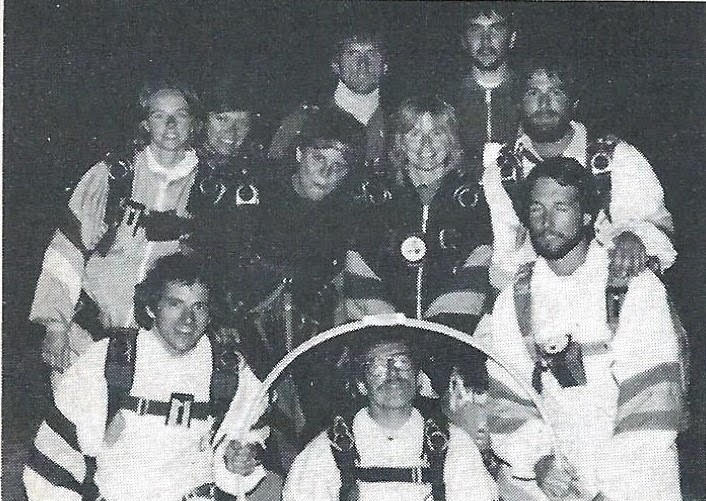
In 1981 I was considered an experienced skydiver, and this jump was in celebration of this — my 1000th skydive to date. In fact, with the exception of just one other jumper, everyone else on the jump had as much or more experience as myself. Collectively, we represented some of the ‘who’s who’ in the sport of skydiving in Virginia at the time. (Nowadays it’s not uncommon for experienced skydivers to have many thousands of jumps worth of experience, and I myself ended up accumulating over 16,000 jumps in the ensuing years.)
Nevertheless — despite the high experience level of our plane load — only one of us noticed we were all just seconds from certain death. Here’s how it played out:
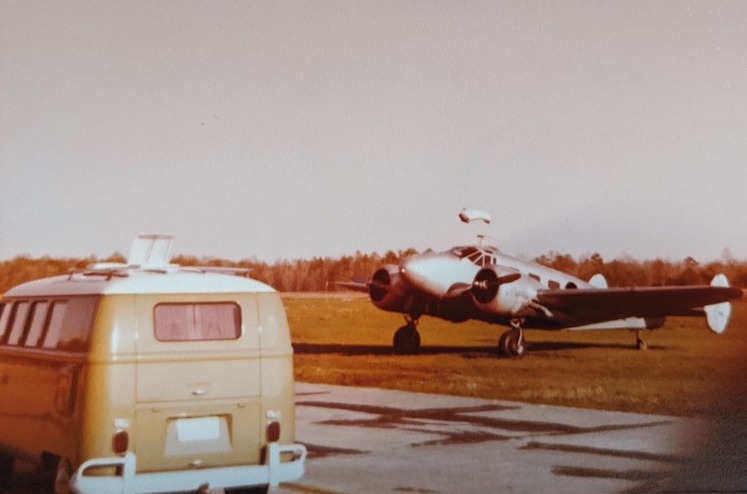
We exited the Beech D-18 aircraft at 14,000 feet AGL (Above Ground Level). After some fun flying through three glowing hula hoops, we formed a circle holding the upper arms of each person to our left and right. I checked my altimeter and was disappointed to see it was malfunctioning, because the needle was passing through the 1000 feet AGL mark on the dial…
I knew it must be reading incorrectly because there were ten other altimeters worn and monitored by the other ten expert skydivers. Surely at least one of them would’ve noticed we had passed through 4000 feet long ago and would have separated from the group, thus alerting everyone else that it was time to move away and open our parachutes.
Audible altimeters worn next to your ear that loudly beep at a preset altitude were not in common use yet; only one jumper, Lex, had an early model (“Paralert”). Evidently it was either inoperative or Lex ignored it as I ignored my altimeter. Another revolutionary piece of safety equipment — the AAD (Automatic Activation Device) — which opens your reserve parachute automatically if you are still in freefall below a certain altitude, was not in common use yet either.
Oh well, I would have to get my crappy altimeter serviced or replaced sometime soon. As this thought crossed my mind, my peripheral vision noticed a dim light that caught my eye. (The act of looking at a chest-mounted altimeter had my face pointed downward.) The light surprised me because — due to the wind — we were supposed to be in free fall north of the airfield, over pitch dark forest and far from any light source…
But yet here was a light and it was accelerating upwards fast! I suddenly realized my altimeter was actually working fine and for whatever reason I was the only person to notice we were all about to die!
Our terminal velocity was likely relatively slow — probably about 110 mph — as we were wearing large jumpsuits and falling belly to earth. Nevertheless, every three seconds at this speed would result in nearly 500′ altitude loss. Since we were at roughly 900′ AGL at this point, we now had only about 3.5 seconds remaining to pull our ripcords, since we would need the last 400 feet above the ground for our parachutes to have enough altitude to open. (At terminal velocity, it typically takes 300 to 400 feet or more for a ram-air gliding parachute to fully open.)
I violently shook loose the mutual grips between myself and the jumpers to my left and right, and then immediately threw out my pilot chute (the ‘ripcord’). I knew this was the quickest way to alert everyone of the urgency of our situation, while saving my own life in the process. After all, nobody normally opens their parachute inches from other jumpers still in a free fall formation, especially at night…
I noticed the heads of shocked jumpers abruptly turn in my direction as my parachute started coming out. Their shock turned to ‘panic’ as everyone quickly realized their dire situation. Parachutes started coming out below me with almost no separation between them. (No time and altitude to safely separate from neighboring jumpers.)
Despite the normal loud sound of the terminal velocity wind and my own opening parachute, I heard screams, shouts, cursing, and the loud crack of parachutes opening close below me. It was surreal but in a horrifying way, as I suspected the outcome was not going to be good.
…It took just a few seconds for me to grab my just-opened parachute’s steering toggles and look down — in an attempt to count the parachutes below me.
There was some moonlight — night skydives are typically done during a full moon — but I can’t remember if it was full or not. I do remember being able to easily see the tops of the parachutes — despite being hundreds of feet below me — as well as the looks on the faces of some jumpers before they fell away from me and my opening parachute.
I counted five parachutes. This meant five jumpers met their fate on the edge of the airfield.
Unbelievably, however, we all lived to jump another day. No one was hurt — physically anyway. There were really, really low openings, with a couple of jumpers not even having time to reach their steering toggles before their feet hit the ground. The five jumpers I thought had perished had simply already landed in those few seconds before I was able to count them!
The ‘miracle’ that made the difference was that we exited the aircraft before we should have. As a result of this fortuitous error, one light on the front of a hanger door was in my field of vision and alerted me to our predicament. If we would have exited where planned, I never would have noticed the light and you would not be reading this.
To those of us on the jump, it became known as “The Night Hoop Dive.” I can’t remember reminiscing about it with anyone. It was just something we wanted to forget. To this day it still flummoxes me that every jumper was unaware of the altitude (including myself).
Night jumps typically involve careful planning, some special equipment, and a high degree of awareness. My experience has been (at least in those days) people tended to check their altimeters too often on a night skydive — even to the point of staring at them. This was obviously not a typical night dive. Happily, this scenario will never happen again because nowadays audible altimeters are worn by every skydiver — day or night — including AADs (Automatic Activation Devices).
Miracle #8:
The NVG Takeoff
I was in the right seat of a UH-60 (Blackhawk) Army helicopter during a training mission near Fort Polk, Louisiana in 1992. The Blackhawk is a two-pilot aircraft. The other pilot was on the controls at the time as we took off in a climbing right turn. The aircraft was lightly loaded and climbing like a homesick angel. It was pitch dark outside except for the circular green tunnel vision offered by our NVGs (Night Vision Goggles) that were mounted on our flight helmets.
To appreciate this incident, it’s helpful to have an idea of what flying with NVGs is like:
Imagine a pair of binoculars mounted on your helmet such that the eyepieces are an inch or so in front of your eyes, your hands are free. Now also imagine the binoculars do not magnify the image (very little anyway) and that it is in ‘greenscale’ (as opposed to black ‘n white or greyscale).
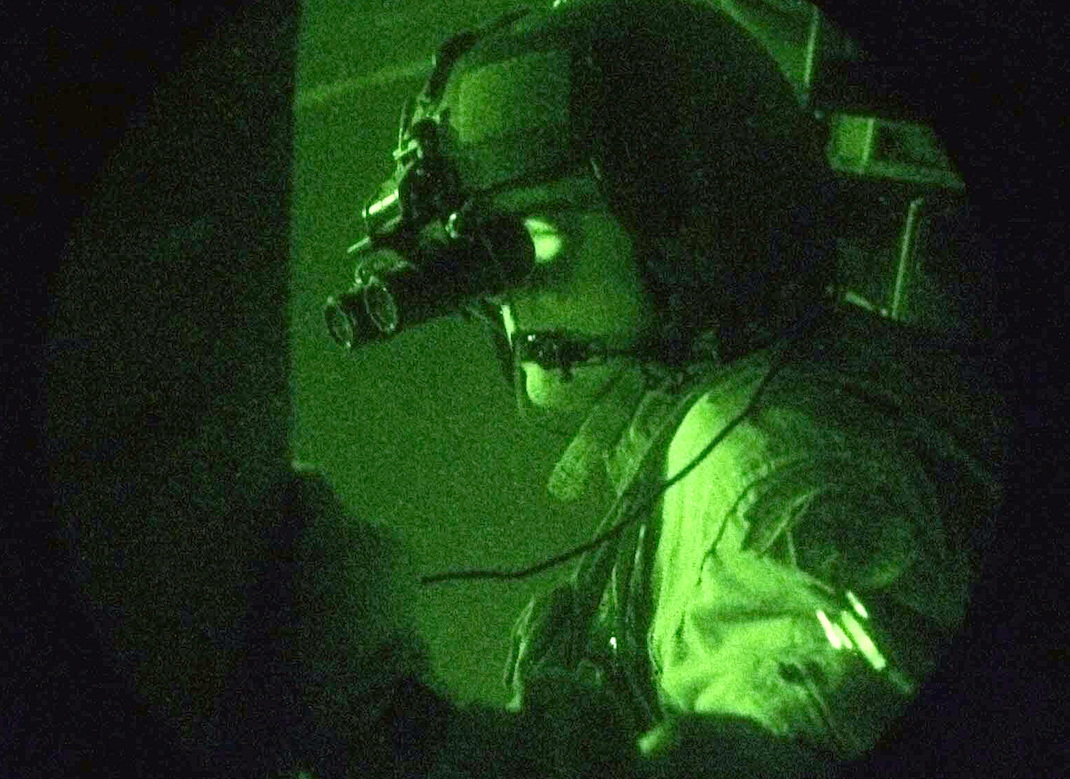
It is truly amazing how NVGs amplify light. But the image — just like with normal binoculars — is a round disk floating in front of your face. And it is so bright the contrast makes everything outside this disk appear solid black. The only exception is the muted interior lights of your instruments — viewed by peering below the eyepieces. Your only reference outside the aircraft is this greenish round image; no wide field of view and no peripheral vision whatsoever.
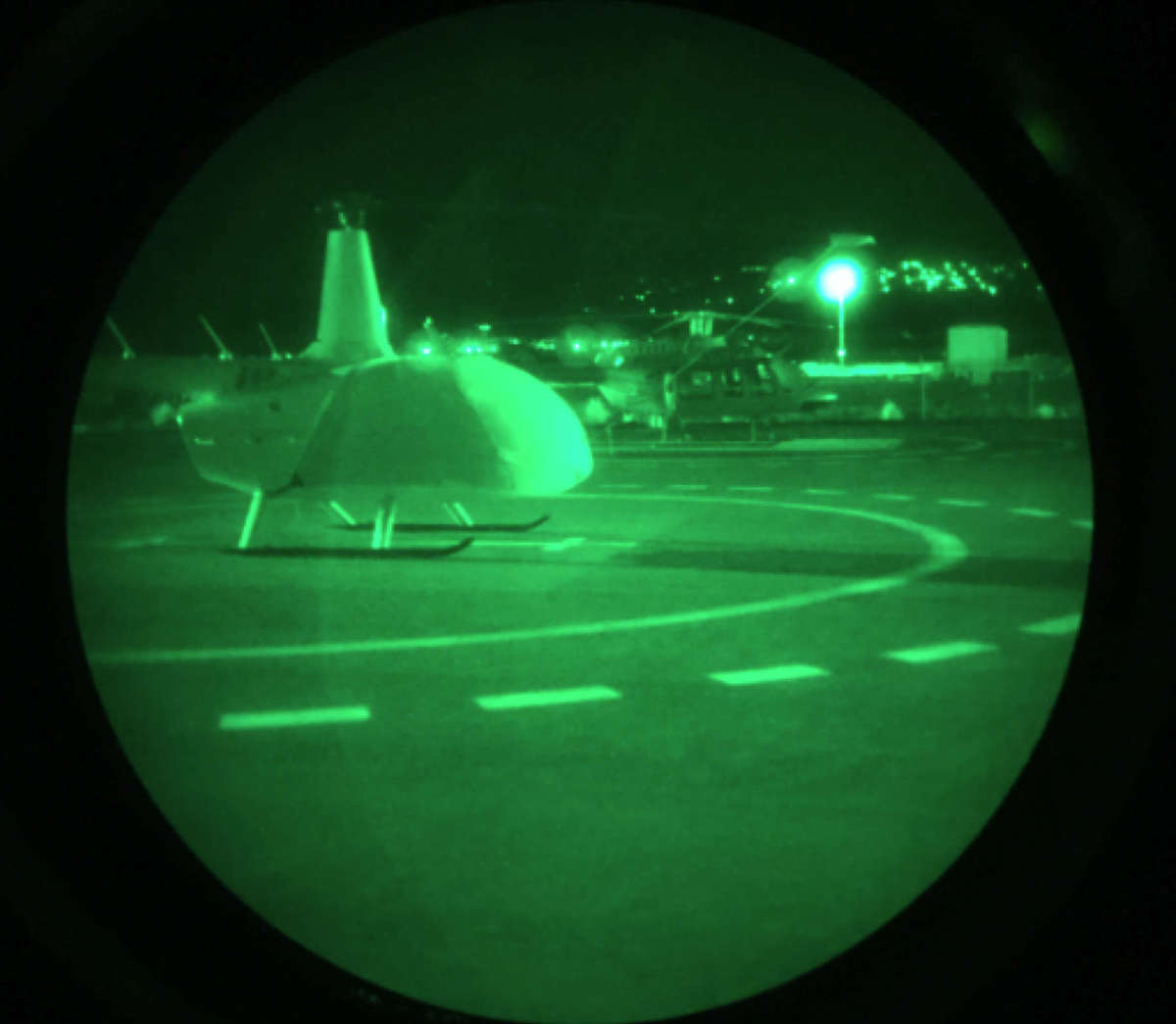
Only very slow head movements work; otherwise you will get disoriented at minimum, with dizziness and vertigo coming next. To compensate (somewhat) for these shortcomings, at least one crew chief with his or her own NVGs is seated on one or both sides of the aircraft. They have M60 machine guns on swivel mounts at their disposal, but they are also the ‘eyes’ to the sides for the pilots. Everyone is on intercom and this allows you to keep your gaze facing forward with only minor (and slow) left and right head movements.
Now that you have an idea of what it’s like to use NVGs, you need to add the critical addition of flight in a powerful, lightly-loaded helicopter — the feeling of inertial (“G”) forces. You are riding in an imaginary ‘super’ elevator that is accelerating upwards so fast while turning that you need to be strapped into a seat bolted to the floor. That greenish disk in front of your eyes is sweeping across the landscape and trees like a flashlight.
Remember that I am in the right seat and currently not on the controls, as the other pilot has taken off in a climbing right turn. His right turn surprised me because the safest way would be for me to do the takeoff, since I was in the right seat and thus had unrestricted viz to the right.
Since we had only one crew chief, and he was seated on the left side of the aircraft, I was our only eyes to the right. So I hazarded an abrupt head turn far to the right — vertigo be damned — because I had a sudden scary feeling we were turning into something solid — like another aircraft.
My view immediately fell on a radio (or TV) tower that was so close I was certain we would hit it!
I smacked the right side of the cyclic (the steering control for helicopters) with my right hand as hard and fast as I could, pushing it all the way to the left stop. There was no time for an explanation to the other pilot. The aircraft rolled forcefully over onto its left side as the tower came into view, including the ladder than ran up through its center. For a brief moment the whole structure appeared stationary and so close it seemed you could leap off the aircraft and grab ahold of it…
I couldn’t see the rotor blades but they were obviously just clear of the tower — parallel to it. If they hadn’t have cleared it…
Miracle #9:
The NVG Sling Load
Another Army Aviation-related miracle on another NVG training mission:
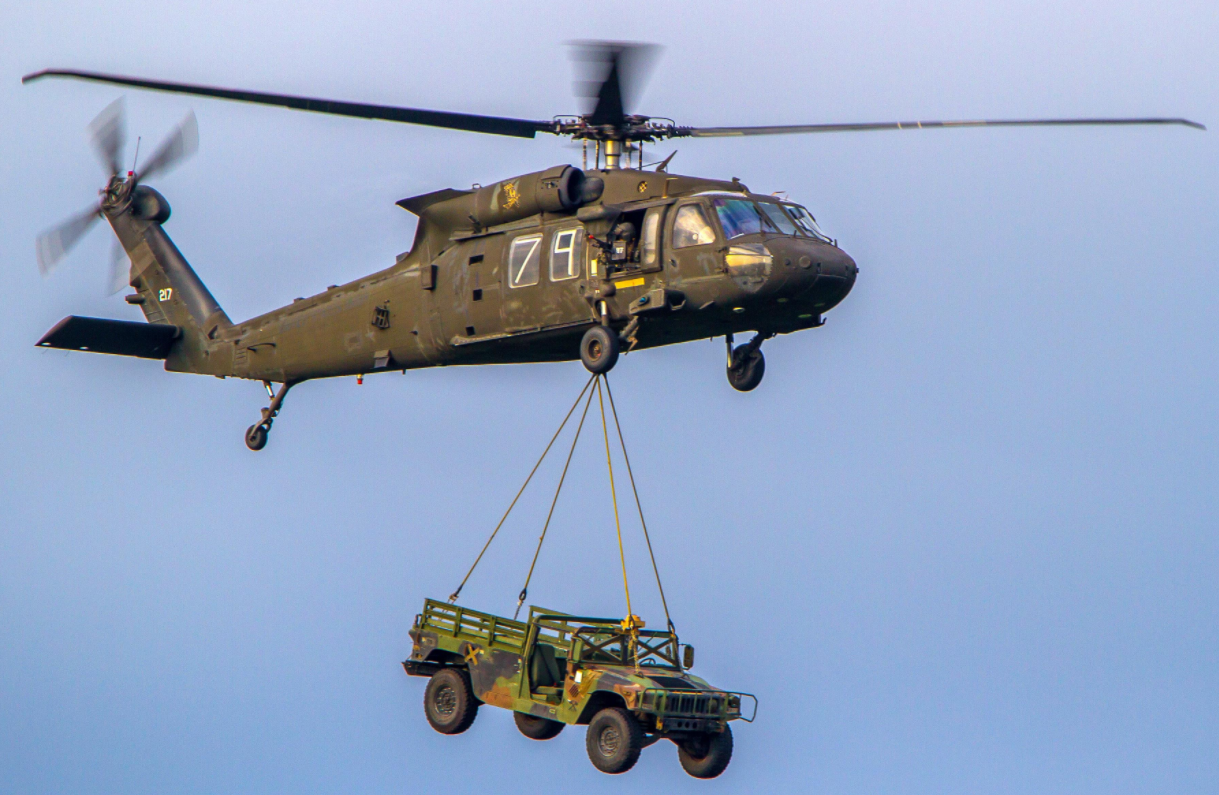
We were sling loading Humvees (term comes from the military acronym “HMMWV” — High Mobility Multi-Purpose Wheeled Vehicle) from one place to another in the foothills along Salinas Valley, California.
The UH-60 Blackhawk (at least the version I flew) had a maximum sling load weight limit of 8000 pounds. The M998 HMMWVs we were sling loading approached that limit with fuel, weapons, etc. This would be the configuration used in a hostile zone.
Sling loads are flown low — 300′ AGL. This minimizes load instability (‘swinging’), exposure to enemy fire, and danger to those on the ground in case it becomes necessary to drop the load for whatever reason (engine issue, excessive swinging).
We had just dropped off a HMMWV and were flying back to the LZ (Landing Zone) to get another. I was on the controls. About halfway back I started having trouble keeping the aircraft flying straight; it would yaw slightly to the left, I’d respond with a subtle rudder (tail rotor) correction to the right, then I would have to correct to the left, and so on. The UH-60 has a marvelous automatic heading control system that makes the job of flying easier. Was that circuit starting to fail, or was I simply over-correcting with the pedals?
Whatever the reason, I thought a second opinion would help, so I asked Tom to take the controls. No sooner had he replied, “I have the controls” than the aircraft started yawing left and right with increasing force and frequency. It soon became violent, so our NVGs became useless.*
*Think of the NVG limitations discussed in the previous ‘miracle’ incident. Imagine that small circle of greenish light sweeping wildly left and right — nothing but a blur accompanied by overwhelming disorientation. Because of this, we both flipped our “nods” (nickname we all used for NVGs) up out of the way (they are mounted on hinges for this purpose) so we could have easier visual access to all the aircraft’s instruments, to say nothing of ridding ourselves of the disorientating visual distraction brought on by the yawing.
While Tom was struggling with the tail rotor pedals in a futile attempt to dampen the yawing, another UH-60 in our squadron was close by and flew over to a position just above and to the side of us. One of its pilots practically shouted on the radio that our number two engine was on fire.
The UH-60 is a two-pilot aircraft because the workload can exceed what a lone pilot can easily handle — especially in an emergency. Therefore it’s the responsibility of the pilot who is not actually flying the aircraft to handle emergencies, or at least help handle them. Since I had handed over the flight controls to Tom, it was my responsibility to try to make sense of this emergency.
The first thing I looked at was both engine instruments — RPMs and temperatures. Right between both engine RPMs is the all-important rotor RPM. If you allow the rotor RPM to degrade below about 80 percent of its normal 100 percent operating RPM in the UH-60, there is insufficient centrifugal force to hold the blades rigidly out and they will start to ‘cone’ upwards while slowing. It becomes unrecoverable very quickly and death is certain at that point.
Thankfully the rotor RPM was not varying much from 100 percent, so OK there. The right engine was supposedly on fire, yet both engines were operating like mirror images of each other: Both were erratically producing power, with RPMs and temps ‘see-sawing’ identically from maximum to minimum.
One of the maxims in aviation is to not make things worse — similar to the doctor’s oath of ‘do no harm.’ This thought was at the forefront of my mind as I tried to stay calm and think clearly while seated in an aircraft that appeared nearly out of control with an excited voice in my headset from an eyewitness warning we were basically on fire.
I recalled in flight school being told — no, hammered into us — that if there is indeed a fire in one of the engines, the throttle handle for that engine will be glowing red — no exceptions.*
*Each handle was made of clear plastic imbedded with redundant red neon lights (probably red LEDs nowadays). These are connected to no less than five photocells in each engine compartment. If any one photocell detects light inside an engine compartment, the corresponding engine throttle handle will glow red. If neither handle is glowing red, there is no fire — don’t be fooled! was the message hammered home.
I did not want to shut down a good engine — which in aviation often turns out to be the ONLY good engine — yet I had an eyewitness insisting our number two engine was on fire…
Crap, what to do? I decided to ignore the issue for the time being because from the moment Tom heard the word “fire,” he started descending. Suddenly the gravity of the situation (no pun intended) hit me like a brick in the head:
We were descending blind in the dark over mountainous terrain from a starting altitude of merely 300 feet AGL!! With a feeling of imminent impact, I hit the switch for the floodlight (‘let there be light!’). The pitch dark was replaced by the blinding light from a several-million candle-power floodlight. And right there just below us — and rising fast — was a huge boulder the size of a SUV on the edge of a steep cliff…
Tom immediately rolled the aircraft away from the cliff face while pulling up on the collective. This arrested our descent but temporarily worsened the yawing. He continued our descent as soon as we cleared the big rock — because in his mind, we were on fire!
We landed maybe ten seconds later on a slope. If my left hand was but a split second slower turning on the floodlight…
Fire?
There was no fire whatsoever in the number two engine. What happened?
A computer failure for the right engine caused excess fuel to be dumped into its combustion chamber, like suddenly flooring the accelerator of a car. The sudden excess torque caused the fuselage to rotate the opposite direction. At this time a protection circuit shut off the fuel flow to keep the engine from blowing apart from excessive RPM, and the fuselage swung back the other direction. This cycle repeated continuously.
So much fuel was intermittently dumped into the number two engine that it was not completely burned. The effect was a long plume of hot fuel ejected from the exhaust. What the well-meaning but mistaken pilot in the other aircraft didn’t realize was that NVGs are very sensitive to not only ‘visual’ light but to otherwise invisible infrared light — heat. If he would’ve thought to flip his nods up, he would’ve seen nothing but darkness.
Miracle #10:
The Night 7-Stack
Another skydiving miracle I almost forgot, this one also at night. But as you’ll see, this was far different than typical close calls related to skydiving.
Not surprisingly, there’s a pattern here with incidents happening mostly at night — jumping related or not.
With some of the same folks who were on the ‘night hoop dive,’ we planned to do a ‘night seven stack.’ In skydiving lingo, a “canopy stack” refers to forming a vertical ‘stack’ of parachutes, each jumper standing (sort of – without weight) on the shoulders of the one below him or her.
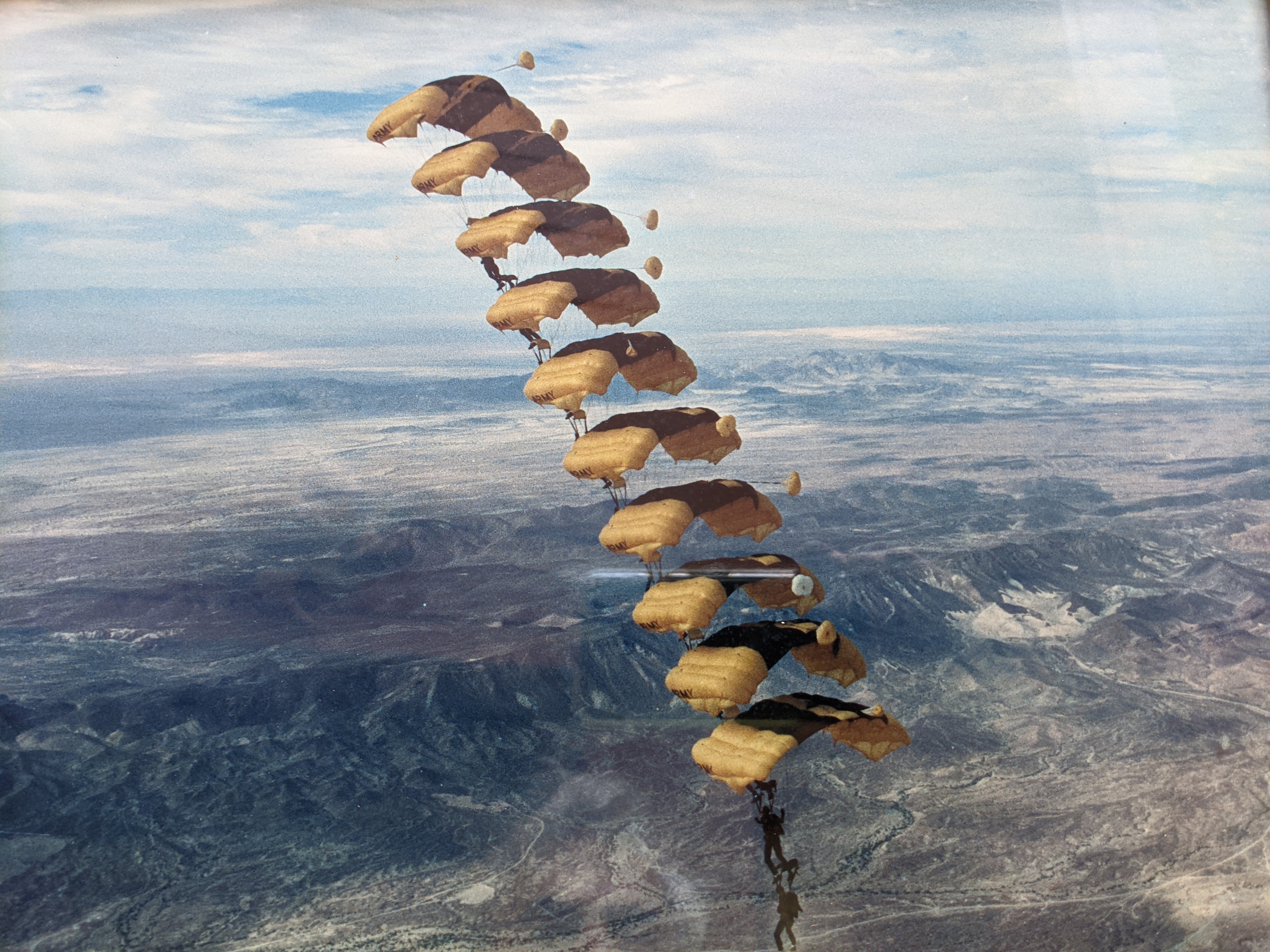
Canopy formations have since been taken to many levels of complexity, such as huge diamond-shaped formations comprised of dozens of parachutes, delicately-connected and flown with precision. A dazzling display of color.
Sport skydivers, apparently, are easily bored. As if the thrill of jumping out of a perfectly good airplane is not enough, we tend to add all sorts of related challenges to our skill sets. Safety is always important, and we most definitely do not have a ‘death wish,’ as I’ve occasionally heard. If anything, we have a ‘life wish,’ and feel most alive when skydiving.
Nevertheless, our exhilarating and insanely fun pursuits can seem incredibly stupid, sometimes even to ourselves. Regardless, the result is an added element of risk — carefully controlled though it may be.
One of the things skydivers like to do is either break skydiving-related records or set new ones. In most cases, nobody on the planet but ourselves really care about these so-called “records,” even if we manage to shoe-horn our way into the Guinness World Records book. In this case, we were going to attempt to set a record for the largest night canopy stack in Virginia. (1981 or 2)
This was to be a “seven stack,” and I was to be number seven. Since stacks are built from the top down, I would be the last jumper to maneuver my parachute up to dock on the sixth jumper (who would already be connected to the fifth jumper, and so on). We jumped from two small aircraft (which were flying in formation) and opened our canopies at around 9000′ AGL — much higher than normal in order to give us extra time to safely assemble the stack.
By about 6000′ I was flying my approach to the sixth jumper, when I started to hear what sounded like a distant train approaching. Suddenly the sound increased to a deafening roar as my parachute’s suspension lines lit up from behind by a bright light. Simultaneously, my steering toggles went completely limp, my parachute collapsed and I spun around, falling away from the six-stack above me.
What happened? I was absolutely bewildered. Eventually I was able to untwist my canopy’s suspension lines and get the parachute to re-inflate. Then the realization hit me: I had just narrowly missed being hit at high speed by one of the aircraft we had jumped from!
The pilot who almost took me out radioed she was certain she had just hit and killed a jumper. While in a diving turn, her windscreen suddenly filled with the image of my parachute and me — lit up by her landing light. The collision had forcefully rocked her aircraft, the distraught pilot exclaimed to anyone who was listening on the CTAF (Common Traffic Advisory Frequency). After landing, she found and hugged me, tearfully relieved she hadn’t actually killed anyone.
I’ll never forget her name — first and last — because that may have been my closest call while jumping. But there had been no actual collision: Her aircraft had encountered my gliding parachute’s vortices (the turbulent eddies behind all wings) — such was our close proximity! This caused her aircraft and my parachute to buffet violently. If she had actually collided with me, it’s unlikely she would’ve survived either.
Miracle #11:
The Fuel Decision
One day early in my flying ‘career,’ a friend and I rented a small airplane — a Cessna 172 — for some sightseeing along the coast. We took off with full tanks of fuel. After a two-hour leisurely and meandering flight, we landed near a beach town, got lunch at a local eatery, then hung out on the beach. With darkness approaching and a realization we had more pressing responsibilities back home, we headed back to the airport.
The airfield’s fuel truck service attendant asked if I wanted fuel, which I declined.*
*At this point, anyone remotely familiar with aviation will recognize where this story is heading. Fuel starvation is, by far, the number one cause of accidents in general aviation. Of course the “cause” is really the pilot’s poor planning, including the decision to continue flight with low fuel, not plan for headwinds, not get fuel in the first place, or in my case — all four.
Getting fuel would just delay us longer and besides, we had roughly three hours of fuel remaining for a ninety minute flight direct.
A familiar aviation aphorism is, “The three most useless things in aviation are air in the fuel tanks, altitude above you, and runway behind you.” Sage words for any pilot.
Another term, “Get-home-itis” is meant to sound like a medical condition. Even the FAA (Federal Aviation Administration) recognizes this deadly ‘syndrome.’ Ignoring otherwise easy-to-avoid dangers in order to get home sooner has probably cost as many lives as some real medical conditions.
As the sun sank low on the horizon, we took off in perfect weather — a cloudless sky with no wind. But after about an hour into the flight, I became concerned when I noticed the runway lights of an airport I expected to have passed long behind us. The fuel to air mixture was already leaned to the max, throttle retarded to slow cruise…
With no GPS it was difficult to determine our progress over the ground, but from looking down at lights below, it appeared we were barely moving. Were we flying into a strong headwind?
I realized I could call the local ATC (Air Traffic Control) for a wind check or have them radar check our progress over the ground (“groundspeed”). This, however, would be tantamount to stopping your car to ask directions, something I avoided doing as well at that time. This aversion to simply asking for help or advice has also spelled the end of many a pilot.
My concern turned to alarm when the aircraft’s fuel gauges indicated low fuel, the needles wavering just above empty. At this point, my ‘brain-in-denial’ reasoning reminded me that these sorts of old gauges were notoriously unreliable; there was probably more fuel than indicated, I hoped.
Nevertheless, our flight time of the return leg was now approaching two hours and thirty minutes. This left only about thirty minutes flight time available — and that’s only if my rough calculations were spot on and the aircraft was actually burning fuel according to the owner’s manual. My buddy was sound asleep, unaware his pilot was an idiot who may get him killed.
We finally arrived over the pitch dark location of our airfield — located solely by fixing its position with the needles of two navigation instruments. But were we actually there? I nervously keyed the radio’s microphone several times (a routine way of turning on the runway lights of small, untended airfields).
With a sigh of relief, I saw the dim lights lining the runway far below. Gosh it looked small — but then I was viewing it from three thousand feet up, not wanting to give up the altitude ’til I knew we were over an airport. After all, I was expecting a “dead stick” gliding landing when the engine quit. I stayed high on the approach, expecting the engine to sputter and stop at any moment.
Phew! What a huge relief to touch down after sweating the last nerve-wracking hour of thinking what could happen…but thankfully didn’t.
After the landing roll I pulled up to a self-serve fuel island on the deserted little airport. (Like rental cars, rental airplanes must be returned with full fuel.) While I pumped fuel, my buddy walked the hundred or so yards to retrieve our car from the parking lot, oblivious to his good fortune.
While he was gone and the fuel was flowing, I reflected on our good luck. Our entire return flight took us over a landscape of tall pine forests. From the cockpit it looked like an endless sea of blackness, broken only by short sections of roads dimly-lit by car headlamps far below. An emergency ‘landing’ at night over this sort of terrain would mean certain death. My thoughts were interrupted by the fuel pump nozzle sensing full fuel and clicking off. Total fuel purchased came to 42.6 gallons.
…The fuel capacity of this C-172 was 43 gallons, with less than that usable.
Note: These last two ‘miracles’ — 11 and 12 — happen to be the only ones where there was an extended period of time — minutes instead of seconds or split seconds — in which I was painfully aware of impending doom. (The low-fuel flight was not near as scary as these last two, even if it was just as dangerous. You’ll see why.) A minute or so does not sound like a long time until you are in a similar situation.
…The only analogy I can think of is being in severe physical pain, when a minute can seem like eternity. Mental anguish, however, can sometimes seem worse than physical pain because at least with most physical pain you realize there will be an end to the pain and you will live.
The human brain goes thru all sorts of ‘gymnastics’ trying to figure its way out of an otherwise fatal situation. When it realizes it is powerless to stop whatever is coming, terror can be the result. As long as you don’t allow the terror to become panic and ‘take over’ your brain, you’ll have a fighting chance, if only a slim one.
Regardless, having so much time to ponder one’s death makes these experiences much worse than otherwise. A sudden “do or die” situation, on the other hand, is where the phrase, “It happened so fast I didn’t have time to worry!” comes from.
Miracle #12:
The First Tow Flight
Another aviation-related ‘miracle,’ this one involving a high-performance hang glider. As I felt you may be tiring of these ‘miracles,’ I was going to ‘cut to the chase’ for this episode, but then remembered a stunning (and hilarious) incident leading up to the ‘miracle’ you’d probably like to hear. Afterwards comes the terror — enough to make me shudder just to think of it.
The Plan
This hang glider flight was to be my first time being towed up from flat ground instead of foot-launching from a hillside, cliff, or mountain. An old ’64 Ford Galaxy 500 was the tow vehicle. Onto its rear was mounted a structure that held the glider in place until the car’s speed reached the glider’s flying speed, at which time the glider should lift up and away from the car.
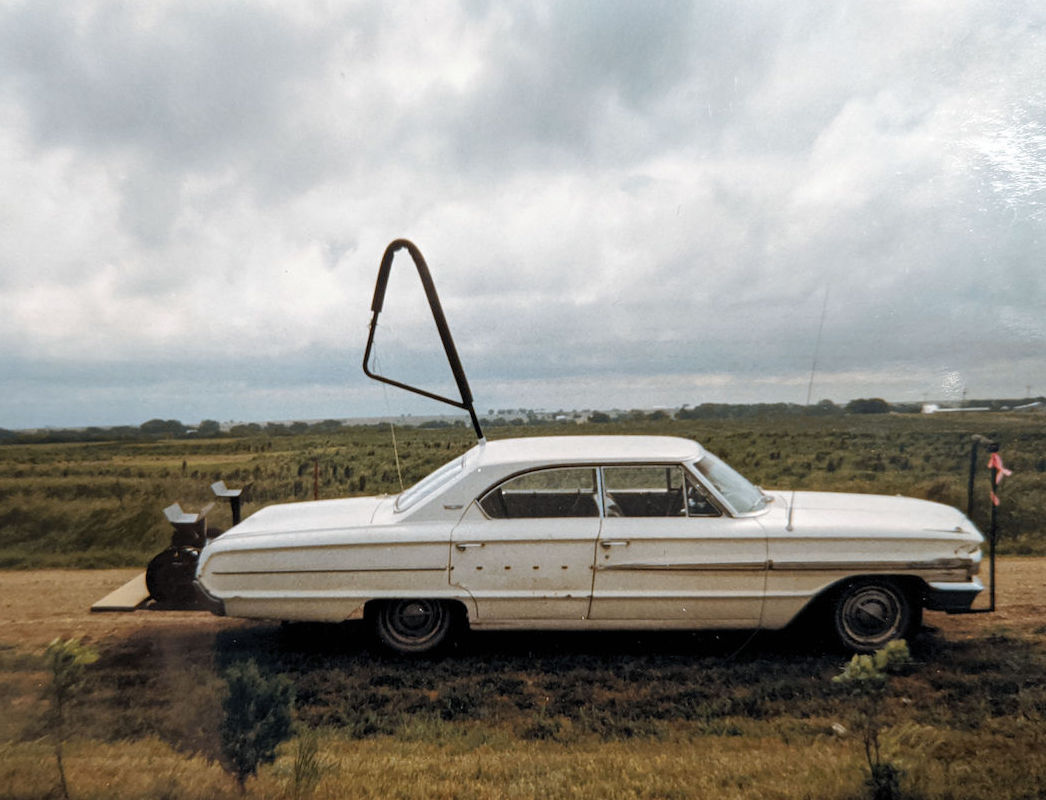
Since I had a hand in modifying the tow system, I was confident in the hardware but nervous about the skill I didn’t yet have for piloting a glider being pulled up like a kite on a string.*
*In this case the “string'” was 3000 feet of .25″ thick polypropylene line wound on a large spool permanently mounted to the car. The end of this tow line would be attached to a quick-release on my harness. Necessary tension was provided by a disc brake on one end of the spool. It was truly a bizarre sight: With a glider mounted on it, the highly-modified car itself appeared poised to fly!
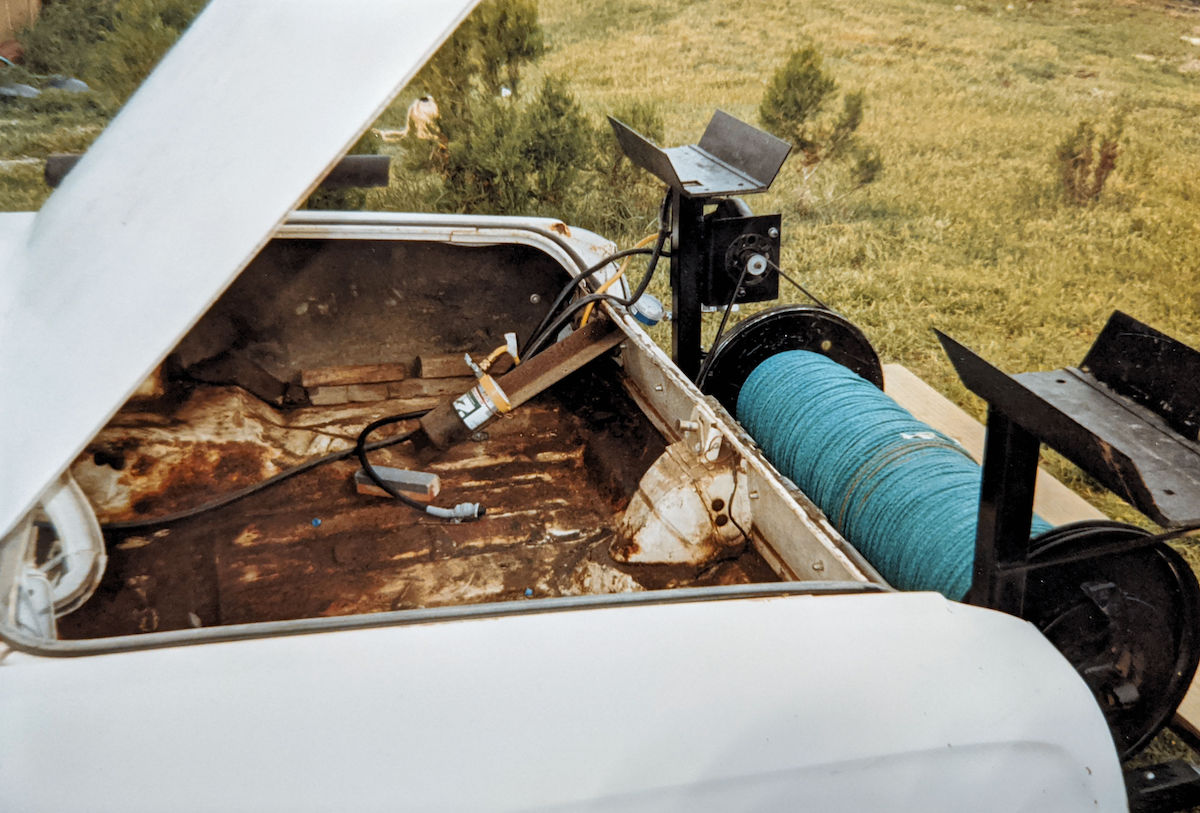
Our ‘runway’ for the tow was literally a runway, but a now-closed WWII-era airport runway. It had disintegrated into a potholed, broken surface dotted with clumps of grass growing everywhere. Maintaining a steady speed would be dicey for my ‘tow pilot’ — the car’s driver. Nevertheless we successfully completed several ‘high speed’ dry runs with me attached to the glider.
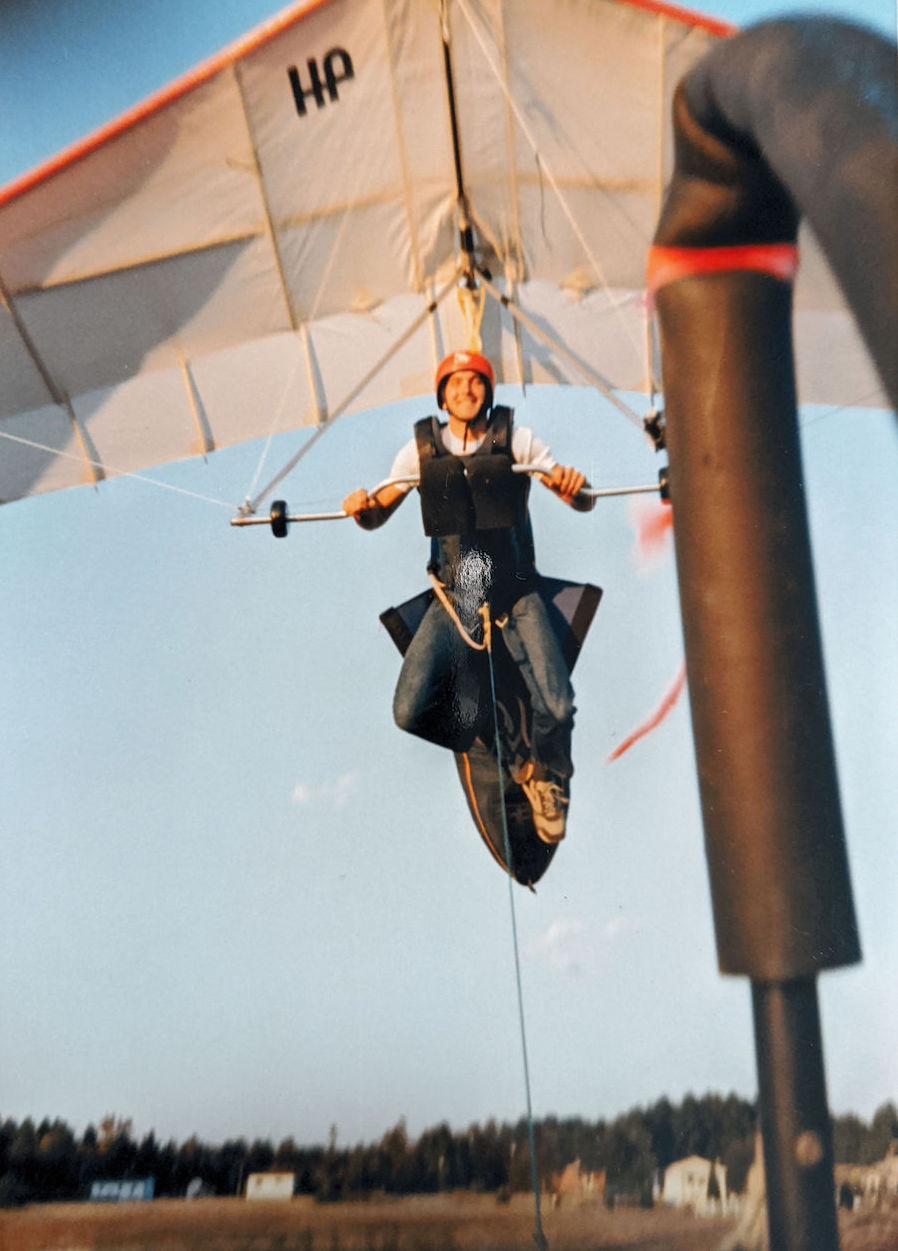
After a few adjustments there was nothing left to do but actually attempt a flight. Surely there was something else needing attention, adjustment — whatever. I dimly realized I was now procrastinating from nervousness. If I was searching for an excuse to cancel this madness, one would arrive shortly:
The Ominous Weather
The sky became increasingly hazy-white — common to the southeast’s hot, humid summers. The problem with this sort of sky is embedded thunderstorms, hidden from view due to the thick, near-fog humidity. My buddy and I stood to the side of the old runway, discussing the weather. It didn’t seem to be getting worse and by golly the flying contraption patiently awaited a willing crew.
I shook off my trepidation and walked towards the car to get my helmet, located on the front seat. Just as my hand was inches from the door handle, a lightning bolt struck the king post of the glider! Rivulets of blue electricity danced along the glider’s wires and metal frame as I staggered backwards, stunned by what had just happened.
The question of whether to attempt a flight was now answered with a definitive “NO.” I was now free to pack up and go home. The release in tension along with the thought I’d nearly been killed — not by a crash but by ‘glider electrocution on the ground’ — hit me like the funniest thing ever. My buddy and I started laughing our heads off 🙂
Then we spent the next ten minutes or so walking around, afraid to be the first to touch the car. But we needed to get the glider off to disassemble it so we could drive home. After some clumsy attempts to ‘ground’ the car with a large stick we found at the treeline, I finally grabbed a door handle. Phew! Nothing happened — I wasn’t electrocuted — we could get going.
With the glider disassembled and secured to the vehicle’s roof rack, we hit the road for home. I vowed to return asap for another try, when conditions were better.
In accident analysis, there’s usually a poor decision from which the fatal event is just a matter of time. In this case, it was when I’d decided to turn the car around to return to the airfield for another go. We’d been driving about fifteen minutes when I’d noticed the sky getting brighter. I could actually see some blue sky in a few places. Besides, except for a tiny hole burnt through one side of the aluminum kingpost, the glider appeared undamaged from the lightning strike.
Finally, the Test Flight
Except for the lightning strike, I rationalized the earlier effort was good training. Now we could really get down to business. The air was dead still, a humid haze hung in the air, but nevertheless an improvement from the earlier trial. Should be perfect conditions for towing, especially for a newbie like me. But just before launch time, a line of clouds had appeared some miles away in the now-clearer skies — a safe distance.
Or so I thought.
I put on my harness and hooked into the glider, connected the polypro line to my harness. Helmet on, altimeter set, variometer* on, spool brake tension set, all systems go! But would everything work as planned?
*Abbreviated as “vario,” it’s an instrument commonly used by sailplane, paraglider, and hang glider pilots alike. It shows if the glider is climbing or descending, simultaneously beeping in accordance with the rate of climb or descent: Increasingly higher pitch for climb, low-pitched for descent. This audible feature allows pilots to keep their eyes ‘on the road’ (outside the aircraft).
As the airspeed indicator (mounted to the front of the car) showed about thirty mph, the glider slowly lifted up, climbing steadily like it was on rails. What a stable, easy-to-fly way to altitude! I was absolutely elated. Everything was working even better than I’d imagined! I was beaming with cocky confidence and pride in my handiwork.
At just over 800′ AGL I pulled the tow line release and was now gliding in silky-smooth, humid air. No soaring on thermals today, but oh well, this was just a first test flight anyway. I turned the glider towards that line of clouds to see what was going on with them…
Wow what a change since I’d looked at them just a few minutes earlier. It had morphed into an ominous-looking squall line!
“A squall line or quasi-linear convective system is a line of thunderstorms forming along or ahead of a cold front. In the early 20th century, the term was used as a synonym for cold front. It contains heavy precipitation, hail, frequent lightning, strong straight-line winds, and possibly tornadoes and waterspouts.” – wikipedia, this page
A Rude Awakening
Thankfully, however, it still appeared far enough away that I’d have plenty of time to land before it was anywhere near overhead. Turning away from the squall line, I focused on flying the glider and getting setup for landing. No sooner had I completed a 180 than I was surprised to see my vario indicating a slight climb. At first I thought this was pretty cool until I realized the only reason for the glider to gain altitude would be convective activity!
Anyone familiar with hang gliding has heard the horror stories of pilots being sucked up into thunderstorms. The outcome is usually not good. Rising vertical wind can easily exceed a hang glider’s ability to descend — even in a dive. The stories of pilots being found frozen to their gliders, covered in a layer of ice — like a big hailstone — were on my mind.
Think of the updrafts necessary to keep balls of ice — hail — from falling until they are too heavy. Now think of a lightweight hang glider wing that is designed to ‘float’ down at only 150 feet per minute with no extra lift from thermals. Some calculations show convective updrafts capable of 100 mph, which is about 8,800 feet per minute!
Death would likely come from hypoxia before freezing, as the tops of the powerful updrafts can reach over fifty thousand feet for big storms. There would also be loss of control and violent tumbling — like a toy balsa wood glider caught in a dust devil. Violent contact with the glider’s frame would be a given.
…I pulled in the control bar to get the nose down for descent. I needed to bleed off altitude to escape what might be a thunderstorm building right overhead! Pulling in would have the added benefit of increasing speed to put more distance between me and the bad weather.
Despite the glider’s nose-down attitude, however, my vario began emitting the high-pitched beeping that accompanies a rapid climb. One glance at the needle showed me climbing at least a thousand feet per minute! (The gauge maxed out at only 1000 feet per minute climb or descent.)
I responded by pulling in the control bar as far as it would go. Since my glider was equipped with a “speed bar,” I was able to get the nose down further than without it. The glider was now pointing steeply down, the sound of rushing wind now louder. But looking at the vario only confirmed its high-pitched beeping:
The glider was still climbing at least a thousand feet per minute, undoubtedly more! One glance at the altimeter confirmed my worst fear: I was now passing 3000 feet AGL, yet just moments ago it read about 800 feet.
I remembered advice from more experienced hang glider pilots warning me to do whatever is necessary to escape before its too late! This included unclipping from the glider and jumping, deploying the emergency parachute. Being an experienced skydiver, I was certainly not afraid of jumping, but to unload the G-forces to accomplish this feat would have me climbing so fast I’d surely be inside the storm in short order — long before I could unclip. (For one thing, I was zipped into a ‘cocoon’ style harness.)
Another important consideration is the danger associated with being suspended under a round parachute that you cannot collapse or otherwise keep from being sucked into the thunderstorm. This is because the suspension lines of glider (and paraglider) emergency parachutes are connected to a single long kevlar bridle line that is attached to your harness. You’d be completely at the mercy of the storm at that point. You could easily be pulled up to unsurvivable altitudes.
If you could manage to ‘jump’ from your glider, you’d have to wait until you were safely below the storm to open your parachute. This would be a crap shoot; open it too early and you die, too late and you die.
The Last Resort
So instead, I did the only other thing I could do, the last option:
I put the glider into a vertical slip. Imagine a glider banked so steeply that the wings are perpendicular to the ground. Similar to the steepest possible turn — a ninety degree bank angle — but maintaining this position without turning. With a high-performance hang glider, this can be accomplished — but only with constant and careful input from the pilot. As you might imagine, the low wing wants to react to the high-speed air by violently lifting up and leveling the wings. This would likely break the glider, fold the wings up.
If you allowed that to happen, you could very well be in the parachute situation I discussed above; suspended in a broken glider, unable to do anything but endure a violent ride to your death, spinning while being sucked rapidly upwards to altitudes incompatible with life.
I had never executed a vertical slip before, yet my very life now depended on me accomplishing just that — and in conditions that were far from ideal. I quickly found that getting the glider into a vertical slip was not as difficult as maintaining it. The glider felt as if a mistake of only a degree or so would require an exponentially-increasing effort to recover. The left wing would instantly snap upwards, breaking the connection between it and the right wing.
The sound of the wind gradually became a deafening roar as I focused on keeping the low wing from grabbing air. There was also the sound of the glider’s stainless steel cables cutting through the air — an eerie, high-pitched “zzzzzzzz…” It became clear at this point my downward airspeed had reached the maximum possible; I sensed an equilibrium — the glider’s terminal velocity for this position — because the buzzing sound from the wires became steady.
Maintaining the slip required intense concentration, but I was literally flying for my life. One benefit is it distracted me from thoughts of doom. I was so absorbed in the effort, the fear subsided somewhat and a bit of confidence returned. At this time I allowed myself a look at the ground below. What I saw was troubling: It was not getting any closer! My thoughts immediately went to the instruments — the altimeter and vario — but I dared not actually look at them, because I truly feared what I might see…
I couldn’t hear anything from the vario — neither the ascent nor the descent alarms — but the wind noise was masking it anyway. Looking at the gauges, however, would be an unambiguous confirmation of death if the vario still indicated a climb. It would be like looking at a death sentence since I was already ‘maxed out’ in the slip and out of options.
The Terror
Instead of looking at the ground or instruments, I decided to look up — ninety degrees to my right. Since I was in a left slip, the view to the right offered an unobstructed view of the sky and storm above me. This was a big mistake, because what I saw is the ‘coup de gras’ that almost put me into a real panic:
Words cannot describe the terrifying yet awesome sight that still haunts me to this day. Perhaps like yourself, I enjoy the thrill of seeing mother nature at her most intense. Although I’m not a “storm chaser,” the occasional sight of dark, forbidding storm clouds always fascinates me. The bottoms are an endless show of breath-taking if not fearsome beauty. In the southeast, there is no shortage of such weather…
But what I saw here took my breath away and ratcheted my fear up ten notches: A roiling, boiling, cauldron of dark grey clouds that looked more like smoke than cloud. It was so close it looked literally less than fifty feet away. It’s size alone — especially this close — was intimidating, to say the least. After all, it covered the entire sky above me. I instantly became aware of my tiny size and felt like a vulnerable little mouse about to be swallowed by a sinister monster trying to suck me into its death smoke. This is no exaggeration. I had never experienced such fear before and haven’t since.
The speed with which the dark bubbling shapes (that defined the bottom of the cloud) moved was like water at a fast boil. To me it demonstrated how violent would be the ‘ride’ inside it. Death would be likely, especially considering what I knew later. All this I took in with several quick glances because I couldn’t afford to lose control of the slip and let the monster win. (I had to return my view to some sweet spot between the ground and the front of the glider, so as to keep the wings perfectly vertical.)
The Standoff
The most troubling aspect of what I saw dawned on me: My position relative to the building storm appeared stationary, despite my successful glider slipping efforts. When this realization hit me, I thought “hell with it, just go ahead and look at the instruments no matter what they might predict.” A sort of detached, grim feeling of resignation swept over me.
With a feeling of dread, I looked directly at the vario. What I saw was disturbing: It alternated between 200 fpm (feet per minute) climb and zero (or level flight). This meant I was literally hanging motionless just below the building storm, yet definitely not motionless relative to the surrounding air (which was probably at least 70 mph or higher — straight from below). At this point it looked like the monster storm was gradually winning this life-or-death tug-o-war.
This standoff of sorts continued for what seemed like thirty minutes, but was likely less than five. I was consumed by fear yet determined to keep the slip going as well as I could. Finally, after what seemed like a ‘miniature eternity,’ the vario started alternating between zero and 200 fpm descent. Progress!
This was later followed by the vario wavering around 300 fpm descent, then 400 fpm. The altimeter confirmed I’d lost a few hundred feet of altitude. I was putting some hard-earned distance between myself and the monstrous storm brewing! But I was not out of the woods yet.
…That moment came when the vario needle showed approximately 500 fpm descent: Suddenly the ‘bottom dropped out.’ The suction from above stopped completely and abruptly. The feeling was like the glider and I were suddenly released in dead air from being suspended by a crane’s cable attached to the right wingtip. This was wind shear at its best.
The ground was coming rapidly upwards as the airspeed from below quickly picked up to ‘normal.’ I was now actually moving straight down at my true airspeed (unknown, but likely between 70 and 80 mph). No time to celebrate, because now my job was to get the glider gradually out of the slip and into level, controlled flight without breaking it apart and causing another emergency I’d be forced to deal with.
Since I’d never been in an extended vertical slip before, I’d never recovered from one either. With the firmest grip on the control bar, I tried to gradually let the wing up while getting a diving turn to the left started. No sooner had I sensed a slowing of the airspeed than the left wing started coming rapidly up no matter what I did to make it gradual. The G-force was so great I was surprised and relieved the glider stayed in one piece. I was alive! I was so relieved at this point that I hardly put any effort into setting up for landing.
After a dicey approach to land in wind gusting to probably forty mph, my friend Bob Hibbard grabbed and hung on to the nose of the glider just as I touched down. The wind was fierce and we could neither move the glider from where I landed nor disassemble it. ‘Miraculously,’ sand bags were a few feet from us that we used to hold the glider’s wings down (after collapsing the ‘control cage’).
There was a big concrete pad with a sturdy steel roof structure about 40 yards away. We drove the tow car onto it and shut the engine off, watching the hail start to come down in bigger and bigger chunks. Just as Bob and I were commenting on how big the hailstones had gotten, a bolt of lightning struck a power company transformer right next to the pad. The concussion from that strike was ear-splitting, with the unexpected secondary explosion of the transformer spiking our adrenaline even further.
We sat there in that old ’64 Ford Galaxy 500, waiting out the huge storm for nearly an hour. The first ten minutes or so I spent giving Bob an adrenaline-fueled play-by-play of my close brush with death. Afterwards I calmed down and we both leaned back in our seats to watch the rest of the show. I used this time to reflect on my good fortune: The hail stones were some of the largest I’ve ever seen. If I had been sucked up into the storm, it’s probable I’d have come tumbling down in a broken glider — maybe miles from here — covered in a layer of ice.
After about fifty minutes, the storm intensity weakened enough for us to retrieve the soaking-wet glider. It had stopped hailing but the hailstones on the ground were still sizable despite the warm air. While disassembling the glider, I noticed the stainless steel side cables (which keep the wings from folding up in flight), had pulled shut the “thimbles” where the cables attach. It would require huge G-forces to do this. Luckily the connections themselves held.
This was a big storm. The next day a local newspaper — the Fayetteville Observer Times — reported a tornado it had spawned. Luckily no one was hurt, including myself 🙂
Miracle #13:
The Bermuda Night Dive
Yet another ‘miracle’ story, this one involving SCUBA diving again (as well as another nighttime incident). By 1995 I had more SCUBA experience, and would never allow myself to enter deep water over-weighted — like I’d done as a ‘kid’ in Miracle #2. Nevertheless I was still fully capable of making poor decisions. Interestingly, I was unaware of one of the biggest mistakes I made for this dive until returning to North Carolina a full week after the incident…
I was staying at the VOQ (Visiting Officers’ Quarters) at the NAS (Naval Air Station) Bermuda, along with my nine teammates from the Army Parachute Team’s competition formation skydiving team (“Golden Knights”). We were on a nine-day training mission, jumping from a C-130 aircraft. The scenery from high above was beautiful, but after making nine jumps on our first day, the aircraft developed a maintenance issue that couldn’t be resolved until our scheduled departure about a week later.
What to do in the meantime? I was just getting ready to turn off the light to sleep after that first day of jumping, when a teammate knocked on my door at five past nine pm. “Charlie, let’s go spearfishing on the reef.” I begged off, but he was persistent, so I finally relented. This was poor decision #1. At least the weather was calm, sky clear and full of stars.
We had permission from the local Navy Seal detachment to get lobsters and whatever else we wanted on the dive. In fact, they gave us access to their recreational SCUBA gear. I didn’t even inspect the set I got, because after all, this was Navy Seal diving gear; it was surely sea worthy, right? (Poor decision #2.)
The Bizarre ‘Drugged’ Hallucination
The plan was to surface swim out to a reef on our snorkels (to save our back-mounted air). From there we’d do some hunting, then return to the beach. Sometime during this swim, breathing through the snorkel felt like trying to breath through a drinking straw while running; I was completely spent and out of breath. This was puzzling because as an avid runner, I knew my cardiovascular fitness level was at least as good as my buddy’s. Yet he was pulling way ahead and hadn’t noticed my sluggish progress.
In an effort to catch my breath, I stopped swimming, put some air in my BC (Buoyancy Compensator), and sat high up in the water. Wow — what was this weird, drugged feeling I was experiencing? It was a sort of hallucinogenic state of confusion, where nothing was normal.
Where was Craig? I did a 360 to look for him, but nothing looked familiar. I wanted to swim back to shore, but where was the shore? The starry sky appeared unbroken from horizon to horizon in all directions. Despite being a short distance — maybe less than a hundred yards — from the beach, I could see nothing but ocean and stars. No lights from the shore, no trees — nothing. It was as if I was in the middle of the ocean.
Worse, my breathing became alarmingly labored, as if there was a heavy weight on my chest; it was becoming harder and harder to expand my lungs to breathe. Was I starting to panic? But why? One thing was clear: I was having a pronounced physical reaction to something, and my mental confusion was becoming an adrenaline-fueled fear. I discarded my speargun and flashlight, unable to do anything but try to survive.
My breathing was now coming in fast ‘sips’ of air, as if its rate matched my elevated heartbeat. I couldn’t take a deep breath no matter how hard I tried — and I was trying very hard to take one long, deep breath at a time. Evidently my diaphragm muscle (which expands your lungs for breathing) was being paralyzed, although I didn’t intellectualize this at the time.
Gear failure
Added to this drama was the fact I could not seem to keep my head above water anymore, despite repeated injections of air into my BC. I was finning as hard as I could to stay afloat. I realized I needed to drop my SCUBA weights asap. I figured what the hell, I’ve already tossed away two other pieces of gear that was loaned by someone I’d never met (flashlight and speargun), what’s one more? I dropped the weights without a second thought.
…Unfortunately, dropping the few pounds of weight (I was wearing no wetsuit) didn’t seem to help.
Fatalities are often the result of a cascade of events, the culmination of several things gone wrong. In this case — aside from my bizarre medical condition — my gear started malfunctioning at the same time the wind was causing whitecaps. My BC had developed a fast leak around some deteriorated material holding a ‘dump valve.’ I was slightly negatively buoyant as a result, and couldn’t use my lungs for positive buoyancy like normal.
Thankfully, about this time I could see Craig’s silhouette against the stars as he stood on the edge of the reef in knee-deep water. He’d clambered up on it in an effort to locate me. When I called out to him he replied, “Charlie – the reef’s over here.” He couldn’t see me and could barely hear me.
I was starting to lose my fight to keep my head above water, and an increasing wind caused small surface waves to break over my head. My BC was worthless. My legs felt like lead, my fin kicks were becoming ineffective as if the water was the consistency of molasses. I was fighting negative buoyancy with nothing but weak fin kicks; my lungs were basically empty of air and of no help, as I was unable to inflate them more than a few percent of their normal capacity.
I realized I could put the regulator in my mouth, but was afraid I’d sink below the surface — as my negative buoyancy would take over — and Craig would be unable to find me. I’d have to wait until he found me first, it was my only chance at survival.
About this time I thought of something which sent me over the edge: I was very close to leaving my three month old daughter without a dad. This — more than anything else — was such a terribly sad thought that it was years before I could tell this story without tearing up.
It’s interesting how many thoughts can race through your mind when under duress. I also thought about how I might be remembered as an irresponsible and reckless father who left his family fatherless because of his selfish pursuits. What was I doing out here at night in this weather anyway? Surely a caring dad would not be here.
When the image of my infant daughter crossed my mind, I yelled “Help!” — which Craig clearly heard, and he dove off the reef in the direction of my voice.
Later he told me he’d thought I was being attacked by a shark. I thanked him for his bravery.
When he reached me, I told him between rasps, “I don’t know what’s happening. I’ve gotten myself into some sort of panic I guess!” — which was a huge understatement of my condition. Then I told him I needed to be towed back to shore and not to expect any help from me.
At this point I could not keep the regulator in my mouth — the forceful but shallow rasps resulting in ‘spitting out’ the regulator. It was pretty scary as l’d slipped into hypoxemia — which is a low oxygen state that will lead to unconsciousness and death (by drowning in my case) if not soon alleviated.
I was in real danger of passing out and drowning with a full tank of air. To Craig’s credit, he repeatedly shouted, “Charlie put the regulator in your mouth!” as he towed me towards shore, holding me from behind by my regulator’s first stage.
It took tremendous self control for me to use both hands — one on top the other — to hold the regulator in my mouth. At the same time I forced myself to relax as much as was physically and mentally possible, and sink just below the surface as I was being towed. My very life depended on my ability to remain calm and stay conscious despite getting very little oxygen for minutes on end.
I still had no idea what was going on. I was fighting to stay conscious from moment-to-moment, second-to-second, which stretched to maybe ten minutes for the whole ordeal. It was taking a hundred percent of my resolve to keep from passing out. My survival depended on maintaining focus. Otherwise Craig would’ve found an unconscious and likely drowned diver when finally reaching the beach.
After what seemed like a ‘miniature eternity’ (similar to the hang glider ‘storm flight’), I felt my body sliding on sand, my regulator now unnecessary. As Craig disconnected me from my gear, he complained about a sharp pain on the surface of his thighs. Perhaps my speargun tip had cut his thighs as he pumped his legs to tow me back, he wondered aloud? But I didn’t have my speargun; I’d discarded it long ago.
I rolled over onto my hands and knees. About that time I started feeling the most intense stinging sensations I’d ever experienced. The pain quickly became indescribably bad, but at least remaining conscious was no longer an issue. I had survived!
Our team leader had also dove with his wife (they had swam to a different area), but they coincidentally emerged at the same time and place as us. When he saw what was going on, I heard him say, “Oh there’s the problem.” The beam of his flashlight shone on the gas-filled bladder of a Portuguese man-war, which was on my tank valve assembly (and first stage of my regulator).
When I saw that, I was instantly relieved — mentally anyway — as now I knew the reason for my ordeal. The stinging pain now made sense too, except I wondered why I hadn’t felt even the slightest stinging sensation while in the water.

The reason for Craig’s pain on his thighs was explained as well; some tentacles had draped under me and onto his legs, his thighs periodically touching them as he swam us both back. Although he had towed me by grasping my tank valve assembly (and regulator first stage) with a bare hand, evidently there were no stinging nematocysts right next to the man-o-war’s gas envelope.
Jellyfish* Paralysis
Unbeknownst to me while early in our surface swim out to the reef, the long tentacles (typically 10 meters and as long as thirty meters) of a Portuguese Man-O-War had become entangled in my SCUBA tank valve assembly, just behind my neck. I had accidentally swam directly into its tentacles, which also wrapped around my neck, right armpit and forearm.
I had no sensation of their presence — except, of course, for the actions of the venom. I did not experience even the slightest stinging — none whatsoever. (I found out why later.)
…So I had no idea I was being continually envenomated by countless tentacles of the man-o-war on very vulnerable, sensitive areas. In retrospect, I’m convinced my psychological reaction to the venom would have been far better if I’d have just known what was causing my delirium. Because not knowing was terrifying by itself. The effect was like someone had slipped you a mind-altering drug laced with a poison that slowly paralyzed your ability to inhale. Definitely a ‘bad trip.’
*The Portuguese man-o-war is actually not a jellyfish, despite its appearance. Man-o-war stings are rarely fatal to humans, but all written accounts I’m aware of describe momentary brushes with the tentacles; other than my own, I’ve yet to see an account of the effects of prolonged contact with its stinging nematocysts around someone’s neck and armpit. Small scars (“welts”) on my neck, right armpit and forearm remained for nearly a year before fading.
I was taken to the base hospital and given oxygen, which helped but was unnecessary at this point. It was suggested I might have anaphylaxis — an allergic reaction to venom of jellyfish or bee stings, making future stings by a bee dangerous. But this was unlikely given I’ve been stung by bees and wasps since with no unusual reactions…
More likely the lymph nodes in my neck and armpit were envenomated, causing a systemic reaction that included paralyzing of the lungs’ diaphragm muscle, cardiac arrhythmia, and shock.
The pain was so excruciating, I could not stop myself from doing something that was totally out of character for me:
I sprang up off the gurney and started pacing madly around the emergency room while shouting, “f–k – f–k – f–k…” They could do nothing about the pain. “Just wait it out, the pain will probably subside by around 2 am or so,” was the unhelpful advice.
Time now was 11 pm. I remember sitting up in bed back in my room at the VOQ, unable to do anything for the pain but try to distract myself with the television. The pain was so bad I would literally ‘pass out’ for a wonderful second or two before being yanked rudely back awake. This cycle went on for an ‘eternity.’
There was a cold white, institutional-looking clock on the wall directly across from my bed. I’d glance at it, hoping the hands would move faster, as I knew it was only time that would alleviate the pain. After what seemed like five or ten minutes since my last time check, I’d glance hopefully at the minute hand, only to find it had moved only one minute or so.
Relief finally arrived at almost exactly 3 am, and I fell asleep soon after. The VOQ happened to be co-located with the base Naval library. The first thing I did when I woke was go into the library to search for any info about the Portuguese man-o-war. I read everything I could and photocopied some of what I found. One of the factoids I noticed was that, for some people, there is no stinging sensation while immersed in salt water. Mystery solved.
The Telling Photo
Upon return to Fort Bragg, North Carolina a week later, I was shocked and amused by a photograph taped to my locker. It was a photo of one of our teammates, Rob, standing next to a prominent sign posted in the sand at the beach from where my ordeal started. It read:
“DANGER! NO SWIMMING ALOWED. THIS AREA
IS KNOWN FOR PORTUGUESE MAN-O-WARS.”
Mistake #3: Not knowing the local info about the water. A daytime recon would have stopped the dive before it started!