Are So-called Miracles Actually ‘Happy Coincidences’ or Deliberate Acts of a God?
Most of us are aware of “miracles” in Holy books, but it’s obviously impossible to know if they actually happened as described. But what about claims of miraculous events today — when practically every man, woman, and child carries a high-res video camera in their pockets?
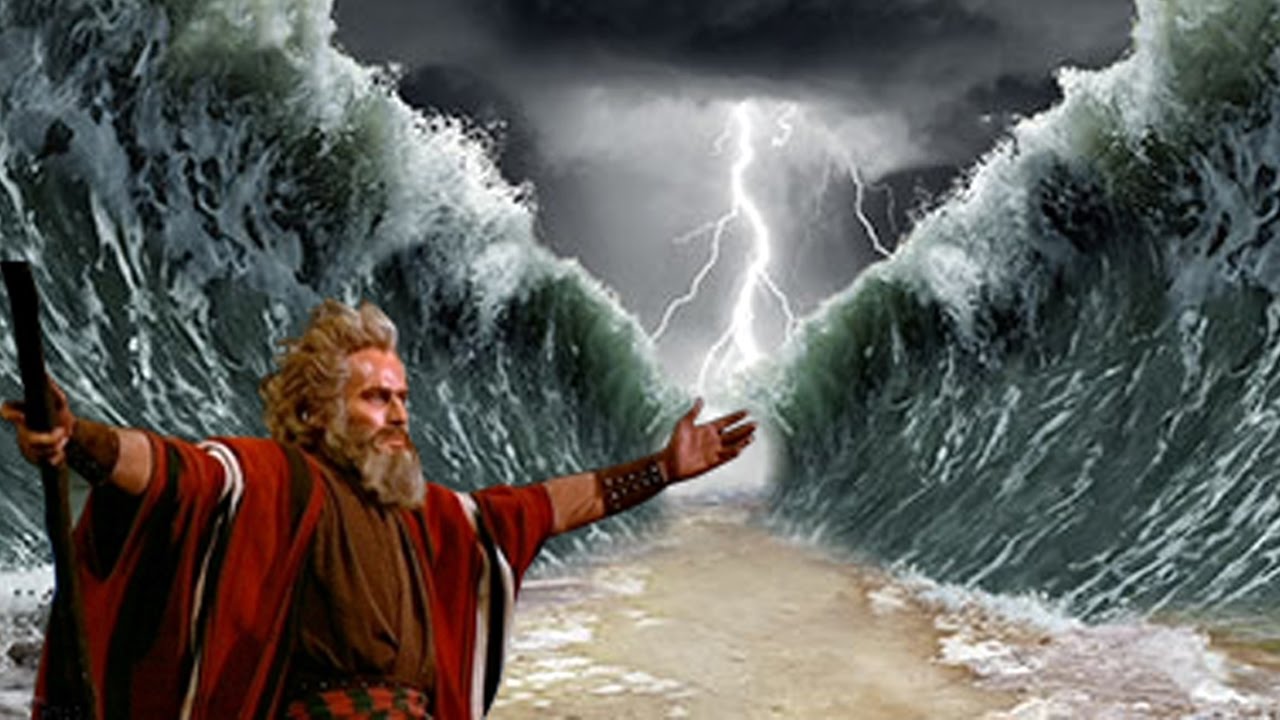
Today’s miracles come in somewhat less grandiose fashion. Nevertheless, what today’s miracles lack in grandiosity, they make up for it in volume:
From the ‘miracle’ of lost keys made ‘findable,’ to people surviving ‘impossible’ odds and everything in between, miracles happen on a daily basis to millions of believers* worldwide.
*People who believe miracles really happen.
mir-a-cle noun
– a surprising and welcome event that is not explicable by natural or scientific laws and is therefore considered to be the work of a divine agency or other supernatural cause.
co-in-ci-dence noun
– a remarkable concurrence of events or circumstances without apparent causal connection.
“The first principle is that you must not fool yourself and you are the easiest person to fool.” – Richard P. Feynman
Do “miracles” really happen? Personally, I don’t depend on miracles, I count on them!*
*You might agree if you read “How Did I Survive?” following this section if you’re interested. It details twelve ‘miraculous’ outcomes of otherwise fatal incidents and accidents I’ve experienced over the years.
Like myself, you might wonder, how did I survive? — after reading it!
Why Me?
Is there a reason for my arguably miraculous survival (without a scratch) of no less than twelve incidents? If there is a God intervening in our lives, was I spared for a reason?
…Seems unlikely, given I’m not a particularly good person — at least not the sort of ‘good’ one might associate with a saint, for example. Although I generally ascribe to the “Golden Rule,” I make sure my wants are addressed while ignoring the needs of others; I buy expensive sporting goods while scores of people in our world and country — including children — are starving.
My wife and I attended a church some years back that was run by a great guy, Pastor John Withem. It was a startup church, with worship services held in the gym of a high school. John was one of those guys you naturally liked. He had no ego, was never ‘preachy,’ and was genuinely dedicated to helping the disenfranchised get on their feet.
John was doing great work getting homeless people off the street and off drugs. But he would go two steps further and get them into jobs that helped them achieve a measure of dignity and sense of purpose. This kept them off the streets, permanently changing their lives for the betterment of mankind. About the time he and his church got rolling, however, he was beset by an aggressive cancer. Despite a brave effort and lots of prayers, John died.
Now, I can’t imagine a scenario where an omnibenevolent Creator of the Universe would see fit to allow someone like John die while saving an agnostic, thrill-seeking sports fanatic like myself twelve times. Surely my agnosticism is at least partly due to crazy incongruities such as this. (Actually, I’m more of a Possibilian.)
Ah, but the Lord works in mysterious ways, I’m told…
Miracles By the Numbers
Perhaps the idea of an irresponsible Creator is not the reason I was spared. It seems we’ve all been the fortunate beneficiaries of a “miracle” at one time or another in our lives, whether it involved a life-or-death scenario or not. It’s likely you have your own ‘miracle story’ to tell — if not about yourself, then about someone you know.
Just this observation alone says something about miracles: They are extremely common. When you run the numbers, you get billions of miracles worldwide each day. This can (and should) be taken as a good thing, but their random nature shows they’re very likely based on the Law of Large Numbers and not on divine intervention.
Heads or Tails? Coin Flips and Rolling Dice Explains Rare Chance Occurrences (certain “Miracles”)
The “Law of Large Numbers” can be explained very simply:
It is just the logical off-shoot of probability, which means in principle that if something is possible, it must happen — if only rarely — given a large enough number of opportunities (chances).
Coin Tosses
Take the flip of a coin, for example. What is the probability the coin toss will land on ‘heads’ or ‘tails’? Since there are only two possibilities, there’s a fifty-fifty chance it will land on either. Simple enough, right? Even if the first five or more tosses result in all heads or all tails, eventually — given enough tosses — the likelihood of heads or tails will average out to fifty percent chance for either.
The math is straightforward: You divide 1 by 2 to get .5 or 50 percent.
Dice Tosses
But the coin toss seems too simple an analogy to explain rare occurrences. So let’s add more chances, such as the roll of any number of dice. Let’s start with just one die:
Since a single die has six sides, there are six opportunities. What are the odds it will land on any particular side? You take 1 and divide it by 6 to get 0.166. So the odds of it landing on a certain side is 0.166 or roughly a 16.7 percent chance the roll of a single die will land on any one side.
Simple, right? Well, the math gets more complex when you start adding more variables. Nevertheless, the Law of Large Numbers is, in principle, nothing more than a toss of many dice that matches a particular sequence. (The “sequence” represents a rare event with odds like “one in a million,” for example.)
The “Birthday Problem”
Perhaps one reason for our reluctance to accept simple math as the real cause of most ‘miracles’ is the math is not so simple. At least on the surface anyway. Another big reason for our reluctance is the real-world results the math predicts are counterintuitive.
Take the “birthday problem,” for example:
Q: How many people are required for greater than fifty percent chance any two will have the same birthday?
A: 23
Q: How many people are required for greater than 99.9 percent chance any two will have the same birthday?
A: 75
This non-intuitive nature of probability mathematics is surely one reason we find it difficult to accept ‘chance’ as the cause of seemingly miraculous events. Yet the math is unerringly true. This page on BetterExplained.com explains it nicely.
You Must Include Everyone, Not Just Yourself
Another reason for this counterintuitive nature is our commonsense yet naive expectation that miracles are isolated events, with no relation to everyone else; that is, we don’t expect our miracle to be just one chance result from a pool of gazillions. Yet the evidence shows this is precisely the case.
Math professor David J. Hand published a book, “The Improbability Principle: Why Coincidences, Miracles, and Rare Events Happen Every Day.” He also created an interesting blog specifically to highlight the unexpected results of probability mathematics…
The headline on his homepage is titled, “The really unusual day would be one where nothing unusual happens…” There’s a section, “Tales of Strange Coincidences” where you can write in your own miracle story. Last check it had 108 entries of ‘miracles.’
But despite the math, there are some events that just seem too orchestrated to attribute to coincidence…
The Prophetic Dream
I’ll never forget a certain early weekday morning in 1973 when I was in the kitchen with my parents, shuffling around in our individual routines. Mom and Dad getting ready for work, me for school — 7th grade.
Mom says (in a distracted, sort of disinterested way), “Your father had a dream last night, and when he woke he was crying.” (Not sobbing with tears, but in the ‘play-acting post-dream state’ you might find yourself upon waking from a particularly engaging dream. Or at least that’s the jest of what they told me when I wanted details.)
Turns out Dad had a gal prior to meeting my mom in college. Gal’s name was Enis, and they had nearly wed. This explains my Mom’s ‘I’d like to forget about this little surprise asap’ aloof attitude. Although nothing specific happened in my Dad’s dream, he “just knew something terrible happened to Enis.”
Later that same day my Dad ran into an old friend from college who said, “Hey John, did you hear about Enis? A train hit her car at a crossing.”
What are the odds of this whole scenario happening?
On the surface, it seems to require several unlikely coincidences:
First there’s the dream itself — as if a ‘supernatural information system’ alerted my Dad that something bad happened to Enis.* Then there’s the coincidence of seeing an old friend on the ‘dream day’ who actually knew Enis. Finally, there’s the coincidence of this friend having knowledge of her death and deciding to share that info with my Dad.
*Although this section is entitled, “The Prophetic Dream,” it’s not clear if my Dad’s dream preceded Enis’s death. Regardless, the story seems incredible.
Coincidence or Miracle?
Common sense tells us it’s too much to chalk up to mere coincidence. For years I was convinced my Dad’s dream was either some sort of paranormal phenomenon yet to be explained by science or divine intervention. Then I learned about probability.
The following italicized paragraphs are excerpts from “Miracle On Probability Street,” authored by Michael Shermer, from the AUG 2004 issue of Scientific American:
“Because I am often introduced as a “professional skeptic,” people feel compelled to challenge me with stories about highly improbable events. The implication is that if I cannot offer a satisfactory natural explanation for that particular event, the general principle of supernaturalism is preserved. A common story is the one about having a dream or thought about the death of a friend or relative and then receiving a phone call five minutes later about the unexpected death of that very person.
In the case of death premonitions, suppose that you know of 10 people a year who die and that you think about each of those people once a year. One year contains 105,120 five-minute intervals during which you might think about each of the 10 people, a probability of one out of 10,512 — certainly an improbable event.
Yet there are 295 million Americans. Assume, for the sake of our calculation, that they think like you. That makes 1/10,512 × 295,000,000 = 28,063 people a year, or 77 people a day for whom this improbable premonition becomes probable.
With the well-known cognitive phenomenon of confirmation bias firmly in force (where we notice the hits and ignore the misses in support of our favorite beliefs), if just a couple of these people recount their miraculous tales in a public forum (next on Oprah!), the paranormal seems vindicated. In fact, they are merely demonstrating the laws of probability writ large.” – Michael Shermer
(Since April 2001, Michael Shermer has written over 200 columns for Scientific American magazine. Two of his TED talks are listed in the top 100 TED talks of all time.)
When it comes to my father’s dream, Michael Shermer’s above explanation would need to also account for a specific thought or dream — not merely thinking about the deceased. In my Dad’s dream he “just knew something terrible happened to Enis.” This adds another layer of coincidence which must also be accounted for when figuring odds.
“I don’t believe in coincidences; everything happens for a reason.”
The above quote about coincidences is one I occasionally hear from otherwise intelligent people. To actually believe there is no such thing as coincidence is to disbelieve in the mathematics that enables the existence of the cell phone in our pockets, the existence of cars, airliners, medical devices, etc.
One of the cool things about science is that it’s true whether we believe in it or not. (I’ve heard Dr. Neil DeGrasse Tyson say this — or some version of this — many times.)
Casinos continue to use probability mathematics to accurately predict long-range payouts. (House always wins in the long run; never the reverse.)
“Statistically “impossible” events are often called miracles. For instance, when three classmates accidentally meet in a different country decades after having left school, they may consider this as “miraculous”. However, a colossal number of events happen every moment on earth; thus extremely unlikely coincidences also happen every moment. Events that are considered “impossible” are therefore not impossible at all — they are just increasingly rare and dependent on the number of individual events. British mathematician J. E. Littlewood suggested that individuals should statistically expect one-in-a-million events (“miracles”) to happen to them at the rate of about one per month. By Littlewood’s definition, seemingly miraculous events are actually commonplace.” – wikipedia from the Law of Truly Large Numbers and Littlewood’s Law
Faith Healing

We’ve all seen television evangelists ‘heal’ random audience members. Whether true healing takes place or whether the audience member was random or a pre-screened participant has always been called into question. That’s because over the years, fraud has been proven to be involved in too many faith-healing events to ignore.
Regardless, we’re always happy for the person ‘healed,’ and it’s hard to imagine someone who would take advantage of innocent people for their own gain (money and fame). But, alas, the inconvenient truth is there seems to be no shortage of TV evangelists who are more than willing to do just that.
Typically, the guy (almost always males) will be miked up, and his assistants (‘accomplices’) — often outfitted with a microphone and earbuds too — help the sick or injured persons from their seats down to his performance area, front and center. He will invariably be a likable, gregarious, smiling religious leader who inspires confidence that there’s nothing he and God cannot do.*
*This is where there’s a big, otherwise obvious problem…
The Fundamental Problem
If you think about the fundamental principle of faith healing, you’ll realize it’s likely a farce. (Except for the placebo effect, which we’ll cover in a moment.)
Faith healing assumes only certain, special humans are able to convince a god to do wonderful things at their request. This only makes sense if you believe your God is absent-minded and unaware of certain sick people until some clever person points it out.*
*This should immediately raise red flags on your ‘BS radar,’ because this would NOT be the way a benevolent, all-knowing deity would act. (This is the same problem with prayer in general.)
Apparently, God cannot perform these so-called miracles without intervention from loud religious leaders. One of the requirements appears to be pushing the sickly person on their forehead (after appropriate appeals to God for help), making them fall into the waiting arms of assistants. Afterwards, the person is deemed healed and eventually sent back to their seat or, better, remains at the front as a potent reminder that your money is being well-spent.
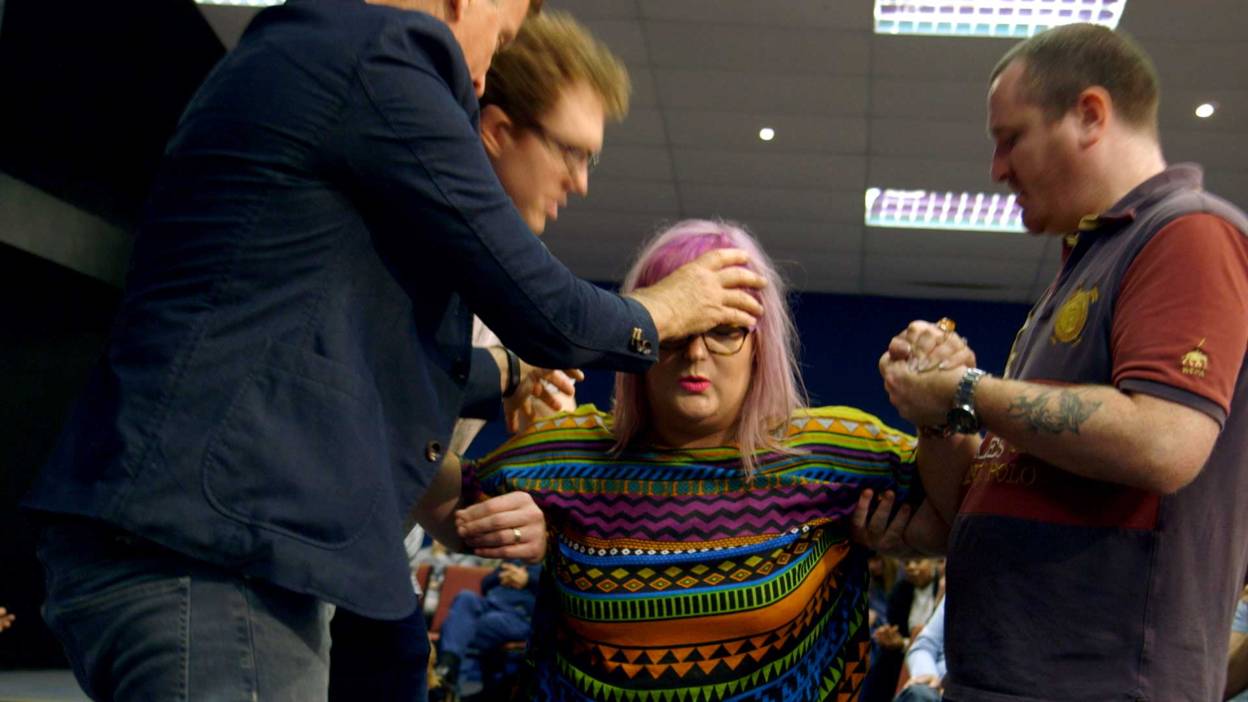
Here’s Emily Yates’ experience as a hopeful audience member of a faith healing event.
The placebo effect should be called “The Awesome Effect.”
placebo effect, noun
pla·ce·bo ef·fect
/pləˈsēbō əˈfekt
“A beneficial effect produced by a placebo drug or treatment, which cannot be attributed to the properties of the placebo itself, and must therefore be due to the patient’s belief in that treatment.” – Google dictionary
We should not be so quick to discount ALL so-called “faith healings” as cleverly designed and executed farces. No, there is an incredible benefit awaiting some folks who truly believe in the power of faith healing. It’s this benefit that’s likely why the practice continues to enjoy limited (very limited — see below) success.
I remember reading someone’s take on the placebo effect I thought was spot-on: The author wrote, “They shouldn’t call it ‘the placebo effect,’ it should be known as ‘the awesome effect’.”
…Because it would be far better to heal yourself by simply having faith a technique works, rather than putting yourself at risk with drugs or medical procedures. And wow! — what a low-cost, low barrier to entry to get these wonderful benefits by simply believing!
Serious Limitations of Faith Healing’s Placebo Effect
“Faith healing” is actually a good description of the placebo effect. Obviously, however, this technique has limitations:
There has never been a limb grown back by faith healing, and nearly all serious diseases and injuries have not been successfully cured by faith healing. Nevertheless, the human brain has the marvelous ability to perform limited but effective cures of all sorts of (so-called) ‘minor’ medical issues.
…What are the limits of ‘healing’ with the placebo effect? Since everyone’s health issues and level of faith are different, it’s likely we can’t know the limits of the placebo effect. But remember the ‘no limbs growing back inability,’ and ponder from there.
The ‘Elephant in the Room’ Problem:
Miracles That Did Not Happen, a.k.a. “Confirmation Bias”
In a perfect world, everyone would patiently wait until all sides of an argument were fairly examined before arriving at a conclusion — however minor or major the issue would be. In this fantasy-perfect world, only the evidence that best explains something would win out. Personal wishes, hopes, and desires would be suppressed and ignored.
We’re all prone to confirmation bias, each and every one of us. After all, we’re human. We ‘count the hits while ignoring the misses.’ We almost never allow ourselves to be coerced by nagging disconfirming evidence. And we especially will not tolerate someone else trying to force their opinion on us. (This is so annoying we will argue our point even if we suspect the obnoxious antagonist is actually correct.)
It’s completely natural. We all do it. The only exception is when we (rarely) purposefully suppress our biases for whatever reason. Judges (good ones anyway), for example, routinely put their personal biases aside when they step up to the bench. The rest of us, however, operate like a monarchy — especially when we’re confronted by a challenge to our cherished beliefs.
Unanswered prayers are rationalized away or ignored. You hear about only the prayers that appear to have been granted or happy coincidences that seem too good to be from chance alone.
So it’s not surprising we automatically ignore anything that goes against our cherished beliefs. We completely ignore miracles that did not happen!*
*Real life examples include victims of the Holocaust, soldiers who can’t return home, murder victims, cancer patients who die after a long, painful fight despite the earnest prayers of dozens of their friends, etc, etc, ad nauseam. (Read “Does Prayer Really Work?”)
Can We Still Be Happy Despite Having Limited Control Over Reality?
As noted in “Does Prayer Really Work?” we are accustomed to having lots of control over our world and our lives. We can make or get shelter, food, clothing, etc. Modern medicine and education about our bodies and our environment have extended life expectancies far beyond average lifespans of just a few decades ago.
We’ve created large-scale industrial automation that enables 40 hour work weeks with weeks-long vacations. And this just scratches the surface of what we’ve already accomplished. As a species, we’ve been quite successful in making our lives simpler, healthier, and more enjoyable.
Heck, we’ve even been to the moon several times and are planning trips to Mars. It’s easy to imagine there are no limits to what we can do!
Yet some areas of our lives will remain impossible to completely control or eliminate — such as diseases, aging, death, accidents, weather, earthquakes, etc.
…The ancient Romans created Gods (or adapted them from the Greeks) to address these very same otherwise uncontrollable issues that continue to dog us to this day.
For example, they concocted Poseidon — God of the Seas and storms — to help with safe passage across an ocean. After all, it was far easier to appeal to a personality than to the uncaring and uncontrollable weather. (Poseidon was also responsible for controlling earthquakes and horses as well.)
The Romans also created eleven other Gods to deal with everything from war to fertility and art. Like modern-day humans, they needed a way to control — if only in their minds — frightening areas of reality they’d otherwise be helpless to control.
Is this a universal human psychological need? (Invent Gods to help us control areas of reality we’re otherwise unable — such as death, diseases, weather, etc.)
Why so many Gods?
Why not have just one God who controls everything? Enter the God of Abraham. Muslims, Christians, and Jews are followers of the most popular religions, whose believers enjoy the convenience of one ‘God of Everything’; a personality who can be appealed to for all those areas of life for which we would otherwise have no control.
This commonsense observation does not mean that man has always created Gods. It could just be a coincidence. 😉