…And What Does It Mean for Us?
Introduction
It is something we never have enough of. It regulates every waking moment and even some dreams. It is something we absolutely cannot ignore. It is arguably the most valuable commodity on Earth. To say that time rules our very existence would not be an exaggeration. But exactly what is this “something” we call “time?”
time / noun / “The indefinite continued progress of existence and events in the past, present, and future regarded as a whole.”
– Oxford’s online dictionary
Great, except like most definitions of time, it uses concepts of time to define time. Words like, “past, present, future, duration, or measurement” assume an understanding of time to begin with.*
*Even this sentence uses the concept of time: “…to begin with.”
Dictionary definitions say nothing about the fundamental nature of time. Are we making “time” more complex than it really is? One thing is crystal clear: Time is not only a fundamental part of our reality but also the most valuable. One might understandably conclude any effort to ‘deconstruct’ time is a waste of….time…
After all, time comes in a limited quantity for every creature. When people pay enormous medical bills to endure last-ditch efforts to repair themselves or loved ones – such as transplants or experimental cancer treatments – what they are really paying for is more time.
Time’s priceless value is surely one reason the subject has maintained a grip on our imaginations since time immemorial. For four full days in June, 2016, about sixty distinguished theoretical physicists from around the world gathered together at the Perimeter Institute for Theoretical Physics in Ontario, Canada to debate the physics of time.
The conference produced no new information. The exceptional participants departed just as confused as when they arrived. So far, modern science’s ideas about (the fundamental nature of) time are really no better than yours. But this last statement assumes you’re familiar with the basic physics of time (as understood since 1927) to start with.
We’ll catch you up on that and much more.
Onward…
Measurement of Time
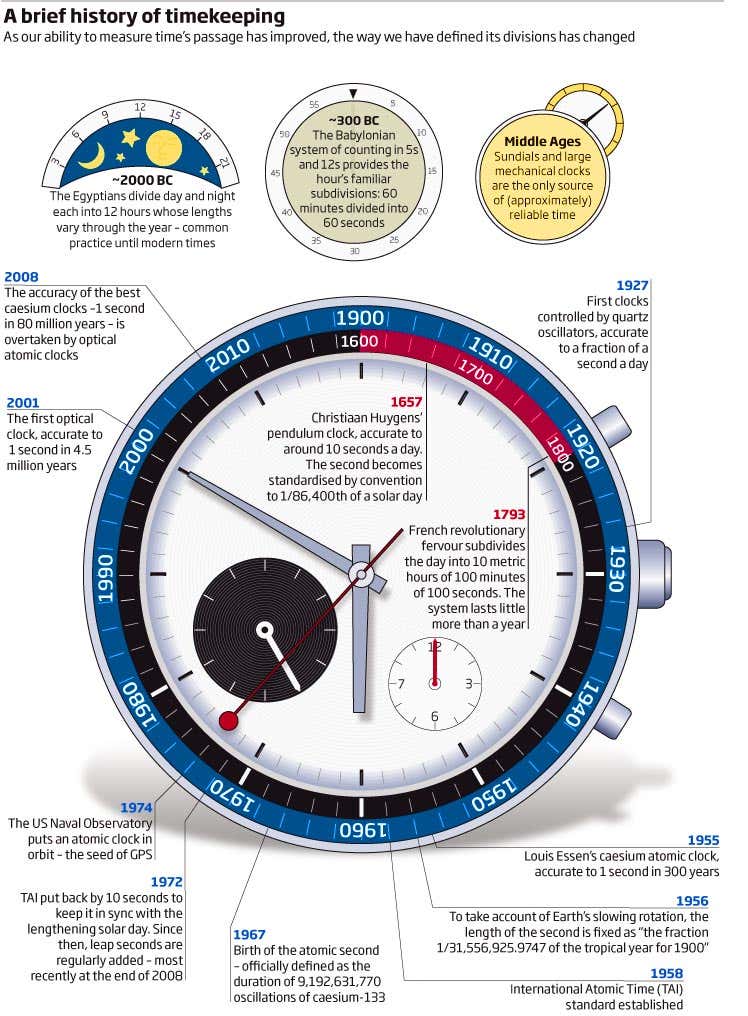
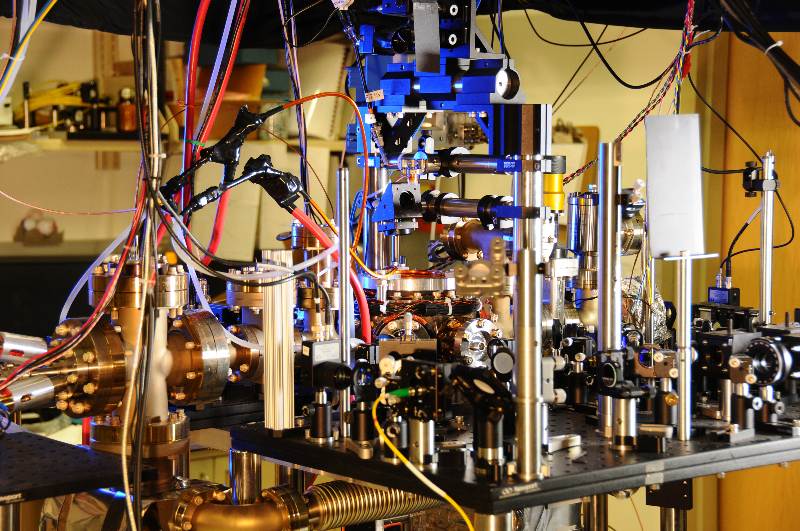
At least we DO know how to measure time, and we’ve gotten really good at it: From an accuracy of roughly two minutes per day for the best sundials of ancient times to a mind-blowing accuracy of one second per fifteen billion years for the latest atomic clock! (One reason this precision is so astounding is because our Universe is ‘only’ about 13.8 billion years old.)
But while our scientists can pat themselves on their backs for this amazing achievement in clockmaking, they cannot agree on the exact nature of time. Perhaps this should not concern us, because it is obvious we could never have any control over it.
Nevertheless the subject remains irresistibly fascinating. Does time exist in a perfect vacuum? Is there such thing as a “perfect vacuum?” Is time travel even possible? Could biological aging be stopped or reversed? Could we ever hope to exploit cosmological ‘shortcuts’ across spacetime – such as wormholes – to escape a problematic Earth?
…We may not ever know the answers to these and other questions with confident certainty – at least in our lifetimes. But recent insights into the nature of time may be on the right track.
The Arrow of Time
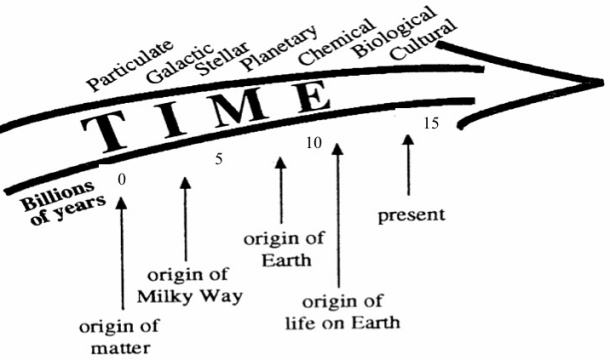
The fact that time always ‘flows’ from past through present to future is so obvious we take it for granted. Yesterday is gone forever and tomorrow is just an expectation, a ‘dream.’ All we really have is the present moment. Physicists refer to this ‘one-way’ direction as “the arrow of time,” a phrase first coined in 1927 by British astronomer, Sir Arthur Eddington.
So why do the immutable laws of physics treat time as non-directional (or time-symmetric)? In other words, the underlying laws of physics consider the past no different than the future; there is no arrow of time according to firmly-established physics. What does this otherwise conflicting aspect of time mean?
Turns out there is no conflict after all: Because the classical view is the Arrow of Time is not really a physical law but more a statistical principle. (Easy examples in a moment.) It IS, however, based on an established, immutable law of physics – the Second Law of Thermodynamics (a.k.a. the Thermodynamic Arrow of Time) – which says the total entropy of the Universe has continued to increase since the Big Bang and will continue indefinitely.
…There is compelling new information, however, that suggests entropy could be merely a side-effect of a more fundamental reason for time’s arrow. Also, new research suggests the underlying laws of physics are NOT time symmetric after all. More on these discoveries soon, but for now it’s important to learn a bit about entropy, because it’s certainly a ubiquitous reality throughout our world and Universe — side-effect or not.
Entropy
In order to understand the classical reasoning behind time’s “arrow,” you must understand entropy. It has been the standard explanation since the early twentieth century and is a fairly straightforward concept stemming from the Thermodynamic Arrow of Time.
Entropy is often defined as the tendency for everything to deteriorate from an orderly state to disorder — from lower to higher entropy. But a better description is that a closed ‘system’* will always ‘seek’ the maximum number of ways to arrange itself. Physicists prefer to say that a system will always seek the maximum number of microstates.
*The Universe is the ultimate example of a “closed system.” An open system would be like a campfire, which is open to the atmosphere, heating the air molecules and so forth. The Universe, however, cannot interact with anything because it is, by definition, ‘everything that exists, considered as a whole’; it has nothing external it could interact with.
For example, imagine a perfectly-ordered arrangement of propane gas molecules in the corner of an enclosed room. Over time — as you would expect — the molecules would spread out into the room, ultimately becoming randomly-scattered. You would smell propane gas after a while.
The reason a ‘system’ seeks the maximum number of “microstates” is stability: The more microstates (or arrangements) a system’s parts are in, the more stable it is. The propane molecules — being in an enclosed room — are a “system” and are more stable spread out randomly in the air of the room.
So perhaps a more accurate definition of entropy may be worded as, “Entropy will always increase in a system because it is most stable when it is in the maximum number of random arrangements.”
But how does this relate to time — specifically, the arrow of time?
Entropy and Time’s Arrow
Odds are the propane molecules would not ever rearrange themselves back into the corner of the room. There is no law of classical physics, however, that prevents this from happening. It’s just the odds are vanishingly scant on this ever occurring.
Another example:
If you tossed a few hundred loose pages of a book into the air in an enclosed room, they would be scattered all over the place, right? Would it even be possible for the pages to settle on top of one another — perfectly lined up in the correct order — page 1 thru 300? Absolutely! Likely? Absolutely not!
…Specifically, there is only one way for the pages to land in the correct order but countless ways for them to land askew and out of order. So there is no law of physics saying the pages could not land perfectly-stacked in the correct order. It’s just highly unlikely because of the huge difference in probabilities; it is far more probable the pages (“system”) would ‘seek’ any one of the other gazillions of random arrangements (“microstates”), rather than the only one that would result in the ordered arrangement.
If you could do the math to determine how many throws of the ordered pages into the air would finally result in them landing back into a perfectly-ordered stack, you may end up with a number like “one throw out of 10^100 throws” — which would take far longer than the current age of the Universe to achieve. Although this would make it an impossible feat to actually test, it would not be an impossible feat in principle.
The overwhelming odds favoring this tendency is called “entropy” in physics — specifically higher entropy — but could just as easily be called, “The Arrow of Time.” The Second Law of Thermodynamics says the (overall*) entropy of the Universe will always increase with time.
*Locally, however, entropy can and does routinely decrease for some things, becoming more ordered and complex. But this is temporary. For example, all forms of life are temporarily more organized and complex, but produce waste heat from burning oxygen and through other metabolic processes, including decomposition after death. This waste heat contributes to the Universe’s higher entropy over time.
Our Expanding, Cooling Universe
All actions, processes, machines, and life produce waste heat – however slight. There are cleverly-engineered machines that recapture much of the waste heat generated in order to re-purpose that energy, thus reducing waste heat and saving energy.
But it is impossible to recapture or re-purpose 100% of the waste heat generated by a process, action, machine, or life. This waste heat simply leaks into the atmosphere and, ultimately, contributes to the increasing entropy of the Universe.
Waste heat and entropy result from the Laws of Thermodynamics. Heat always ‘flows’ into cooler areas, never the reverse:
When a floating ice cube melts in a glass of water, the colder ice does not ‘lose its cold’ to the liquid; instead, the warmer water surrounding the cube loses heat to the ice, melting the cube and cooling the water…
This ‘one-way’ process of heat dissipation happens all over the Universe and to the Universe itself. The Universe was once extremely small and hot until the Big Bang, when it expanded from a tiny, ordered state to universe-size in a very short time, cooling as it expanded.
We can see this cosmological evolution with our very eyes – from lower to higher entropy – through telescopes. In fact, we can see the first galaxies formed not long after the Big Bang. The Universe is expanding and cooling at the same time that, locally, entropy temporarily decreases – but at the expense of waste heat. This waste heat ensures the overall entropy always increases in the Universe with the passage of time.
Summary of the Classical “Entropy” Reasoning for Time’s Arrow
So according to the classical reasoning for time’s arrow, things have happened and will continue to happen in a certain order (past – present – future) due to the high probability of them happening the way they do — which is the tendency always towards higher entropy.
…In other words, the past, present, and future are caused by the overwhelming odds of everything ‘seeking’ as many random arrangements as possible. What has happened cannot be undone, probabilistically speaking.*
*If you think it’s nuts to say time’s ‘arrow’ can be at least partially attributed to probabilities, remember these two points: 1. Perhaps time itself is time’s ‘arrow’ (entropy). 2. Casinos are built on probability mathematics, and can precisely predict long term revenue. (House always wins in the long run as mathematically planned — never the reverse.)
So there you have it: The classic ‘go-to’ explanation for why the past comes before the present, which precedes the future — time’s “arrow.” The past cannot be revisited or changed because it would be far too difficult (“practically” impossible) to ‘undo’ everything — reversing every action and process the Universe over…
Would this also require reversing the expansion of the Universe (which would be impossible to effect)?
What is the REAL Reason for Time’s Arrow?
If the ‘increasing entropy’ reasoning for time’s arrow seems somewhat incomplete to you, you’re not alone…
One commonsense cause behind time’s arrow is that the expansion of the Universe itself from a starting point causes time’s direction. In fact, it was soon after Georges Lemaitre theorized in 1927 that the Universe was expanding — observationally verified by Edwin Hubble two years later — that the Big Bang Theory was developed:
If something is expanding, obviously it must have been smaller in the past. Taken to its logical conclusion, the Universe must have started at a single point.
Just the fact the Universe had a beginning means time flowed ‘forward’ (or ‘outward’) into what we call “the future.” According to Richard A. Muller, this expansion may actually create the future.
To clearly see how this is a fundamental reason (with increasing entropy a ‘side-effect’) for time’s arrow, imagine a fictional universe that is static and eternal:
There was no beginning — no Big Bang — and no accelerating expansion of spacetime and resulting higher entropy. If this were the case, time would indeed be symmetrical; there would be no direction, no arrow of time — no past, present, and future. There could be no evolution of the Universe from young to old.
Stephen Hawking once noted the arrow of time in our Universe (unlike a static universe in the above example) — this moving from lower to higher entropy in our expanding Universe — is a requirement for our existence, for life in general. It’s easy to agree with him because we’re here now in precisely that sort of Universe.
One might understandably conclude our fictional static Universe — with no past and future — would have only the “present,” but it would be a ‘frozen now.’ It would be meaningless because without the past and future, the present moment would be nonsensical. There could be no energy created (locally) like it is in our expanding Universe, no entropy and heat dissipation to maintain time’s arrow, and no birth-life-death for macroscopic life.
“How can the past and future be, when the past no longer is, and the future is not yet? As for the present, if it were always present and never moved on to become the past, it would not be time, but eternity.”
― Augustine of Hippo, Confessions
A static Universe could not evolve and grow, and neither could life. Time would be non-existent. A static Universe appears to be an impossibility, unless an idea like the “Big Crunch” is true — when there would be a brief period between expansion and contraction of temporary stasis.
Entropy, in this view, seems to be merely a corollary of the expansion of the Universe.
A snapshot of the Universe is an unrealistic rendition of the Universe in the same way a camera snapshot of you is an unrealistic version of you: You are always breathing, moving, thinking, doing, and aging; you’re not a static, still creature.
An Expanding Universe Means “Spacetime” – Space and Time – Are Being Continually Created, Right?
This otherwise commonsense conclusion is actually not quite correct, according to physicists:
Although it does indeed appear that all matter (the finite amount of everything ‘in’ the Universe) is becoming ever more diffuse with the expansion of the Universe, space itself could be a finite feature that is being “stretched” like a balloon. But even this analogy is not precisely correct for several confusing but well-established reasons we won’t go into here. (Besides, this level of understanding does little to help our grasp of time’s nature.)
…The bottom line — as far as time is concerned — is that without an accelerating expansion of the Universe, the arrow of time would not exist (known to us as simply, “time.”) Therefore, time is known as the fourth dimension, a ubiquitous part of our Universe, which makes it an ongoing ‘objective’ reality for all creatures. Even when you are sitting still, you are literally moving thru time as the Universe expands.
So perhaps the base reason for time’s arrow is simply the fact our Universe had a beginning and has been expanding ever since. It’s an intuitive cause of time’s arrow at macroscopic scales.
But what about the ‘microscopic’ cause of time’s arrow – the most fundamental cause?
Can Time’s Arrow Be Traced To a Quantum Source?
In 1988, Seth Lloyd (now a professor at MIT), presented his doctoral thesis that suggested quantum entanglement as the true source of the arrow of time. More recently, a group of physicists developed a theory that corroborates Seth’s earlier work, and other independent research has done so as well.
This article in Quantamagazine by Natalie Wolchover does a great job explaining the bread crumb trail leading to the current theories. Here’s the general idea in a nutshell:
The ‘microscopic reason’ a hot cup of coffee cools to room temperature (or “equilibrates” with the surrounding air) is because the subatomic particles comprising the coffee become “entangled” with the subatomic particles of the surrounding air.
When this happens, the coffee (subatomic) particles gradually lose their individuality (unique spin directions, for example) as they become more and more correlated with the room air particles they are entangled with. Eventually, each coffee and its entangled room particle are indistinguishable, from a quantum information standpoint:
“Finally, we can understand why a cup of coffee equilibrates in a room,” said Tony Short, a quantum physicist at Bristol. “Entanglement builds up between the state of the coffee cup and the state of the room.”
“What’s really going on is things are becoming more correlated with each other,” Seth Lloyd recalls realizing. “The arrow of time is an arrow of increasing correlations.” – (Quotes from Natalie Wolchover’s article mentioned above.)
In 2012, the BABAR collaboration of physicists published what might have been a Nobel Prize-worthy paper: Clear proof that the underlying laws of physics (at a quantum level) are NOT identical whether time runs forwards or backwards (“time reversal invariant”). An article posted July 09, 2019 on Medium by Ethan Siegel thoroughly covers the highlights of the work leading to their amazing findings.
…According to Ethan Siegel, the reason their work went mostly unnoticed was because the discovery of the Higgs boson at the same time overshadowed their accomplishment.
So it appears we may be on track to nailing down the precise macroscopic and microscopic causes of time’s arrow.
“Great!” you say. “But what is time itself?”
Does Time Exist Independently of the Universe, Or Is Time an Emergent Property?
Arriving at a consensus on this question was one of the primary objectives of the Perimeter Institute conference in Ontario, mentioned in the introduction. If around sixty distinguished physicists from around the world could not agree on the answer(s) to this question, it would seem overly ambitious to assume we could.
Nevertheless, let’s try:
Time may be a separate dimension in our Universe, but did it take a Universe for time to exist?
Complicating the answers to these deep questions is the fact we aren’t sure what, if anything, existed prior to the Big Bang. The latest information suggests there was indeed ‘something’ before the Big Bang – namely, a frothy soup of virtual particles; a ‘quantum foam’ of potential energy that could have ‘sparked’ the Big Bang…
If there was indeed eternally “something” before the Big Bang, has time existed eternally?
We know – from Einstein’s relativistic equations – time is inseparable from space. This is why the term, “spacetime” is used; you can’t have one without the other in our Universe. And this is likely because space has been expanding since the Big Bang…
A static and eternal Universe would likely NOT have time as one of its dimensions. For that matter, it could very well be impossible for a static and eternal universe to exist.
So the question is whether or not expanding space existed prior to the Big Bang – the type of space we are somewhat familiar with in our ‘post-Bang’ Universe.
Since the laws of physics in our post-Bang Universe break down when physicists use them in attempts to figure out what came before the ‘Bang,’ perhaps there was no ‘conventional,’ expanding space prior to the Big Bang…
Therefore – virtual particles or not – it seems likely time did not exist prior to the Big Bang.
So the likely answer is…
It appears likely time — specifically, the “arrow of time” — is an emergent property of our post-Bang Universe. Here’s a summary of the reasons why:
- We know our laws of physics do not work for the exact moment of the Big Bang and, presumably, before.
- It’s likely time had no meaning prior to the Big Bang.
- It’s likely time’s arrow IS time – at least as we know it. A static, eternal universe would be timeless; there would be no direction — no past, present, and future.
”Great,” you say again. “We’ve established time did not exist prior to our Universe — it was “meaningless” — so let’s talk about it’s meaning in this Universe!”
Time’s Experiential Meaning to Us Humans
The Past
What is the past but present moments already happened? In a sense, the past is nothing but an ongoing stack of present moments – the most recent always pushing down the next most recent, and so on…
”Sooner or later, we all have to give up hope for a better past.” – unknown
The Present: Where We Always Live
“It’s being here now that’s important. There’s no past and there’s no future. Time is a very misleading thing. All there is ever, is the now. We can gain experience from the past, but we can’t relive it; and we can hope for the future, but we don’t know if there is one.” ― George Harrison
It may sound esoteric, but if you take a moment to really think it through, the only part of time that truly exists for living creatures such as ourselves, is the present. It is more than just a philosophical distinction.
…That’s because our experience of time is always in the present. How could it be any different? The future obviously cannot be lived until it IS the present, and the past obviously cannot be re-lived or changed.
But thanks to our memories, we can at least learn from present moments gone past. This is the only way we can influence present moments yet to come turn out the way we desire.
“I have realized that the past and future are real illusions, that they exist in the present, which is what there is and all there is.”
― Alan W. Watts
What duration of time is the present moment?
Is the present moment a half of one second or shorter? Complicating our answer to this question is the fact that our brains actually serve up a ‘playback’ of the present moment based on sensory inputs it received in the past. It is only a fraction of a second past, but nevertheless we firmly but mistakenly believe we are experiencing each present moment as it actually happens.
…But in reality each moment we believe is the “present” is actually a clever construct of our brains: Since our visual, auditory, and proprioceptive sensory systems operate at vastly different speeds, our brains wait until all the information has been properly processed before delivering a ‘package’ of sights, sounds, and touch at the same time…
The result is our actual experience of the present is on a slight ‘time delay’ – similar to many so-called “live” T.V. broadcasts – which insert a slight delay in signal delivery in case they need to cut out profanity or some other unwanted action from the broadcast.
Even though there is no such thing as “the precise present” in our experiential reality, our brain served-up experience of the present is close enough for us humans. It ‘feels’ like the present, and for most practical purposes, it is.
Our brains are by far the most complex thing on this planet, bar none. Perhaps we don’t properly appreciate the incredible complexity of work going on ‘under the hood’ that ensures our experience of the present is as smooth and error-free as possible…
Why say this? Because too many of us live in the past or the future, so-to-speak. We allow our pasts to haunt us. But mostly, we worry incessantly about the future.
”True happiness is… to enjoy the present without anxious dependence on the future.” – Lucius Annaeus Seneca
The Future
“People don’t realize that the future is just now, but later.”
― Russell Brand
The future is comprised of all present moments yet to come. The farther ahead in time a present moment is, the more difficult it is to make accurate predictions about it.
While every creature on our planet experiences time, it’s likely only humans think about time (like we’re doing now). We worry about time. Present moments can be rife with stress as we ignore the present in our all-consuming concern for our future – whether it’s the worry of approaching seconds or years.
Our worry about future present moments is compounded by our knowledge of our inevitable deaths.
“Man alone chimes the hour. And, because of this, man alone suffers a paralyzing fear that no other creature endures. A fear of time running out.” — Mitch Albom, The Time Keeper
You are born, then you live until you die. Every single human and other creatures experience this exact same process. It is clear there exists a past, present, and future.
No doubt this reality (experiential or not) is tied to our expanding Universe, which had a beginning. But is our experience of time’s arrow – of time’s ‘flow’ – entirely the result of our brains’ construct of reality, our conscious experience as living creatures, having no other objective reality?
One of Albert Einstein’s most famous quotes was actually taken from a letter he wrote to console the family of his best friend, Michele Besso, after Besso had died. (Einstein himself died just a month and three days after Besso):
”Michele has departed this strange world a little ahead of me. That means nothing. For us convinced physicists, the difference between the past, present, and future is only a stubbornly persistent illusion.” – Albert Einstein (paraphrased from German text)
It seems Einstein’s letter hints at a different reality for time after death, but it’s unknown whether he was simply consoling Besso’s family. While this may be obvious, there’s more to the subject than you might think at first glance. If you want to read an article that explores this quite thoroughly, check out, “Birth-Life-Next?”
Is Time Travel Possible?
Although travel back in time is likely not possible, travel to the future is theoretically possible. This view has remained unchanged in the science community since the early twentieth century. And the reason is likely due, once again, to our expanding Universe with the speed of light being a fundamental constant.
The only way we know how to “travel to the future” is to travel near the speed of light or get really close to a black hole. For the foreseeable future, the challenges to successfully pulling off either one of these endeavors is so great as to remain in the realm of science fiction.
Will Time Ever Stop?
If the current accelerating expansion of the Universe does not change, the far future of our Universe will result in galaxies becoming more distant from each other until each one would appear to be an ‘island universe’ to any future civilizations:
Inhabitants on a given planet will believe the Universe to be just the galaxy in which their solar system resides – just like we once believed our Milky Way to comprise our entire Universe. We labored under this mistaken belief until 1922, when Edwin Hubble saw countless other galaxies with one of the first really powerful telescopes – the 100-inch Hooker telescope at the Mount Wilson Observatory in Los Angeles, California.
…So due to the expansion of the Universe, our once (relatively) orderly Universe containing life-enabling galaxies with rich, molecular clouds will eventually become a Universe diffused over so large a space that random arrangements of matter (‘disorder’) will rein…
Eventually, stars will have long since exhausted their nuclear fuel, even black holes will radiate away – similar to water slowly evaporating. All hotter areas will seek cooler areas, resulting in a homogeneous, static Universe of constant temperature. The current evidence shows this is our far-future fate, and is called the “heat death of the universe” (specifically, lack of concentrated, usable heat).
So if the current accelerating expansion does not change, the Universe and time will indeed have an end. But remember that a static and eternal Universe – never having begun and never to end – would have no arrow of time and you and I would not be here. There could be no past, present, future – no cycle of life – no birth, life, death…
It’s better to have lived and died than never to have lived at all, right?
Possibility of Infinite Universes
But perhaps things will change and our Universe will ‘re-ignite’ into another life-friendly format. There’s a compelling idea that ours was not the first and likely not the last Universe that ever was or ever will be…
The Big Crunch and Multiverse ‘Theories’
The latest Big Bang theory (started about 1980, largely by Alan Guth) predicts an infinite ‘multiverse’ of “Bubble Universes” – ours being just one of them. It is called “inflationary cosmology,” and is the version of the Big Bang theory most supported by the physics community today. That’s because it makes some predictions that have agreed with some observations.*
*Important note: While inflationary cosmology is a bona fide and well-supported scientific theory, “multiverse ideas” are, so far, NOT well-supported in the physics community. As of this writing, there are no observations that support multiverse ideas. (This is why the word, “idea” is used with any multiverse term; they do not, so far, qualify as bona fide theories.)
Inflationary Cosmology is on sound footing in the physics community. Its prediction of infinite universes is therefore more believable. But this ‘offshoot’ of Inflationary Cosmology is not alone in the highly-speculative field of multiverse ideas:
The “Big Crunch” idea is making a comeback. In this scenario, our one-and-only Universe stops expanding at some time, then re-collapses back to a point before re-expanding to another ‘fresh’ Universe. This cycle is eternal. But there are other well-thought-out ideas that predict an infinity of universes.
It appears, however, that Inflationary Cosmology is the most supported, as it is based on the most popular Big Bang model (which agrees with some observations). The upshot of this is that there is some actual evidence that suggests your time may not be up when you die!