How Many Planets With Intelligent Life Might Be Out There?
…And If There Are Any, Why Haven’t We Heard From Them?! (Fermi paradox.)
Let’s run the some numbers!
…And based on those numbers, how far apart (evenly dispersed) from each other would those planets be? (Spoiler: Likely explanation for the so-called Fermi paradox.)
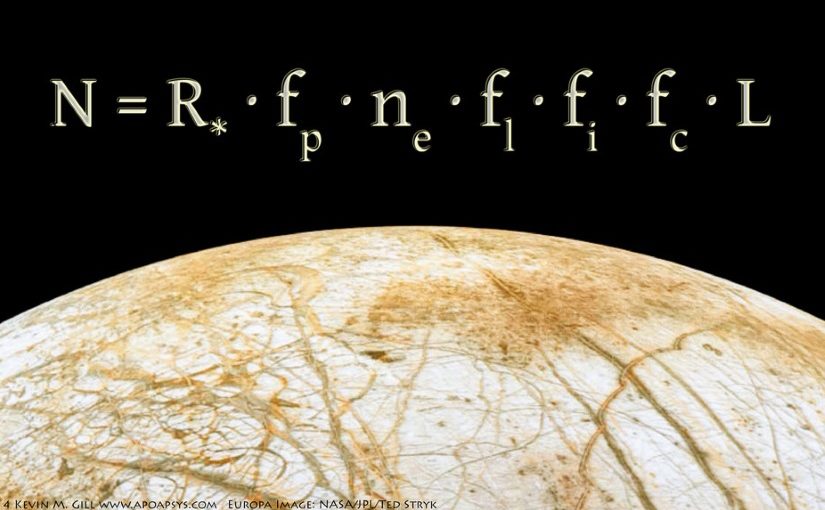
N = Ns ∙ R* ∙ fp ∙ ne ∙ fl ∙ fi ∙ fc ∙ L
N = The number of civilizations in The Milky Way Galaxy whose electromagnetic emissions are detectable.
Ns = The estimated number of stars in the Milky Way.
R* = The rate of formation of stars suitable for the development of intelligent life.
fp = The fraction of those stars with planetary systems.
ne = The number of planets, per solar system, with an environment suitable for life.
fl = The fraction of suitable planets on which life actually appears.
fi = The fraction of life-bearing planets on which intelligent life emerges.
fc = The fraction of civilizations that develop a technology that releases detectable signals into space.
L = The length of time such civilizations release detectable signals into space. (In other words, the lifespan of a civilization or its detectable time.)

You may have already seen the famous “Drake equation” (above). Named for SETI (Search for Extraterrestrial Intelligence) Institute founder Frank Drake, the equation is a simple list of factors — each representing a different estimate — that when multiplied together, results in a number “N” that approximates the number of habitable planets in our Milky Way (at any given moment) on which intelligent life has developed to the point where they are capable of sending and receiving radio signals (or any signal).
It doesn’t take a mathematician to see that any error in the estimate of any one factor is blown up by orders of magnitude with successive multiplications with other error-prone factors, resulting in a number “N” that cannot — even in principle — be expected to be accurate, not even close.
The last four factors are so speculative that the values used might say as much about the person’s beliefs who plug in those values as real science.
The uncertainties are many, such that the margin for error is far beyond what is normally considered acceptable or meaningful in science.
…But the equation was never intended or expected to produce an accurate result.
In fact, it was Frank Drake’s original intent for the equation to simply spark original, imaginative debate and dialogue on the likelihood of finding intelligent life outside our Solar System — using his equation or not. He wrote it in preparation for a meeting called a “search for extraterrestrial intelligence” that he hosted in 1961. The attendees were 12 scientists of various disciplines and included Carl Sagan.
Eventually, however, the Drake equation was used as a tool for deriving a more realistic range of numbers:
By plugging in very conservative numbers and then comparing “N” with the “N” that resulted from not-so-conservative estimates, a range of planets with intelligent civilizations expected to be near or in advance of ours would result…
Common sense would then dictate the precise number “N” would lie somewhere in between the two numbers. We could never know this number, but at least we’d have an idea of the range in which it might be located (for the values plugged into the equation).
Exoplanet Discoveries = An Improved Drake Equation
The Drake Equation was designed in 1961. Not surprisingly, many good suggestions for additions or other changes to the equation have been made. But the biggest improvements have been in the values used to plug in for the first four factors — not necessarily the equation itself. These more realistic values are possible with today’s far-improved knowledge of exoplanets and other astronomical data and discoveries — many of which were made possible by NASA’s “Great Observatories Program” (or “GO” satellites).
Starting with Hubble in 1990, these satellites comprised a ‘constellation’ of four large, space-based telescopes designed to analyze different regions of the light spectrum using four very different technologies. They’ve been spectacularly successful, and as of 2019, three are (amazingly) still operational.
Better instruments alone have made a huge impact on our overall knowledge of the cosmos. Starting with NASA’s four GO Program telescopes, here’s a brief summary of just a small sampling of the main equipment:
- In 1990, the Hubble Space Telescope (HST) was launched (although not very effective until multiple repairs and retrofits, starting with its optical mirror fix in ‘93). Named after pioneering astronomer Edwin Hubble (who was the first to discover our Milky Way is but one of countless galaxies in the Universe), the Hubble continues to amaze and educate.
- The Compton Gamma Ray Observatory (CGRO) was deployed from the shuttle Atlantis (STS-37) in 1991. It was designed to examine gamma rays but was also used to observe “hard” x-rays as well. After nine years of service, one of its gyroscopes failed and it was de-orbited.
- The Chandra X-ray Observatory (CXO) was deployed from the shuttle Columbia (STS-93) in 1999. Still operational as of 2019, its primary mission is to observe “soft” x-rays.
- The Spitzer Space Telescope (SST) continues (as of 2019) to observe the infrared spectrum and – along with the huge ground-based Keck observatories – continues to send us previously-obscured images of infant stars and their protoplanetary discs in stellar nurseries deep inside the GMCs (Giant Molecular Clouds) of the Orion and other beautiful nebulae in the Milky Way. Its deployment in 1993 was unique in that it was launched aboard a Delta II rocket into an “Earth-trailing solar orbit.” Depletion of its onboard liquid helium coolant in 2009 reduced its effectiveness, but it’s still productive.
- In the early ‘90s, the huge, Mauna Kea mountaintop-based dual Keck optical/infrared light telescopes were put into action. Along with Spitzer (SST), these revolutionary tools of the trade continue to reveal previously unseen infant stars in their otherwise gas-obscured stellar nurseries, including their protoplanetary disks. Keck has also proven valuable in finding extrasolar planets.
- In 2009, the Kepler Space Observatory was launched, its sole design and mission to find Earth-like (“extrasolar”) planets in a small, nearby area of our Milky Way. As of its retirement on October 30, 2018, Kepler has identified thousands of exoplanet candidates, with over 2600 verified as actual planets. Of this total, twelve have been identified as being Earth-sized and orbiting their host stars in habitable zones. (From this press release on nasa.gov.)
…If the survey area of Kepler’s findings is typical, there are likely at least 2 billion Earth-size planets orbiting in the habitable zones of Sun-like stars in our Milky Way galaxy alone!*
*This does not mean there are likely 2 billion planets with intelligent life in our Milky Way. It could very well be that there is but one (Earth) or perhaps a measly handful with intelligent life during any given time frame. Regardless, it simply means there are about 2 billion planets in near-circular orbits around sun-like stars, at distances from their host stars that allow water to exist in liquid form. Life could have arisen on lots of these planets, but not evolved to intelligent life.
- At this point in history (September 2021), the much anticipated James Webb Space Telescope (JWST or WEBB) is in the final stages of preparation for launch and deployment, optimistically scheduled for December. It will allow unprecedented views of the interior of otherwise invisible gas clouds, such as the Horsehead nebula (located inside the huge Orion gas cloud complex). That’s because it’s designed to see in the infrared part of the spectrum — longer wavelengths than the Hubble, also allowing clearer views much farther back in time (as more distant celestial objects are more red-shifted). Amazing discoveries are surely coming soon!
- This list is far from complete. We haven’t even acknowledged the ESA’s (European Space Agency’s) massive contributions, as well as the contributions of many other foreign space agencies, including many NASA projects not mentioned here.
The upshot of all this has been a much better idea of what numbers to plug in for the first four factors in the Drake equation. The last four factors will remain highly speculative until if and when life is discovered on another planet or its moon somewhere. (Even finding microbial life or evidence of it would provide a more realistic factor to use for “fl.”)
…So Give Me the Numbers!
The “N” number today ranges somewhere from less than 1 (only 1 would be Earth) to some thousands of potential worlds in our Milky Way where similarly advanced life resides at the present time, depending on which values you use.
…As expected, there is nothing precise about such a range of numbers, but the fact that it suggests a number above zero is interesting.
This online interactive Drake Equation is a great way to get a feel for the range of numbers for each individual factor that astrophysicists and astrobiologists think is realistic.
For what it’s worth, I carefully considered each factor in the Drake Equation in light of the latest findings. After plugging in (what I consider to be) conservative values for the unknowable factors, I came up with less than 1; In other words, zero planets (other than our own) currently having intelligent life in our galaxy that can communicate via radio waves like ourselves.*
*My low estimate, by the way, is basically in agreement with the “Rare Earth Hypothesis,” which holds that the conditions for Earth to exist — which allows for not only the origin of life but for the evolution of the biological complexity that led to us — is extremely rare. In this view (which I share — at least to the degree to which it’s supported by science) our planet may be the only one in our galaxy to have resulted in intelligent life during our time. But regardless if it IS the only one or one of, say, twenty at this moment, the distances between such civilizations practically guarantees that two-way communication between any two potential worlds is highly unlikely…
Let’s say we figured two other planets (other than Earth) that likely have intelligent life like our own — able to send and receive signals in our Milky Way at this point in cosmological history. But would this communication really be possible — or more accurately — be practically possible?
…This number, along with any other low estimate — say, less than 100 — may be one reason we haven’t heard from another cosmic neighbor and is (IMO) the obvious answer to the “Fermi paradox” (covered in the next sub-chapter).
How Far Apart (evenly dispersed) Would Potential Planets With Intelligent Life Be?
Let’s assume a higher estimate of planets currently having intelligent life in our Milky Way instead of the number (less than one) I came up with. Let’s assume there are twenty-two other planets in our Milky Way on which there reside civilizations roughly equal to or ahead of ours — from a technological standpoint.
…Assuming a roughly even dispersion of these 22 Earth siblings, how far apart would they be?
Answer: Roughly 21,000 light-years apart.*
*Google search “how to figure dispersion distance of objects in a 3d space” for the math.
How Far Can a Strong Radio Signal Travel in Interstellar Space Before Degrading Into Useless ‘Noise?’
The degradation of any signal departing a planet or spacecraft obeys the “inverse-square law,” which says that for each doubling of a given distance from the signal source, the signal power (or intensity) is only .25 (or one-quarter) of the original signal strength for a given size receiver.
Besides normal signal dispersion, there are particles (yes, even in interstellar space) that scatter (or deflect) any photons that hit them. The reason many distant stars are visible is because they are, well, stars. A civilization focusing and sending artificial signals through vast stretches of space has a huge challenge to compete with stars, gas, and even very diffuse gas in interstellar space.
Estimates vary because the variables are many, but the predicted limits for a strong, focused signal are in the few hundreds of light-years, which is problematic — as our galaxy is 100,000 light-years across. Nevertheless, SETI is doing the right thing by listening, because even if two-way communication may be unrealistic, it would be nuts to not even listen for a signal sent hundreds or thousands of years ago.*
*This is why two-way communication with an alien species is highly unlikely; by the time we get their signal, the alien civilization that sent it could be extinct, and if they aren’t, they (and/or ourselves) could very well be extinct by the time our response signal reaches them. (This is the “L” factor in the Drake Equation.)
What about radio and television shows from long past — they could be picked up by an alien civilization, right? Not likely, due to two reasons: The fact they would be very diffuse and perhaps most significantly, even “I Love Lucy” or “The Jackie Gleason Show” (started airing in 1949) will have only gotten roughly 80 light-years away from Earth by now.
So because of the immutable laws of physics — specifically, the speed of light — it could take thousands of years for a one-way signal to arrive from a potential neighbor, assuming there is another planet with beings like us somewhere in the Milky Way.*
*It should be noted that if there was only one instance of intelligent life per galaxy during, say, any half a million-year period, the distances would obviously be impossibly far — millions of light-years apart — as the closest galaxy, Andromeda, is about 2.5 million light-years from our Milky Way!
As Einstein and virtually every other scientist since have confirmed (through not only theoretical physics but from many years of observations and lab experiments — to include observations using the Large Hadron Collider), the cosmic speed limit is the speed of light.
…So perhaps this is one reason we have yet to be visited by or receive a signal from another world: The time for interstellar radio signals (or any signal) becomes prohibitively long, to say nothing of physical travel.
Better Ways to Detect Alien Civilizations May Be Coming…
Scientists are now realizing radio waves may not be the best method of detecting intelligent life from other areas of the Milky Way. This easy-to-understand article by Ethan Siegel covers intriguing new technologies that hold promise for future detection of other civilizations such as ours.
Regardless of the technology, however, the cosmic speed limit still applies; a signal arriving here after thousands of years of travel, for example, would require the same travel time to send a signal back.
Survival of a Civilization – Including Our Own (“L” factor)
It’s important to acknowledge the following very significant factor in the Drake Equation (the last one):
The factor, “L” = The length of time an intelligent civilization is able to release detectable signals into space; its survival until extinction time — or at least close enough to extinction such that it is technologically unable to continue doing such resource-intense things as SETI is doing now, which is sending and receiving signals from space.
From the perspective of Earth’s habitable time, we humans have been thriving here for an astonishingly short amount of time — only about 200,000 years. Yet we are already showing signs of wearing out our welcome on this planet.
Clearly, intelligence is not a guarantee we will prevail. Think of cockroaches and other insects that have been here for many millions of years. Dinosaurs lasted nearly 180 million years and would have been here longer would it not have been for a large meteor strike off the coast of what is now the Yucatan peninsula in Mexico.
The pessimistic view is higher intelligence could end up being our undoing. Each human comes with an irreducible ‘carbon footprint’ demand on our planet, and the higher the intelligence, the greater the exploitation of our Earth’s limited resources (the larger the carbon footprint). For example, think of United States citizens compared to Afghanistan’s:
In the U.S. we have lots of airplanes — even personal airplanes, big recreational vehicles (I own a big Class A RV — perhaps the epitome of obnoxious American consumerism), boats, cars, SUVs, large homes, theme parks, mass transportation, millions of restaurants and fast-food eateries, gas stations everywhere, construction is constantly going on for new roads, industrial parks, the list goes on and on.
The large majority of Afghanistan’s citizens are illiterate and don’t even own homes or vehicles. Clearly, higher education and intelligence — great for many other reasons (which I’ll cover in a moment) — nevertheless leads to a larger carbon footprint.
Our advancing technology has culminated in our ability to exploit Earth’s resources at an accelerating rate to meet the demands of our burgeoning population of needy and greedy citizens. This is a direct result of our so-called higher intelligence. It’s probably the biggest threat to our survival beyond a few more centuries.* (This time — “…a few more centuries” is admittedly not based on anything but a guess, but then how could it be otherwise? This is new territory for us all.)
*Philosophical side note 1: This begs the question of would it be better for a (an otherwise intelligent) civilization to survive thousands of years longer by living like Brazilian rainforest or Australian aboriginal tribes** than like today’s modern society populations? (Even though to live as we do might result in our own extinction in a far shorter period of time.)
Note 2: Individual lifespans of some Amazonian tribes today is about 42 years, but species lifespan, in this view, would be far longer than if they lived like modern
Hopefully, we will be able to deal with chronic problems such as overpopulation and global warming (and other problems such as war and disease) before it’s too late. The optimistic view is we’ll be able to handle anything that comes our way (except, perhaps, a huge meteorite). But alas, the optimistic view is not based on experience; this appears to be our first attempt at long-term survival of our species!
What This Means for “L” Factor in the Drake Equation
It’s easy to imagine the same or similar challenges facing other intelligent civilizations across the Milky Way and Universe. Alien species would have to successfully handle their own challenges to survival before they could send and receive radio signals (or any signal) that may be picked up here on Earth — not to mention actually traveling here.
Common sense says it’s highly unlikely there could be another species in our Universe that automatically ‘skipped to the front of the line’ of evolution, being designed (by a god?) to be perfectly adapted in every way — able to automatically handle every challenge to their species that comes their way.
But due to the vastness of the Universe, it’s also easy to imagine at least some fraction — tiny though it may be — of alien civilizations that successfully survive and advance far beyond our current level and have been able to populate other planets local to theirs. Given what we know now, however, populating or visiting far-off planets seems as unlikely for them as it does for us.