We may be lonely, but we’re likely not alone.
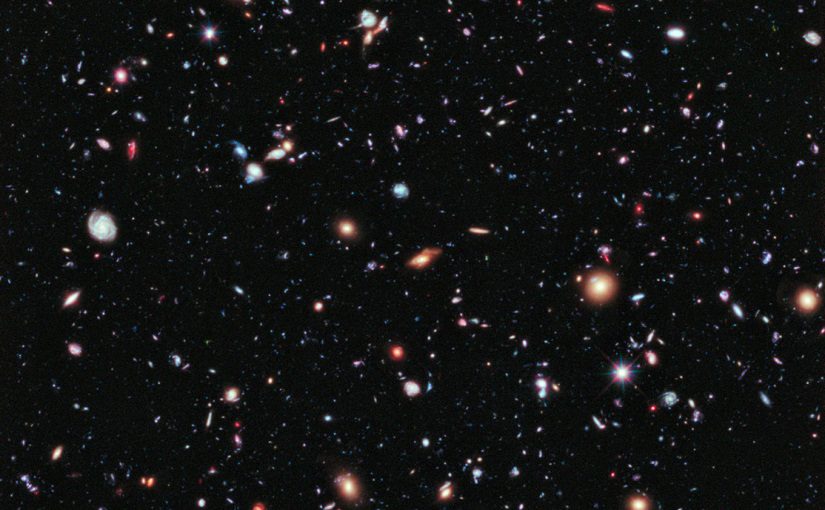
The above image is the Hubble eXtreme Deep Field “XDF” (2012) photo in the constellation Fornax. Except for a few stars (which are bright with diffraction spikes – because they’re close to us), every speck of light is an entire galaxy – some 5500 of them. The observable Universe is estimated (as of 2015) to encompass at least 200 billion galaxies. – From this page in Wikipedia
UPDATE: On October 13, 2016, NASA announced, “The Hubble Space Telescope Reveals Observable Universe Contains 10 Times More Galaxies Than Previously Thought.” (It was previously thought the observable Universe had about 200 billion galaxies, so the new estimate is about two trillion galaxies.)
Introduction
Neil DeGrasse Tyson, famed ‘rock star’ astrophysicist says,

“People really care about whether or not we are alone in the Universe. If the person next to me on a long airplane flight ever finds out that I am an astrophysicist, nine times out of ten they ask, with wide eyes, about life in the universe. And only later do they ask me about the big bang and black holes. I know of no other discipline that triggers such a consistent and reliable reaction in public sentiment.” – quote from this NASA page
Many people think our planet is the only one with intelligent life. It can be tempting to think so because Earth is the only one we know of. Plus, this knowledge preserves our ego’s sense of a privileged status in the Universe.
Over 400 years ago, Giordano Bruno was burnt at the stake in Rome for the following statement in which he dared to threaten this privileged status:
“In space there are countless constellations, suns and planets; we see only the suns because they give light; the planets remain invisible, for they are small and dark. There are also numberless earths circling around their suns, no worse and no less than this globe of ours. For no reasonable mind can assume that heavenly bodies that may be far more magnificent than ours would not bear upon them creatures similar or even superior to those upon our human earth.”
Calling our privileged status into question has always been met with resistance, largely due to our egos — not because of disagreements with science.
I’m convinced most folks who disbelieve the existence of worlds similar to ours would change their minds if they truly understood the composition and size of the Universe. (A good grasp of its size also makes it clear the capability for interstellar space travel is extremely unlikely. Perhaps it’s better this way, though, as you’ll see later in this essay.)
…These two simple but powerful features say it all. Let’s ‘unpack’ them a bit:
Composition of the Universe
1. The Ingredients
100% of the ‘normal’ matter that composes:
- You, me, the Earth, and all other planets
- Our Sun and all other stars
- Our Milky Way and all other galaxies
- And all the rest of the normal matter in the Universe
…is made of exactly the same stuff in about the same proportions.*
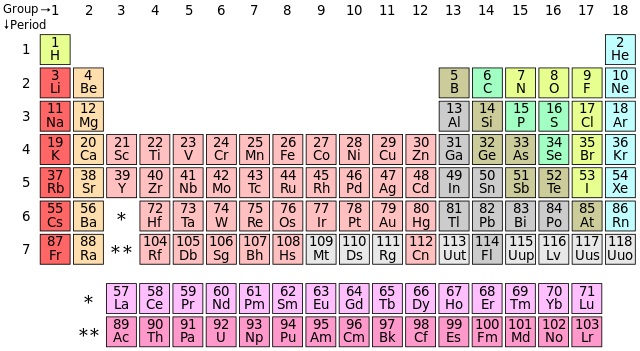
*How do we know these things? With the proven science of spectroscopy, started in the early 1800’s, that’s how. Nowadays, highly advanced spectrometers are sent aboard unmanned spacecraft to send back information about the Universe with ever-increasing precision. For an easy-to-understand explanation of astronomical spectroscopy, click here.
Note that light is needed for spectroscopic analysis, so stars are ideal study candidates. Planets — such as our own Pluto, in contrast, can be impossible to analyze spectroscopically from Earth, because they reflect little or no light. (That’s one reason NASA sent the “New Horizons” spacecraft to Pluto in January 2006, arriving in July 2015.)
It is evident the laws of physics are the same everywhere in our Universe; everything is made of the same stuff.
…Stop and think about that for a moment:
The same elements — which means the same atoms — comprise everything in the universe: You, me, the most distant galaxy, and everything in between.
 Take our bodies, for example:
Everyone knows we are largely made of water and that water is H2O — which is the chemical abbreviation for a water molecule — two atoms of Hydrogen and one atom of Oxygen.
…So it’s not surprising there are more atoms of hydrogen and oxygen in our bodies than any other. But stick with me here:
 We are made of many trillions of small cells, which are made of gazillions of smaller molecules, which are made of a vast number of even smaller atoms.
(A single cell is made of about 10^14 atoms — which is a “1” with 14 zeros afterward. The photo of human cells stained green with blue-stained DNA is from this page.)
But in order to build a human or any other life form, including tiny single-celled bacteria, these elements need a ‘scaffolding’ — or frame — onto which these elements (atoms) can cling.
…And that element is carbon. (Which is why you hear, “carbon-based life” bandied about.) Turns out carbon is another abundant element in the Universe — in about the same percentage as here on Earth.
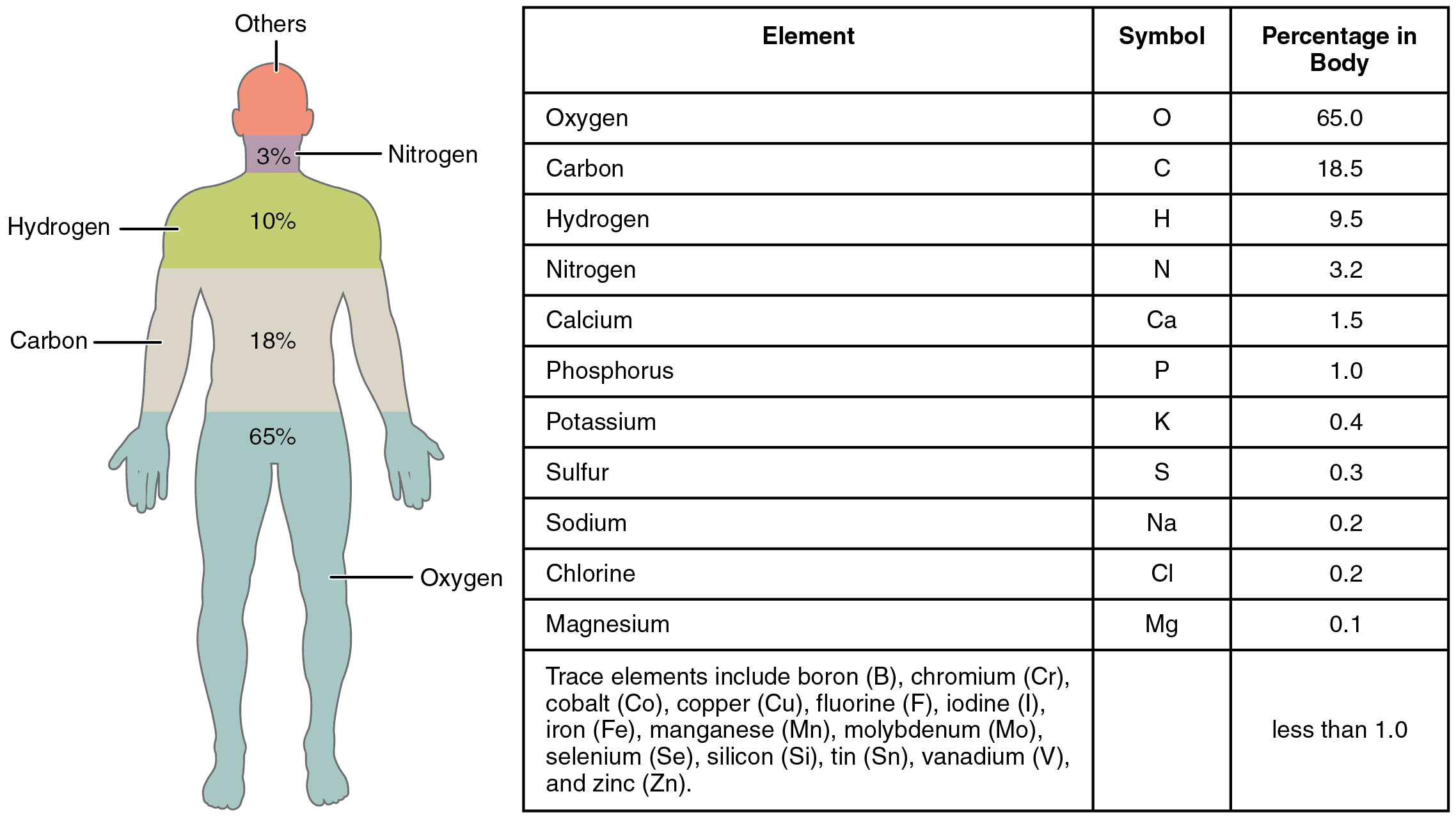
The atoms of the elements combine to form the molecules which make up the cells which, in turn, allow us to live. Looking at the chart above, you’ll see that just four elements (the first four) comprise 96.2% of us.
…And they are in the top five elements in abundance in the Universe!
(Helium is the second most abundant element, but it’s inert — which means it doesn’t react with or attach to other elements.)

Fun fact: It’s interesting that gold is not only rare here on Earth (down near the bottom of the periodic table of elements) but it’s also rare in the rest of the Universe, likely occurring in approximately the same proportion on other planets.
…So if you managed to magically visit another world with a civilization similar to ours in a distant galaxy, you might see their privileged inhabitants wearing gold jewelry too!*
*Gold is one of the “heavy” elements. If you’re interested, here’s a well-done article on how gold is likely formed in our Universe.
2. Water

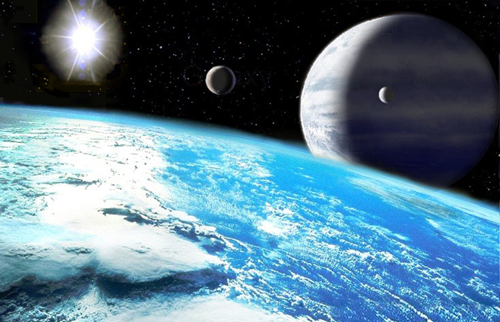
Necessary for life anywhere – water is abundant in the Cosmos, due to the abundance of hydrogen and oxygen. Water is everywhere here on Earth and out there.
*April 2019 marks the first time our Moon has been found to have water abundant just below its surface. Not “flowing” as you might imagine, but diffuse in the form of ice crystals a few inches below the lunar dust and rock. Here’s a NASA press release about this incredible new discovery.
Even Mercury, once thought to have no water, was recently found to have frozen water in areas that remain in its shadows. Water on Mars was far more abundant long ago but is still flowing there intermittently.
Pluto has long been expected to have water (frozen) on it. Now we know that it does for sure. The interesting thing about these findings is now there is solid evidence (without ‘just’ spectroscopic proof) that water is highly likely to exist in every solar system – in perfect alignment with the spectroscopic findings so far.
3. Complex Organic Matter Found Elsewhere (Everywhere)
Some of the most exciting discoveries in astrophysics (specifically, “astrobiology”) involve finding and cataloging dozens of complex organic molecules from interstellar space.
In Meteorites
In 2011, NASA researchers discovered critical building blocks of DNA in meteorites collected mostly from Antarctica (easier to find the dark meteorites on the white background) and some from Australia.
 Slice of a meteorite on display at the Royal Ontario Museum. (No organic material in this one. It’s just nickel and olivine crystals, polished to shine.) – From this page in Wikipedia.
In Comets
Comets have long been known to be loose collections 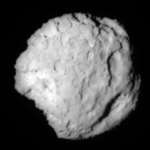 of ice, rock, and dust. Comets are basically dirty snowballs. Until recently, their precise chemical composition was known only through spectroscopy (which can be astoundingly accurate by itself).
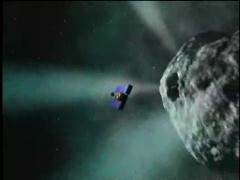
But in 2004, NASA’s Stardust spacecraft flew through the tail of comet Wild 2, with a collector grid deployed to catch its cometary debris. On January 15, 2006, the grid was stowed in a capsule and parachuted to Earth for examination. Nothing short of amino acids were among the findings. Amazing!
27 May 2016
“Ingredients regarded as crucial for the origin of life on Earth have been discovered from the comet that ESA’s Rosetta spacecraft has been probing
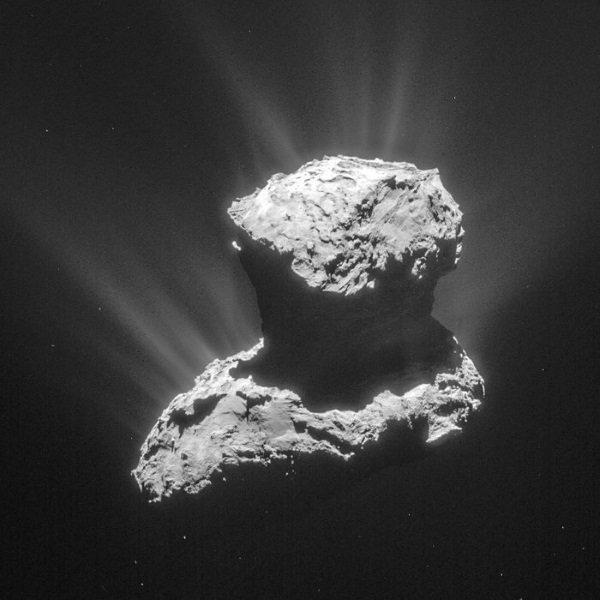 for almost two years. They include the amino acid glycine, which is commonly found in proteins, and phosphorus, a key component of DNA and cell membranes.” – image and quote from this page on the ESA (European Space Agency) website.
In Orion Nebula
With advances in spectroscopy in the last hundred or so years and the deployment of space telescopes, NASA continues to find complex organic molecules populating the Universe — even way beyond the Kuiper Belt and Oort Cloud-originating meteorites.
In 2010, NASA, in conjunction with the European Space Agency, reported chemical fingerprints of potentially life-enabling organic molecules in the Orion Nebula. (The Orion Nebula is a nearby — 1300 light-years away — stellar nursery in our Milky Way. The nebula itself is about 24 light-years across.)
Additionally, the presence of oxygen has been confirmed in the Orion nebula.
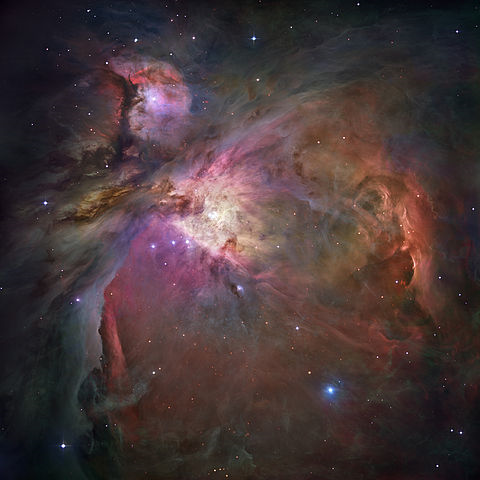 “The Orion Nebula is one of the most scrutinized and photographed objects in the night sky and is among the most intensely studied celestial features. The nebula has revealed much about the process of how stars and planetary systems are formed from collapsing clouds of gas and dust, and astronomers have directly observed protoplanetary disks.” – quote and photo from Wikipedia, this page
4. Planets
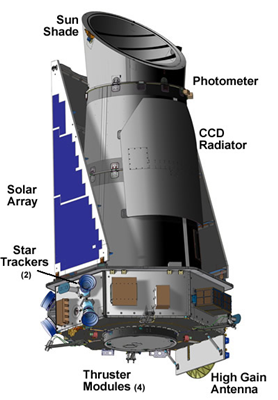
NASA’s Kepler space telescope was launched on March 7, 2009, its mission to find Earth-like planets orbiting other stars. By the time it was retired on October 30, 2018 (due to running out of fuel), it had identified thousands of “exoplanets,” with over 2600 confirmed as bona fide planets. These observations have led to realistic estimates of two billion Earth-like planets orbiting in the habitable zones of Sun-like stars in our Milky Way galaxy alone.
“What we didn’t know five years ago is that perhaps 10 to 20 percent of stars around us have Earth-size planets in the habitable zone,” says Matt Mountain, director and Webb telescope scientist at the Space Telescope Science Institute in Baltimore.
“What a wonderful and amazing scheme have we here of the magnificent vastness of the Universe! So many Suns, so many Earths!”– Christiaan Huygens, 1670
It’s interesting that ancient astronomers’ predictions about the prevalence of Earth-like planets – no doubt thought to be heretical in their time – are turning out to be true.*
*NASA’s JPL (Jet Propulsion Laboratory) did a great job with this interactive, visual historic timeline of planetary discoveries.
Also from Matt Mountain:
“It’s within our grasp to pull off a discovery that will change the world forever. It is going to take a continuing partnership between NASA, science, technology, the U.S. and international space endeavors, as exemplified by the James Webb Space Telescope, to build the next bridge to humanity’s future.”
Size of the Universe
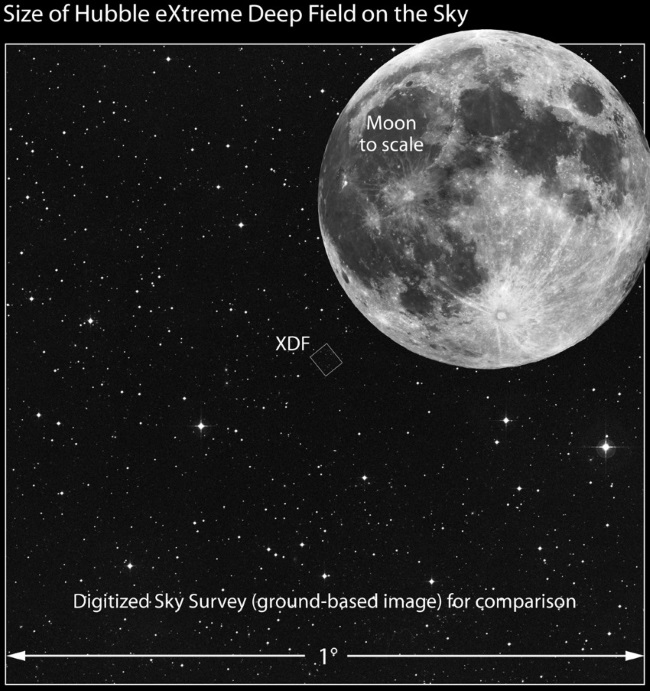
Look at the above image. See the little box labeled XDF? The Hubble eXtreme Deep Field photo you saw at the beginning was taken from this tiny patch of sky. A scale shot of the Moon is offered for comparison. Astounding! – From this page in Wikipedia
1. Paradox in Understanding
 Paradoxically, it’s far more difficult to grasp the size of the Universe than its composition:
While understanding the composition of the Universe can involve many layers of increasing complexity – depending on how much you want to ‘unpack,’ understanding the size of the Universe involves just one single feature. But it’s this understanding that is, by far, the most difficult to grasp.
Why is this? Because the very definition of “understanding” involves the word, “concept.” In order to understand something, the concept or idea must be something you have experienced or be able to relate to from existing ideas.
But with the size of the Universe, we have no experience or existing ideas to compare it with; we can’t relate it to anything. Our heads start to spin just trying to comprehend it all.
The astrophysics community has given us numbers, but they are of little help. When an exponent is in the teens or twenties, the number of zeros makes the distance (or time) measurement unfathomable.
If I tell you a boulder is as big as a house, you can quickly conjure up an image of the boulder. But if I tell you the boulder is 3 x 10^23 times bigger than the observable Universe, which has been expanding for 13.8 billion years – making the observable Universe about 93 billion light-years in diameter (or a radius of 45.7 billion light-years)*…
…you see how the numbers can just confuse you. You’re no further along in your understanding of the Universe’s size than when you started.
*Alan Guth, a prominent theoretical physicist and cosmologist whose work on the Theory of Inflation helped it become the accepted theory of ‘Big Bang evolution,’ postulates that the true size of the present Universe should be in excess of 3×10^23 times larger than the size of the observable universe, and could possibly be infinite.
Help From Technology
Fortunately, with modern computer simulations, some innovative ways to confer the size of the Universe have recently been made. We’ll check out a few in a minute.
…But first, I think it useful to get your head accustomed to huge distances on a small scale, and what it all really means:
Since it’s pretty much useless to think of the universe as a whole, we can instead visualize a tiny chunk of our Universe. We can start with a size we can at least imagine, if only dimly.
The following paragraph is courtesy of the “One-Minute Astronomer:” If you read his website, you’ll see that Dr. Brian Ventrudo did his homework in figuring everyday distances to a convenient scale: One statute mile = about one light year’s distance. (In other words, 1 mile = 1 light-year = 6 trillion miles = 300,000 meters)…
“If the Sun was a grain of sand, and the Earth a microscopic speck one inch away, then Jupiter would lie 5.2 inches away and Pluto an average of 40 inches away. Next stop… the nearest star, about 4.3 miles away, with mostly empty space between it and the Sun. The star Vega would be 26 miles away, the Orion Nebula 1340 miles away, and the globular cluster M15 some 25,000 miles distant (about three times the diameter of the Earth).”
Two Important Takeaways
… There are 2 (two) important takeaways I want you to get from the above paragraph (annotated by the following Roman numerals in red):
I. Appreciation of Scale:
- With our Sun being the size of a grain of sand…
- One inch = 93,000,000 miles, which means…
- The nearest star — Proxima Centauri — would be 4.3 miles from that grain of sand!
…Which means Proxima Centauri would be about 4.3 light-years away (using Dr. Ventrudo’s brilliant scale).
As you probably already know, 4.3 light-years means a spacecraft would have to fly at the speed of light (186,000 miles per second or 300,000,000 meters per second) for 4.3 years to reach Proxima Centauri. (Current estimates are actually about 4.24 light-years to Proxima Centauri.)
 Another fact you may already know is that unless there is a way to circumvent the laws of physics as we currently understand them, it is impossible for anything with mass (weight of any amount — even an ounce) to move at the speed of light.*
*Have other, more advanced civilizations figured out how to exceed the speed of light or otherwise developed the ability to get a massive object (like a spacecraft and its occupants) across vast stretches of space in a short period of time?
Only light (photons) and other massless particles can manage this feat of traveling at 186,000 miles per second. Because, as Einstein found in his calculations (which have been proven countless times since), when any object with any mass whatsoever (even a single ounce*) gets moving at any significant percentage of the speed of light, its mass starts becoming exponentially greater, requiring an exponentially greater amount of thrust (energy) to sustain the speed.
…As speed is increased, so is the mass of the spacecraft, ultimately requiring an infinite amount of energy (thrust) as the mass of the spacecraft becomes infinite at light speed.
*Mass is not the same as weight, but it works for this explanation ;-).
Star Trek, Sci-Fi
This is a real cosmic speed limit, which would require fundamentally different technology than we currently have to achieve. (We’ll cover “wormholes” in a moment.)
Ah, but hope springs eternal:

Most people, myself included, dream of a day when interstellar spaceflight could become a reality. It probably has something to do with the spirit of exploration and adventure in all of us.
Who didn’t love “Star Trek,” “Back to the Future,” “Star Wars,” and other classic sci-fi movies and TV shows?
UFOs(!)
…And the thought of being visited by friendly aliens is about as intriguing as anything could be. A bit of online research reveals UFO sightings increase dramatically after the release of space-themed movies, articles, books — any media attention. We are all fascinated by that stuff, and many of us want to believe extraterrestrial aliens are visiting us regularly, or that aliens are living amongst us.
In fact, many UFO sightings are reported by credible, trustworthy eyewitnesses. You probably know someone yourself who has not wavered from their incredible flying saucer or another related story.
Yet there are two key elements common to ALL of these eyewitness accounts:
- The word, “Unidentified” is typically ignored:
The general unwillingness to acknowledge the “Unidentified” part of the UFO abbreviation and instead assume an extraterrestrial origin for what was seen. - No real evidence:
Despite the fact practically every man, woman, and child have carried a high-res video and still camera in their pockets since the late ’90s, there has been no confirmatory proof of aliens here. Ever. Full stop. Period.
Two possibilities remain:
-
- All of the unidentified objects are of Earthly origin. (Unmanned military or other ‘drones,’ or manned aircraft seen from a distance, or other terrestrial lights and objects, as examples.)
- At least some unidentified objects are indeed extraterrestrial.
(Likely ‘unalienned’ (‘unmanned’ if it came from Earth) drones; Robotic craft sent from another world.)
We have a long history of sending unmanned probes from Earth. Starting with Voyager 1, launched on September 5, 1977, we realized the obvious solution to the perils of long spaceflights was unmanned spacecraft. Cheaper, easier, and risk-free — from the standpoint of human life.
And as technology advances, unmanned spacecraft are becoming more effective, carrying out research as good or better than any human could. So why would an alien civilization be any different? It seems likely if any UFOs are indeed from another world, the “Object” would be ‘unalienned.’*
*But regardless if an Object is manned (‘alienned’) or unmanned (‘unalienned’), any craft would nevertheless be limited by the laws of physics; the cosmic speed limit would still apply.
It’s amusing to think of a civilization far in advance of ours, overcoming the challenges of interstellar spaceflight only to crash land on Earth! This is but one of many inconsistencies with common sense — to say nothing of science — that rebuffs today’s woefully unprofessional and otherwise poorly contrived alien visitation claims. After all, with today’s high-res cell phone cameras, you’d think at least one good (non-post processed) photo or video would stand up to scrutiny.

The reality, however, is that despite millions of reported sightings and alien encounters (“abductions”) — stretching back many years past — there is yet no, none, zero, zilch, nada, not ONE independently verified (or perhaps most telling — verifiable) case of alien visitation that has actually occurred!**
**Die-hard alien visitation fans (including “abductionists”) say the U.S. government has been covering up at least one alien UFO event (“Area 51” – Roswell story), and possibly many others. Stephen Hawking once famously said, “If the government is covering up knowledge of aliens, they are doing a better job of it than they do at anything else.”

Regarding the Roswell story, a revealing and humorous first-hand account by (retired) Colonel Joe Kittinger — the person intimately involved in the entire sequence of events that precipitated the legend — can be found in his autobiography, “Come Up and Get Me.”
The actual events at Area 51 which started the whole Roswell legend are more fascinating than the myth, IMO. (I don’t want to give away those fun facts in Joe’s book here, because he does a great job telling it himself. Get yourself a copy, you won’t be disappointed!)

I know Joe Kittinger personally and can attest to his professional, yet undisguised innocent honesty, no doubt the product of his upbringing and unflappable ethics. Joe is a true American hero.
Here’s the real issue: The challenges of conquering interstellar space travel are not just ours, it’s every potential alien civilization’s as well…Because the laws of physics apply to ‘them’ too. The “cosmic speed limit” — the speed of light — is not just a limit for us, it’s very likely a limit for them too.*
*Of course, after many years of awe-inspiring and well-done sci-fi films, movies, and books — to say nothing of a natural yearning for adventure — many people expect interstellar space travel is an inevitable certainty, becoming a reality just as soon as a few technological hurdles are overcome. But this expectation is not based on science so much as hope; a wistful belief that ‘anything is possible.’
…The reality, however, is that not anything and everything is possible. This is not to say that we could not ever overcome the challenges of interstellar space travel, but that the laws of physics — as we currently understand them — appear to prohibit it, or at minimum, make such travel ‘practically impossible’ for us large, macroscopic beings (at least for the foreseeable future).
On to “takeaway” #2:
II. The Alpha Centauri system of stars (which includes Proxima Centauri) are our closest neighbors. This close proximity (for which Proxima Centauri was named), has profound implications:
Since nearly every star (every star examined closely so far) has at least one orbiting planet — usually two or more — this star system is our best chance for finding an intelligent civilization and visiting it (or being visited by it).
In fact, along with other planets found in the Alpha Centauri constellation, astronomers have discovered a (roughly) Earth-sized exoplanet (named “Proxima b”) in the ‘habitable zone’ orbit of its host star — our closest neighbor star — Proxima Centauri.
But there are three significant problems with expecting Proxima b or any of those planets to have intelligent life, and each of these problems is HUGE:
1. Although a growing number of people — including nearly all cosmologists, astrophysicists, theoretical physicists, and other scientists — think that planets other than our own where intelligent life has evolved is inevitable, it is nonetheless highly unlikely there would be two worlds with intelligent life in such a tiny area of space.
…Two worlds being ours and one somewhere in the Alpha Centauri constellation. Surely a world like ours is rare — especially obvious when you run the numbers (see the “The Drake Equation”) — making two so close together and at the same level or higher of technology highly improbable.
2. But let’s say, for the sake of argument, there’s a planet in that system with intelligent life. How will we reach it or they reach us?
Even though it’s “such a tiny area of space” between us and Alpha Centauri in terms of space distance, it’s still prohibitively far away with today’s technology. With our current spacecraft (traveling at about 18,000 miles per hour), it would take our ship about 165,000 years to reach Alpha Centauri — and this is our closest “neighbor!”
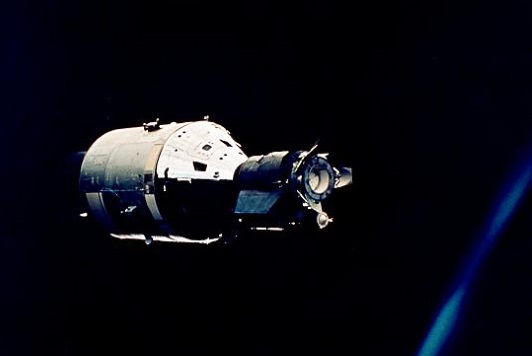
If our ship could travel at 200,000 mph, the 4.24 light-year trip would ‘only’ take about 3,330 years. If our ship could go a million mph, the trip could be shortened to ‘only’ 671 years.
So you’d need to go faster. Much, MUCH faster for a long, loooong time.
Even if we or ‘they’ magically developed the ability to fly at light speed, it would still take 4.24 years to reach each other. Think of what that would entail in terms of astronaut and ship sustainability.
But wait: We’re ignoring another issue with that 4.24 light-years minimum time: Deceleration to orbital velocity!*
*The same amount of energy required to accelerate to lightspeed (which is infinite, according to physics as we know it) — or any speed for that matter — would be required to decelerate (‘reverse thrust’) at some point before arrival at the destination planet, requiring that much more power (fuel) and time. An obvious, but oft-overlooked detail, no doubt one of many.
(Unless acceleration and deceleration could be accomplished in a brief period of time and distance, the only obvious alternative would be a continuous acceleration to the halfway point between Earth and the alien planetary system, followed by a continuous deceleration for the remaining fifty percent of the trip. This, of course, would drastically increase the time required for the trip, yet may be the only option.)
3. SETI would have likely detected unique radio signals (indicating intelligent life) from that area by now anyway. 4.24 years is the amount of time a radio signal would need to reach us (and us to them) because a radio signal travels at light speed — being a form of light itself. While that’s certainly a long time to send and receive messages (or any signal), it’s doable in just a fraction of one human lifetime.
(Gravity waves have been suggested as another communication method between two advanced civilizations, but they, too, are limited to the cosmic speed limit — the speed of light.)
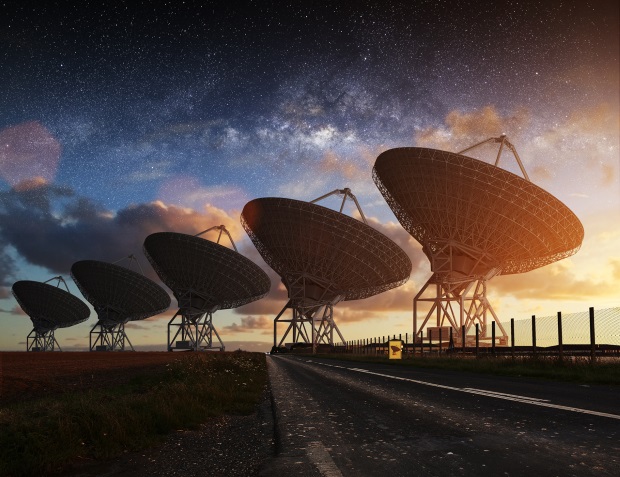
…So, no signal, no intelligent life in the Alpha Centauri system.
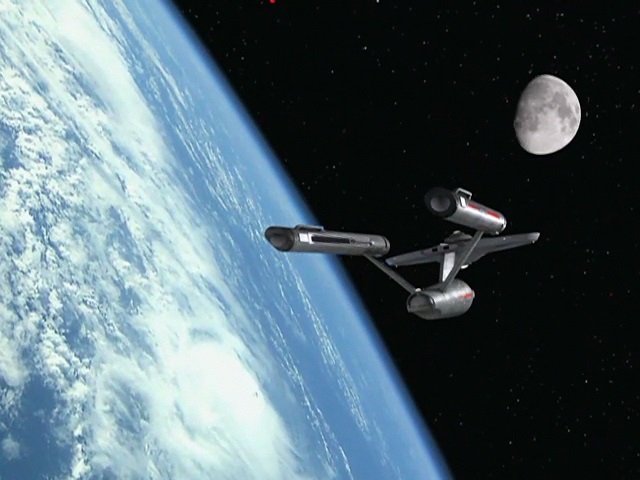
Nevertheless, the image of the Starship Enterprise decelerating to orbital velocity around the Earth (returning to Earth’s past) from an early TV episode, is awe-inspiring.
Worm Holes
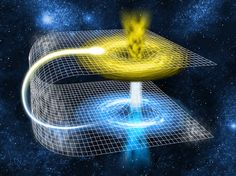 One hopeful idea that has gained traction lately is the prospect of exploiting “wormholes” as an interstellar highway shortcut. The idea is to somehow “fold the fabric” of space-time, poke a hole in it where the two fabric sides touch, then fly through the hole, thus short-cutting across a vast distance of space.
The entertainment industry has jumped on this idea, making it a popular subject — especially among sci-fi fans. In fact, many of us hope that it will be truly possible someday. It seems wormholes are our best bet around the distance and time problem.
Unfortunately, however, the “distance and time problem” looks to remain insurmountable (which may be for the best):
Physicists say using a wormhole — creating, controlling, and traveling in one — is as close to being possible as traveling at light speed. And besides being only a remote mathematical possibility, wormholes are also mathematically shown to be inherently unstable, closing shut the instant any matter — even a single photon — enters one. (The size of a theoretical wormhole is sub-microscopic. If they do exist, inflating one to spaceship size would be yet another huge challenge to overcome.)
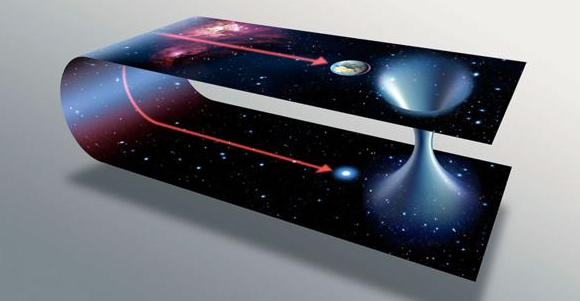
For the foreseeable future, exploiting wormholes will remain in the realm of science fiction. This just underscores the immensity of the Universe, and the implications such vast distances and vast numbers of planets have for the prospects for other intelligent life…
…and the unlikelihood of visiting or being visited by that life. (This will become more evident if you read the short article on the Drake equation.)
More On the Scale of the Universe
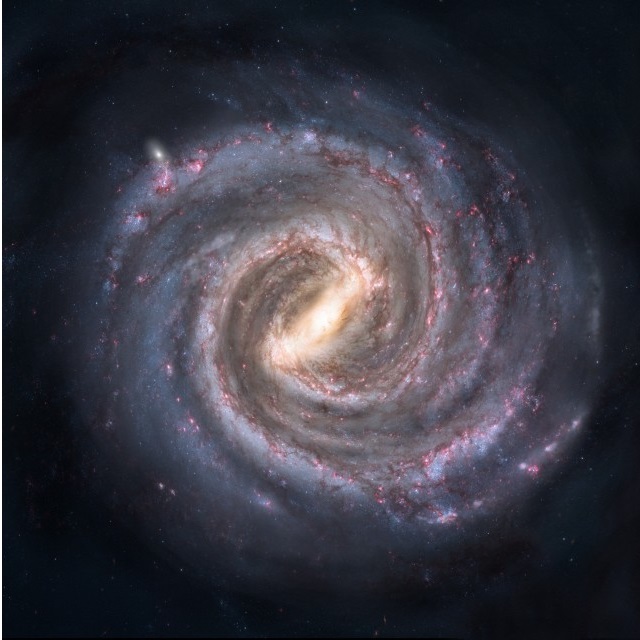
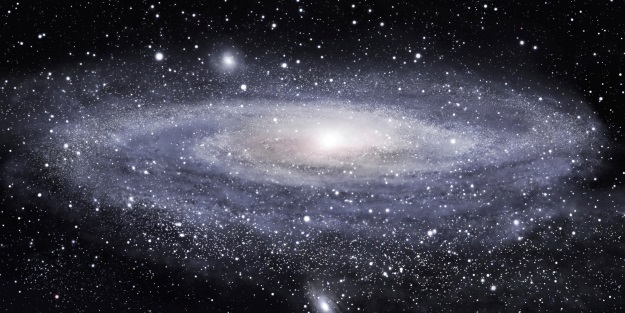
Let’s pretend the above image is a true photograph of our Milky Way. With this in mind, one might think our sun could be visible with, say, a magnifying glass as a tiny pin-prick of light somewhere in the ‘photo.’
The reality, however, is that the Sun would remain impossibly small to see even if the image was expanded (in ultra-high-resolution) to the size of the Earth!
…At an Earth-sized scale, the Sun in such a photo would be about 1/50th of a millimeter in diameter.
If the sun were the size of a white blood cell, the Milky Way would be the size of the continental United States.
Just imagine you are kneeling down, peering at a solitary grain of sand on a sidewalk. That grain of sand represents our Sun at 865,000 miles in diameter. (At this scale, Earth would be invisible.)
…From that grain of sand at this scale, the Milky Way would stretch 100,000 miles across! (This coincides with our Milky Way’s actual diameter of 100,000 light-years, using Dr. Brian Ventrudo’s clever scale.)
The following two links go to a cleverly crafted YouTube video and a well-done interactive scale of the Universe. They both do a great job illustrating the relative size of everything in the Cosmos.
Amazing scale of the Universe-1
Amazing scale of the Universe-2 — This interactive one shows the scale of the Universe from the smallest theoretical length (Planck length) to the largest theoretical size (the observable Universe).*
*The interesting thing about this one is that it shows there is much more ‘universe’ at smaller, micro scales than at larger, macro scales: Note the changing logarithmic powers of 10 while you move the slider!
Conclusion
The size of the Universe is…hmmm…incomprehensibly large. Superlatives fail me; this is a case when, truly, mere words do no justice. To say the Universe is big is like saying the Pacific Ocean has lots of water.
Let’s dispense with the superlatives for a moment and re-examine the facts as we know them:
- We know we are here on Earth with our diversity of life.
- We know the same laws of physics apply everywhere (at least in our observable Universe).
- We know everything is made of the same stuff (same 92 naturally occurring elements) in our observable Universe.
- We know there are complex organic compounds — to include water — everywhere in the (observable) Universe, providing a ‘head start,’ so-to-speak, for life.
- We know four of the most abundant elements in the Universe also comprise over 96% of our bodies. The remaining 4% are also abundant.
- We know that unless the physics expressly forbids something, it is possible.
- We know that there are at least two trillion galaxies in the observable Universe, which means there are at least 10^25 planets in the observable Universe — with hundreds of billions of planets orbiting Sun-like stars in the habitable zones.
7a. We know that even though many planets may orbit their host stars in the “habitable zone,” only some small fraction of these will likely have all the necessary features and ingredients for life (i.e. have the correct combination of elements to include molecules such as water, not be pummeled by meteors long enough for life to ‘take root,’ have a nearly circular orbit, develop a life-friendly atmosphere, and generally have favorable conditions for the assembly of complex organic molecules, etc.)
7b. If the conditions in 7a. are met and life does arise, the odds of that life evolving into an intelligent species such as ourselves, makes intelligent life uncommon (but not impossible) in the Cosmos.
Although our existence is almost certainly rare, many scientists expect large numbers — perhaps billions — of planets to have developed intelligent life, due to the sheer size of the Universe and the resulting staggering number of possibilities (planets and stars) available.
…The odds of winning a huge lottery are pretty slim, but occasionally someone does win, right?
We’re Lonely But Not Alone
So in all likelihood, we are not alone in the Universe. However, due to the vast distances between potentially habitable worlds and the resulting vast amount of time & energy required for ‘interworld’ travel, it will take technologies available only to civilizations far in advance of ours to reach them.
…But what about other civilizations across our Milky Way visiting us? These technologies have apparently been developed by our alien cousins to visit Earth. These ‘visitations’ appear to stretch back to 1947 (Roswell) and perhaps many years prior.
With our current Earthly space technology, the travel time to reach even our closest neighbor planetary star system – Alpha Centauri – would take many, many years. Like thousands of years to travel ‘just’ 4.24 light years distance.
Even our closest galaxy neighbor, the Andromeda Galaxy, is 2.5 million light years distant. So obviously a space ship that could only muster the speed of light would just not do.
So until further notice, the distances (and resulting time required for travel) remain daunting, even here in our own galaxy. That’s why we’d need the technology of our alien galactic cousins to have any hope of traveling to another planet capable of supporting human life. If we have to wait until we develop that technology ourselves, we’re in for many generations to live and die until we achieve that ability.
Can We Trust that Every Alien Civilization that Visits Earth Has Our Best Interests in Mind?
The strongest motivation for “exploring strange new worlds, seeking out new life and new civilizations, and boldly going where no man has gone before…” would not be adventure, but survival.
Let’s put this in the right perspective:
If we needed to populate another planet in order to survive a future problematic Earth, for example, and we came across another Earth-like planet, we’d probably think first about ourselves…
Our joint military force would likely be the first to land, protecting and serving our own interests in the survival of our species. I hope we’d see fit to allow the native species to live alongside us, but there may not be room or food for both in the long run!
“We only have to look at ourselves to see how intelligent life might develop into something we wouldn’t want to meet.” – Stephen Hawking from this BBC News page
Neil DeGrasse Tyson Tells It Like It Is
“The numbers are, well, astronomical: If the count of planets in our solar system is not unusual, then there are more planets in the universe than the sum of all sounds and words ever uttered by every human who has ever lived. To declare that Earth must be the only planet in the cosmos with life would be inexcusably egocentric of us.”
“Claiming there is no other life in the Universe is like scooping up some water, looking at the cup and claiming there are no whales in the ocean.” – Neil DeGrasse Tyson“
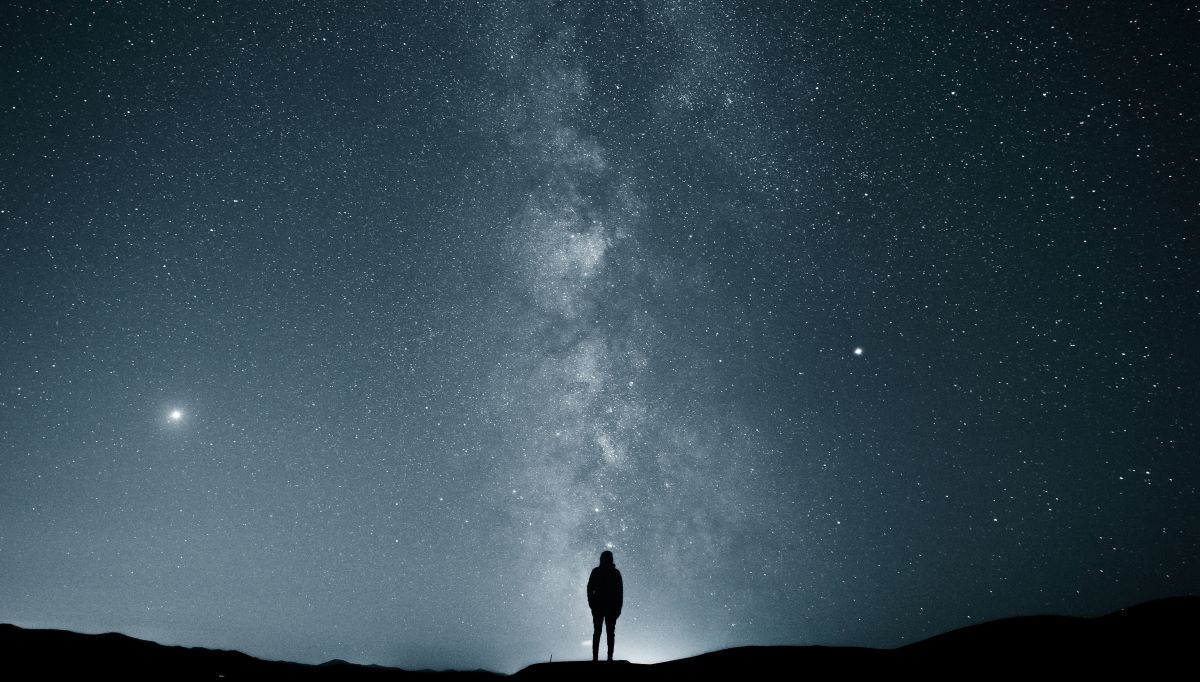
National Geographic Magazine article, March 2019
“Kepler was the greatest step forward in the Copernican revolution since Copernicus. It’s changed the way we approach one of the great mysteries of existence. The question is no longer, is there life beyond Earth? It’s a pretty sure bet there is. The question now is, how do we find it?” – University of California Berkeley astrophysicist Andrew Siemion from an interview for National Geographic magazine, March 2019.
Thanks for reading, “Are We Alone?” I hope you’ve been inspired to learn more! (Read “The Drake Equation,” if you haven’t already.)