Introduction
On the subject of life after death, most people prefer to believe either one of two main possibilities: 1. Everyone has an everlasting “soul” or consciousness or – 2. There is no such thing as a soul or everlasting consciousness; once you die you are dead and gone forever.
But what if the truth about an “afterlife” is actually somewhere between the idea of an everlasting soul (or consciousness) and being forever “dead?” What is the truth? Does it really matter if what you believe is true or not — especially since you cannot know with factual certainty what is actually true?
…The answer to that last question is no, it does not really matter if what you believe becomes reality or not, because your beliefs are real. Your beliefs can provide ongoing comfort while you are still alive. This comfort is real; your ‘reality.’ (This is likely one reason religious beliefs can be so attractive and why religions have been so pervasive since time immemorial.)
But blind faith has its drawbacks. The obvious one being you are often forced to ignore key areas of physical reality, of proven science. To be consistent with your faith — whether it’s religious faith or otherwise — you might have to ignore not only certain established science but commonsense as well. And since you can’t really ignore a hundred percent the relentless march of science and your common sense, blind faith has an uphill battle to maintain a trustworthy seat in one’s mind.
What if there is a way to reconcile your longing for the continued existence (of at least some part) of the consciousness that is you with science and commonsense? If you could, it might make your expectations of any ‘post-life existence’ seem more believable than not; an ‘afterlife’ based more on fact-based knowledge than on faith.
While we cannot know with factual certainty what happens to our ‘conscious selves’ after we die, the information you are about to read may help you reduce or eliminate any fear of death you might occasionally harbor. (Terror Management Theory — a.k.a. “TMT” — is about the psychological conflict people can sometimes experience when they feel an intense desire to live but are simultaneously reminded of their impending departure.)*
*Fearing something you cannot control is nuts. After all, the end of your life will result in certain actions whether you want them to occur or not. You have no say in the matter. Many billions of people have died before you, and like all of them, your existence will proceed with the exact same final biological process…
That is, the cessation of all biological life that defined the person that is you.
“I do not fear death. I had been dead for billions and billions of years before I was born, and had not suffered the slightest inconvenience from it.” — Mark Twain
To assume anything else would be absurd. Our egos may yearn for some sort of ‘special treatment’ or alternative reality, but we have neither knowledge nor control of what will actually happen.* The only thing we know for sure is our bodies will cease to exist — at least in their current organized, low-entropy form.
*Of course, some religions promise an eternal afterlife in paradise. The problem is that there are many religions, each proclaiming authoritative legitimacy. Regardless, there’s no objective evidence of such an “afterlife.” (For more on this, read, “Are We Souls in Human Bodies?”)
Despite the fact we could never know for sure, nothing is stopping us from speculating our likely fates based on our current knowledge and common sense. Perhaps our consciousness (or at least some form of it) does somehow survive the deaths of our bodies. Most people would love for this to be true. The good news is there are a couple of very smart persons who claim this is the case.
Let’s quickly check out their ‘theory’ before moving on…
Stuart Hameroff’s and Roger Penrose’s Orch-OR Theory of Quantum Consciousness
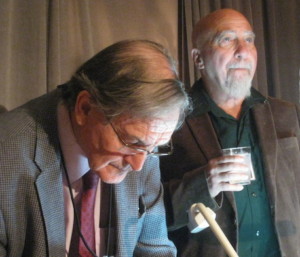
Stuart Hameroff is an anesthesiologist by trade who has been working on a theory of consciousness for over 20 years with the famous British physicist, Roger Penrose. (Penrose was one of two physicists awarded the 2020 Nobel prize in physics).
Called “Orch-OR” for “Orchestrated Objective Reduction,” the theory…
“…suggests consciousness arises from quantum vibrations in protein polymers called microtubules inside the brain’s neurons, vibrations which interfere, ‘collapse’ and resonate across scale, control neuronal firings, generate consciousness, and connect ultimately to ‘deeper order’ ripples in spacetime geometry. Consciousness is more like music than computation.” – from Hameroff’s webpage dedicated to quantum consciousness.
Basically, their theory suggests that consciousness arises from processes on the quantum scale inside of the brain’s neurons, as opposed to the classic view that has consciousness arising from the connections between the neurons.
To be clear, as of this writing, Orch-OR is a hypothesis; it has yet to qualify as a bona fide theory and has some notable critics. Nevertheless it attempts to build on established neuroscience and quantum physics, without violating any principle in either. From the non-physicist and non-neuroscientist viewpoint, it appears to be a very cogent, well-thought out description of how quantum processes may have a fundamental role in producing consciousness from brain function.
What I find most interesting is regardless if Hameroff and Penrose are on the right track or not, biologists and physicists the world over are starting to join forces to explain previously-unexplained issues in biology…
For example, photosynthesis has now been shown to have a quantum process to it: Photosynthesis would not be possible (and life on Earth as we know it would not be possible) without exploiting the electron’s quantum non-locality ability.
This ability – that Einstein once famously called, “spooky action at a distance” – allows certain atoms’ electrons in the photosynthesis process to ‘be everywhere’ in a plant cell at once. It turns out this is necessary for locating a specific part of the plant cell that would otherwise take far too long if using ‘ordinary’ biological processes. Without this quantum shortcut, there would be no photosynthesis, and you and I would not be here without it.
Our sense of smell has also been shown to have a quantum process to it. Is science just discovering the ‘tip of the biological-quantum-connection iceberg?’ Perhaps new discoveries will identify many quantum ‘tricks’ that enable higher consciousness in the brains of humans and perhaps other animals.
After all, if quantum-level processes play a fundamental role in plant life, how much more likely would these helpful ‘shortcuts’ be a fundamental part of brains and the consciousness which arises from brain function?
If you’re interested, British theoretical physicist Jim Al-Khalili put together a fascinating and enlightening Youtube video entitled, “Quantum Life: How Physics Can Revolutionize Biology”
The question is if this newly-discovered quantum aspect of biology has implications for immortality. Even though we accept our bodies must die like everyone before us, we hold out some glimmer of hope that somewhere, somehow we’ll be back in some way, right?
Roger Penrose and Stuart Hameroff do indeed claim their Orch-OR hypothesis provides for everlasting consciousness. However, this is a highly-speculative inference from their hypothesis.
Regardless, it really doesn’t matter what we may know or not know about the precise mechanics of the way consciousness works, because all we are interested in as humans — as far as our ‘deaths’ are concerned — is:
Our all-important Experiential Reality
Regardless of the actual process — the actual mechanics — of what happens when you die, it’s your experiential reality that really matters: What will be your actual conscious experience through all this? You were conscious when your body was alive, but when your body dies, then what?

Surely you cannot experience death, only the moments leading to death, due to the resulting loss of conscious awareness that accompanies the cessation of all brain activity when your brain’s neurons perish. (The last moments include, of course, any and all ‘dreamy’ subconscious awareness preceding death.)
So it may seem the story ends here, with you being the star character. The physicalist/materialist or reductionist viewpoints would agree that physical death is the final curtain fall on consciousness. But I think this view ignores some key parts of reality.
There is a compelling ‘argument’ for the continued existence of you — or at least some fundamental part of you — and it does not depend on religious beliefs or magic. In fact, it follows deductive reasoning based on what we know to be true.*
*We can imagine a separate ‘spiritual dimension’ if we’d like, to accommodate a ‘heaven,’ for example, but we’d have to imagine it; we would be leaving our areas of empirical knowledge.
…And what we know to be true is how I arrived at (what I consider to be) a commonsense expectation of how every conscious creature’s experiential reality will progress from the moment of the complete death of its brain. In fact, it is precisely the physicalist/materialist and reductionist lines of thinking that most support this reasoning — Orch-OR process or not.
A basic understanding of the relationships of time, unconsciousness, the law of conservation of energy, and, optionally, the Big Bang and multiverse ‘theories’ are all we need to see how ‘death’ is likely not the end, but an inescapable point in a continuous cycle. And it’s not all necessarily a rosy picture, because we can’t know where ‘we’ will end up. (And, of course, you could never know whether some part of you may have experienced consciousness before ‘this’ life*).
*I think it highly unlikely people who undergo “past life regression therapy” are ‘remembering’ anything extraordinary, but confabulations. Not that it’s an ineffective therapy, but that’s another subject entirely.
Stick with me here, because to see how all of this makes sense, I need to take you back in time….a looong way back — to the beginning of our (current?) Universe. This is necessary to appreciate your ‘ultimate beginning,’ the starting point which all life shares. From there, I’ll briefly cover the leading theory of how the “Big Bang” was likely not a one-time event, but part of the cyclical nature of time and existence. Finally, I’ll wrap everything up in a tidy summary and conclusion.
First, you need to accept that consciousness — ‘soul’ or not — is a function of physics…
Consciousness: An Emergent Property of a Physical Substance
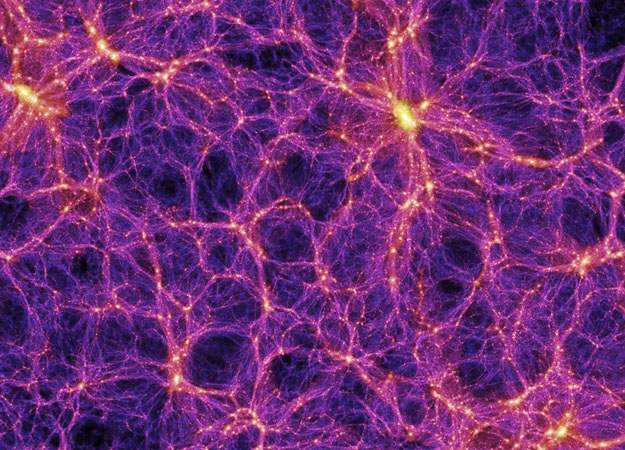
Let’s start with your brain — the organ made of physical matter from which your consciousness arises. While consciousness itself is not physical matter, it arises from physical matter — the fundamental ingredients of which were formed during the formation of our Universe.
Therefore, consciousness is necessarily tied to physical matter as well as to the Big Bang, whether we like this fact or not. But “physical” matter has — at its most fundamental level — very ‘non-physical-like’ properties. So don’t let this mind-body connection be a problem for you. (The “Mind-Body Problem.”)
Obviously not all brains are equal; there are differences among the same species and from species to species. And brains — along with other body parts — deteriorate with age. So consciousness changes throughout life with changes in the brain.
But regardless how a brain of any species turns out when it’s at its best — whether the outcome of faulty genetics resulting in mental retardation or if it was the brain of a human Nobel prize-winning scholar — it could be argued the differences in all brains is in degrees. This equates to degrees of consciousness…
For example, the consciousness level of a severely compromised human brain and, say, an intelligent non-human primate might be closer than the consciousness level of the Nobel prize winner.
To emphasize the physical component of consciousness, I paraphrased some info from neuroscientist David Eagleman’s fascinating book, “Incognito”:
If you lost a toe in an accident, your personality – the essence that is you – would remain unchanged. But if you lost an equivalent-sized piece of your brain tissue, it is likely your personality, memory – everything that is normally described as you by your friends and family – would be dramatically altered.
Another example, this one more interesting:
“There’s someone in my head, but it’s not me.”
– lyric from Pink Floyd’s Dark Side of the Moon
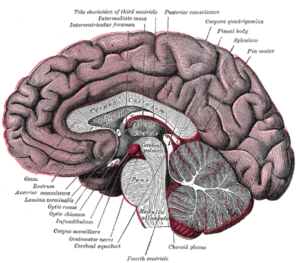
Occasionally, neurosurgeons find it necessary to separate the two hemispheres of a patient’s brain in order to stop debilitating seizures, when drugs are of no help. The tangle of neurons (some 250 million of them) connecting our two hemispheres is called the corpus callosum, and they allow interhemispheric communication. When these nerves are severed in the operation, obviously neither hemisphere can communicate with the other.
…For the most part, a patient is the same person they were before the operation. Memories are intact, speech is normal, and so on. But an interesting side-effect of the procedure is that the two hemispheres are completely unaware of each other and can sometimes act as two completely separate brains in the same person. This can result in alien hand syndrome:
Some patients will be unbuttoning their shirt with one hand while the other hand follows along behind it, buttoning the shirt back up. Or the ‘alien hand’ picks up a cookie to eat, but the other ‘normal’ hand grabs the ‘alien’ wrist and keeps it from getting the cookie to the mouth. For some patients who get frustrated with their ‘alien hand,’ simply yelling, “STOP!” seems to make the alien hand back down.
…Of course, it isn’t the hand they’re really yelling at, but the other brain in their head – the other half of their now independent hemispheres.*
*Another procedure, called a hemispherectomy, involves surgically removing one entire hemisphere from a patient’s skull. Doctors have performed many of these operations to ultimately save patients’ lives. If the patient is eight years or younger, the remaining hemisphere adapts and learns all of the things the other hemisphere was better at. Much after eight years, however, the patient will have difficulty with speech if the left side was removed, or difficulty with numbers if the right side was removed, for example…
So although identical in shape and size, our two hemispheres become ‘specialists’ at specific tasks over time. It’s interesting this is exactly what happens when two people work together for a common goal, such as in a business partnership: Some tasks are shared but others are routinely performed solely by the person naturally better at them.
So it’s clear consciousness requires a brain, and the better the brain, the better the consciousness from which it arises.
The physical substance of a Brain: Where do the fundamental components come from?
We know our bodies are made of atoms, which are comprised of more fundamental components — all of which are part of a Universe having reached its present form after about 13.8 billion Earth years of evolution since its beginning (the “Big Bang“).
Carl Sagan once famously said, “If you wish to make an apple pie from scratch, you must first invent the Universe.” Your brain and the consciousness from which it arose is the culmination of not just Darwinian evolution here on Earth, but cosmic evolution, starting with the Big Bang and continuing for about 13.8 billion years…
You were a long time in the making, but voila — here you are! Although this is a very generalized summary, the overall sequence of events is correct (according to virtually all scientists).
So your consciousness didn’t just arise from scratch when you were born. Your consciousness has been a work in progress for about 13.8 billion years. The significance of this — as far as your possible ‘immortality’ is concerned — starts with the fact your consciousness’s earliest ingredients were the Universe itself!*
*Or at least our observable Universe, which could very well be a small part of an ‘overall’ Universe infinite in spacetime. (Along with the seeds for the consciousness of all past, present, and future creatures.)
It’s important to realize your existence was not guaranteed at that early time anymore than it was guaranteed 13.8 billion years later when your father looked at your mother with a ‘gleam in his eye.’
…Both the initial flash of pure energy (an early moment in the Big Bang process) and your father’s ‘gleam in his eye’ represent potentialities of what might be; your existence at both of these moments was merely a possibility — one of countless others.* It’s important to keep this fact in mind.
*It’s not clear our current Universe — one that can support life — was even guaranteed at that early moment of the Big Bang, to say nothing of our Solar System with our life-friendly Earth. For one thing, we’re aware of many extinction events during Earth’s four-plus billion year history. But nevertheless, here you are.
The Universal Law of Conservation of Energy = Conservation of You
This Richard Feynman quote about the Law of Conservation of Energy highlights a fascinating concept: It suggests the mystifying idea that energy just is. Energy is a fundamental and necessary feature of our Universe, but energy does not exist in and of itself. (In this respect, energy and time have much in common: They do not exist on their own; they appear to be properties of change.)
Perhaps even more perplexing – at least on the surface – is the current body of physics knowledge which holds the sum total of energy in the Universe is precisely zero. This is widely believed to be true at least from the observable Universe, where gravity cancels exactly all ‘positive’ energy (with one caveat – explained after the video). The following short video by physicist Michio Kaku does a good job explaining the ‘zero energy Universe‘ concept.
The “zero energy Universe” is a consequence of an expanding Universe which has positive ‘outward’ energy causing the expansion. But neither the law of conservation of energy nor its popular application – the first law of thermodynamics – are violated because of the ‘negative’ energy of gravity opposing the expansion, along with the redshifting of photons in the expansion – which reduces the otherwise ‘additional’ energy created in the expansion…
So matter and energy is being neither created nor destroyed, only changing form.*
*An oft overlooked detail (actually more like ‘the elephant in the room’) is that energy is not actually conserved in an expanding Universe (our Universe) but increases as spacetime increases. This post by Sean Carroll explains it nicely.
The total energy of the Universe, however, adds up to zero in some popular theoretical models. But it’s a very complex issue due to the fact our Universe is expanding at an accelerated rate. There is no unambiguous mathematical model that everyone can agree on. Nevertheless, most physicists think it makes sense the total energy of the Universe at any one point in time – if it could be actually measured – is likely zero.
What Does Conservation of Energy Mean for Immortality?
The significance of this for your continued existence may not seem obvious on the surface. But when you add another fundamental principle of physics, you’ll start to see the light, no pun intended:
The Uncertainty Principle (a.k.a. Heisenberg Uncertainty Principle) is a foundational principle of quantum mechanics developed by Werner Heisenberg, which helped lead to his Nobel Prize in Physics in 1932 “for the creation of quantum mechanics.”
Among other things, the uncertainty principle describes how there is really no such thing as “empty space” and, ultimately, how a Universe can emerge from the natural quantum field fluctuations* occurring in what was previously considered to be a ‘perfect vacuum.’
*You may have heard the term, “virtual particles” and how they can spontaneously ‘pop’ in and out of existence. They are actually just a mathematical description of what happens in order to explain the presence of ‘real’ particles in quantum physics. They’ve never been actually observed and may never be observed.
They represent the existence of “quantum fields” of varying strengths — a necessary mathematical ‘multiplier’ to arrive at the existence of ‘real’ detectable quantum particles. Some physicists regard virtual particles as a philosophical concept offered to help explain “why there is something rather than nothing.”
…Regardless of the actual force or potential force represented by “virtual particles,” we know that there is something that causes fluctuations in the quantum foam** to produce ‘real’ particles. These ‘real’ particles are nearly always short-lived matter-antimatter pairs that instantly annihilate each other. The current body of physics knowledge supposes this known process very occasionally results in a ‘runaway’ inflation of matter-producing energy – a Big Bang.
**Turns out there is really no such thing as “empty space” or a “perfect vacuum.” After all (as mentioned earlier), “space” was formed as a necessary ‘ingredient’ of energy becoming matter; a consequence of accommodating the formation of fermions (the physical matter of the main parts of atoms – protons, neutrons, and electrons).
But an unknown type of matter also formed in the ‘post-Bang’ process: “Dark matter,” for which we can only indirectly detect (because it doesn’t interact with or give off light). Dark matter comprises about eighty-five percent of the total matter (mass) in our Universe and about 27 percent of the total energy density of the Universe.
Astronomers discovered an intriguing galaxy in August 2016 they named “Dragonfly 44“. It appears to be composed of almost entirely dark matter. It’s an ultra diffuse galaxy (UDG), about the same size as our Milky Way but with a mere one percent of the luminous stars —the remaining ‘structure’ being dark matter.
The story gets more complex and weirder over time since the Big Bang: Evidently there is “Dark Energy” causing an accelerated expansion of the Universe, resulting in space containing the same finite amount of matter but distributed ever more diffusely;
…the original accommodating space is increasing in volume at an accelerated rate while the physical matter remains the same. (But – as mentioned earlier – much of the otherwise additional energy is reduced by the ‘stretching’ of the light waves with the stretching of spacetime.)
Is Our Universe a ‘One-Time Event,’ or One of an Endless Series?
“Cosmic Inflation Theory” — The leading Big Bang model requires an infinity of Universes
Cosmic Inflation theory necessarily includes an infinity of universes, colloquially known as the “multiverse.” Although it is the leading theory, it is not without critics, most notably Paul Steinhardt, who was one of the first physicists who developed the theory.
The “Big Bounce Model”: One continuously-regenerating Universe
Paul gradually shifted his view from supporting the multiverse to a belief in the “Big Bounce model,” which posits an infinity of one expanding and contracting Universe; a never-ending series of Big Bangs from the same ‘oscillating’ Universe. (This is also known as the “Cyclic Model.”)
Cosmic Inflation theory and the Big Bounce model both predict an infinity of universes. But they’re not alone in the (speculative) theoretical landscape of endless Universe formation:
String Theory: An infinity of Universes ‘in parallel’ — in other dimensions
String theory also postulates an infinity of Universes but ‘in parallel’ to ours. In this model, there are many Universes co-existing with ours — but in other dimensions (whatever that means). This article in Scientific American online magazine attempts to explain this highly-speculative idea from string theory in an easily understandable way.
The “Many Worlds Interpretation”: A near-infinite number of variations of our Universe co-existing simultaneously
In 1957, Hugh Everett III proposed the “many-worlds interpretation” (MWI) of quantum physics. This idea has been spun and modified several times since, but the main crux of the ‘theory’ has remained unchanged: A near-infinite number of variations of our Universe co-exist simultaneously…
In this respect, it shares the idea of parallel universes with string theory — the differences being in the details. And like the other ‘multiverse’ ideas, it makes highly-speculative interpretations of accepted and proven physics. Despite this, it is interesting that it has many supporters in the professional physics community today.
“Conformal Cyclic Cosmology”: Similar to the “Big Bounce” Model but slightly different process

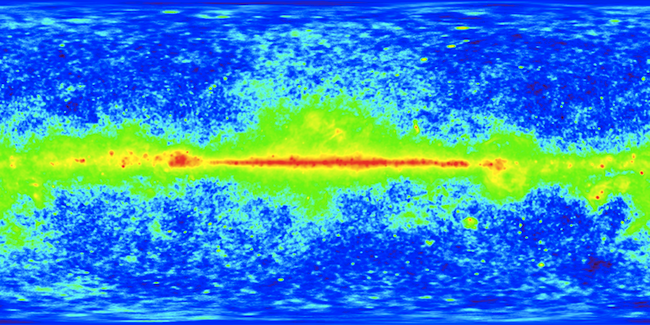
Most recently, the eminent British physicist, Roger Penrose, working with Armenian physicist Vahe Gurzadyan, proposed a controversial model of infinite Universe formation called the CCC (Conformal Cyclic Cosmology). Promisingly, they base their model on unique patterns found on an accepted scientific observation – the Cosmic Microwave Background image (shown earlier).
They claim to have found evidence of a previous Universe imprinted at several places on the image. If true, it would be the first time a multiverse ‘theory’ actually had evidence to back it up.
So it appears much of the established physics community is on board with the idea of our current Universe being ‘just’ one of an endless series — regardless of the precise way in which the “series” comes about. This has serious implications for the continued existence of at least some part of you:
Congratulations: You’re Here!
What the Universe ‘knows’ about you
As discussed earlier, your existence was not guaranteed at any one point in the formation and evolution of our Universe. That is, until sometime in the 20th or 21st century, before which time your existence was merely a possibility; a potentiality. Now, however, you are – without a doubt – here.
The significance of this is not that your current existence is necessarily the only time you (or some part of you) came to be. No, the significance is now we know for sure — the Universe ‘knows’ you are here and have therefore always been here in some way, shape, or form.
…I realize the above paragraph may seem esoteric, vague, and otherwise unscientific, but stick with me here: We know the laws of physics show that matter (and therefore energy – or vice versa) can be neither created nor destroyed. Therefore your existence – the particles that comprise your body and brain – have always been here.
More fundamentally, the energy that gave rise to the physical atomic particles that are you, has always been in existence either as a potential or past or present reality.
All that is known about how your ‘primordial energy seed’ appears to work is summarized below:
- Apparently random disturbances (‘virtual particles‘) in the quantum fields (‘quantum foam?’) have shown to populate so-called ’empty’ space, resulting every great once-in-awhile with a ‘runaway cosmic expansion‘ — a “Big Bang.” Other than the “Heisenberg Uncertainty Principle,” there is yet no explanation for these “random disturbances.” It appears to be natural phenomena of the unfathomably tiny sub-atomic world of quantum physics* that – for all we know – could be eternal and timeless.
- The finite amount of energy that very occasionally does happen to result in a Big Bang is exactly compensated by a like amount of ‘negative energy’ – mostly gravity, including gravity from dark matter. Also, the expanding spacetime ‘stretches’ photons’ frequencies to longer wavelengths – to lower energy levels. The combined effect is the overall energy in the Universe (supposedly) equals zero; nothing gained, nothing lost.**
*Your existence might have its origins in a ‘spark’ of energy so tiny as to be beyond the reach of any instrument ever devised or could be devised. An area so small that an actual “spark” – by our human-world standards (say, from a spark plug) – would be some 10^32 or 100,000,000,000,000,000,000,000,000,000,000 times larger!
**Perhaps a better way to say it is, “while time may be infinite, there are finite periods of time when energy temporarily ‘bubbles up’ from a ‘zero state’ to produce matter, eventually ‘dissolving back’ to its earlier zero state.”
Your earliest theorized starting point is mind-boggling, no matter what the actual details involved. On the surface, it might seem common sense has no place in pondering such things.
What Does Your “Common Sense” Tell You About Your Existence?
What if you were born many hundreds of years ago and, therefore, didn’t know squat about any and all branches of physics, including cosmology? You would have merely your “common sense” to make sense of your existence…
This is precisely the only ‘tool’ you would have in ancient times; no telescopes, microscopes, computers, particle accelerators and all other high-tech tools of today’s science. Moreover, you would not have the benefit of the hard-won knowledge of thousands of intellectuals who came long after you, such as Albert Einstein.
How might you ponder your own existence? It’s likely you would accept whatever explanatory narrative your elders passed on to you, if anything. You might easily accept whatever religious story that is part of the culture you were born into (really no different than today in that respect). You may even regard your own unquestioning acceptance of established thought as “common sense.”
But you may have been one of the few persons of ancient times who thought ‘outside the limiting box’ of your native culture and time. One such person was the famous ancient Greek philosopher, Aristotle, who thought the Universe was finite in extent but was eternal in time and, therefore, existence…
He argued that if time (and the Universe) had a beginning, then obviously there would be a moment before the beginning. So therefore one could not talk about the Universe having a beginning or an end; there would always be a time before and time after.
Aristotle’s ideas of time and existence could very well be spot-on. In my view, this is a commonsense way our existence as conscious beings follows as well:
Everything in nature has shown to follow a ‘birth-life-death’ cycle. On the biggest scales, it’s likely time and existence also follow a cyclical pattern – a pattern known as the “multiverse” or “cyclic model” or “parallel universes” or “many-worlds interpretation” or whatever the likely reality is about one overall eternal or infinite Universe. (Remember there is now compelling evidence our Universe is infinite.)
It’s all a matter of scale. The largest scale – a Universe – is challenging to wrap your brain around. But knowing how a universe can arise from such a tiny area – perhaps from the “quantum field” – makes the ‘infinity of universes concept’ seem much more plausible.*
*We know at least our own observable universe sprang (“banged”) into existence from a tiny ‘area.’ Common sense tells you if it could happen once, it could happen again. Common sense aside, quantum mechanics holds that any process that is not strictly forbidden by the laws of conservation of energy, have a non-zero probability of happening at some point in time. This seems especially obvious when you consider the nature of matter and energy on the quantum scale – which is like a ‘frothy soup’ of potential energy.**
**Similar to the potential energy of electrical voltage awaiting an opportunity to ‘push’ current – valence electrons – through a conductor; electricity through wire. Our intuition has failed us before, but at least this time it matches what we observe all around us, including voltage and current.
Do the details really matter?
For the purposes of your potential ‘immortality,’ there is no need to debate or agonize over the details of how or why there is evidence of:
- A law of conservation of energy (energy and matter can neither be created nor destroyed)
- An infinite, ‘flat, zero-total-energy’ Universe (nothing gained, nothing lost)
- ‘Empty space’ consisting of a ‘frothy soup’ of potential energy (“quantum foam of virtual particles”) popping in and out of existence.
…All of which results in the birth-life-death cycle of the existence of everything – including an endless series of Universes (“Big Bangs”) themselves.
One reason I included certain science details in this article is to show how the post-death consciousness ideas presented here are based on our empirical knowledge and to keep you (and I) from straying too far – say, into mysticism.*
*Not that mystics like the famous and very articulate Deepak Chopra are necessarily wrong about their views. His views on the existence of a “cosmic consciousness” (a.k.a. “universal mind“) can seem very intriguing. But as with all forays into metaphysical topics, the truth cannot be established as fact…
Although this is also a reality of much of the science we’ve covered here, the difference – in a nutshell – is the application of the scientific method. This makes metaphysical cosmology stray a bit too far from the line I am trying to tread for this article.
Some things we know to be true. Other things we don’t know with factual certainty, but the current body of science knowledge often suggests what is likely. With this in mind, we’ll step through the parts of reality (science) which are applicable to your future, ‘post-life existence.’
Then we’ll finally summarize everything and come to (what I consider to be) your inescapable and fantastic future.
Unconsciousness and the passage of time
To think our consciousness to be separate from our bodies is not to acknowledge our own sleeping brains’ unconsciousness, to say nothing of brain damage. In normal, wakeful conscious operation, your brain’s neural circuitry must send and receive signals to every other part of your brain simultaneously. That’s because different parts of your brain are good at different jobs – all necessary for you to think and feel normal.
In other words, your brain must communicate with itself at an astonishingly fast rate for you to be conscious and aware.
…When you are asleep, however, your brain is not communicating with itself at the level required for consciousness. We all know how most dreams are nonsensical, and yet this is the ‘shallowest’ level of sleep – known as REM (Rapid Eye Movement) sleep – when the brain’s unconscious activity is the greatest.
So a deeper, dreamless sleep is getting closer to true unconsciousness. If you have ever been under general anesthesia, you have experienced true unconsciousness. If you have, you know that feeling of waking up from anesthesia with no idea that (perhaps) hours had passed since the anesthesiologist-administered drugs rendered you unconscious. And yet it’s likely you thought maybe but a few seconds had passed…
Therefore, death of your brain would be similar to general anesthesia, except a level of unconsciousness so deep as to be infinite. Experientially, however, the effect will likely be nearly the same. The passage of time will obviously be rendered nonexistent…
The current age of the Universe – approximately 13.8 billion years – could pass by unnoticed and unexperienced; time will have no experiential value whatsoever because you will not be even remotely conscious to experience its passing.
…14 billion years could be ‘contained’ in one billionth of one second or less – in zero seconds, experientially. Keep this in mind…
We are all connected. In some sense, we are all “Star Dust”
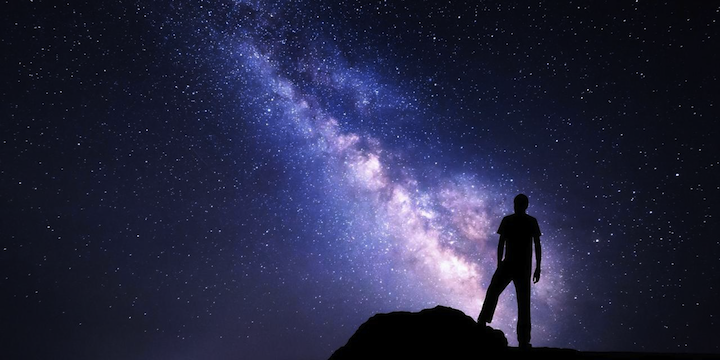
“Our planet, our society, and we ourselves are built of star stuff.” – Carl Sagan
It is clear your consciousness cannot survive the death of your brain – the key word being “your.” Consciousness in general, however, is an emergent property of each and every creature with a brain of sufficient complexity.
Although this complexity may have required an evolution of billions of years (cosmologically – at least for us Earthlings), its origin can be traced back to a quantum-level ‘spark’ of energy which we all share – all creatures in our observable Universe.
All life is connected on a fundamental level with all other life. We are all, quite literally, children of the stars. This is not an esoteric, ‘feel good’ statement, meant to be a palliative to counter the otherwise unacceptable reality of death. It is actually a true statement based on physics firmly-established since the mid-20th century, called stellar nucleosynthesis. A short, well-written article by Peter Tyson for pbs.org’s NOVA explains it nicely. It is called “The Star In You.”
When your body dies, it eventually returns to the Universe’s ‘soup of potential energy.’ What was previously “you” will be subject to natural atomic and sub-atomic processes – no different than every creature that has ever lived or will ever live. In a sense, you will become ‘one with the Universe’ upon your so-called “death.”
…More importantly, this “soup of potential energy” ultimately leads to conscious creatures in a life-friendly Universe such as ours. And if not ‘this’ Universe, perhaps the next.*
*Providing one of the multiverse models is true. (Big Bounce, Many Worlds Interpretation, String Theory, Conformal Cyclic Cosmology, etc.)
Can you directly experience ‘connectedness’ or ‘oneness’ with the Universe?
Your body (and your consciousness from which it arises) is in a very low entropy state – an intrinsic consequence of being a living creature. What does this mean? Our bodies are specialized biological ‘machines,’ existing on a stupendously-huge scale in comparison to the higher-entropy (‘disordered’) quantum ‘world’ of which we’re actually built. (Remember the interactive scale of the Universe – where 10^0 is one meter and 10^-35 is the theorized Planck length.)
…There is, therefore, little chance for detecting or experiencing so-called “connectedness” to the Universe directly, because – even though everything on the quantum scale determines everything on the macro scale (everything larger than an atom) – our human-sized world is orders of magnitude (some 35 of ’em) larger than the quantum world.
For example, quantum tunneling refers to subatomic particles being able to ‘tunnel’ through otherwise ‘solid’ barriers. But we humans cannot walk through a solid wall – even though our bodies are made of quantum particles.
You would not be able to make any mental connection between the behavior of the electrons in every atom in your body and, say, the feeling of love or the beauty of a sunset. These things are processed on scales so diverse and distant from each other as to be impossible to correlate directly.*
*Quantum non-locality is a provocative fact of quantum physics. It is fascinating mostly because it’s so counter-intuitive. Because of this, some of the non-scientist public have hijacked the term as so-called ‘scientific proof’ to support pretty much any speculative metaphysical idea.
Can you indirectly experience a feeling of ‘one with the Universe?’
Meditation has proven to be very beneficial for those who learn to practice it correctly. This page on Psychology Today has links to five well-written articles by folks with Ph.D.s on the benefits of meditation.
But what about feeling “one with the Universe” through meditation? This is a more speculative area of meditation, likely helped by confirmation bias. But if anything could achieve such a feeling of oneness, surely this is it. (The following link goes to a Google results page from the search query, “meditative oneness with the Universe.”)
Your Cosmic Evolution
Let’s trace the steps forward in time from your ‘absolute beginning’ (as is now understood in physics) to your current existence as a conscious, sentient being here on Earth. Then we’ll finally look at what it means for your post-death ‘experience’:
- Random quantum mechanical fluctuation(s) (virtual ‘particles’) that precipitated a ‘Big Bang.’ We know of at least one instance in which an expanding universe had life-friendly physics. So you were once ‘merely’ an energy potential, just one possibility of (perhaps) an infinite number.
- After the start of our Big Bang, you were being expanded from a small area of energy (along with the ingredients for every other creature and all other matter) for further ‘processing.’
- A life-friendly universe must have a way for life to arise. The only way that we know of (and the only way that makes sense with our physics) is for the early formation of huge stars (at least ten times larger than our Sun) that coalesced from light-years-sized clouds of primordial hydrogen. These humongous stars were our Sun’s great, great, great, and so on – grandfathers. These very short-lived gigantic stars exploded (supernovae) at the end of their ‘lives,’ spewing out the raw materials for the formation of other stars (and, ultimately, galaxies).
- Some of the larger of these next-generation stars also went supernova and the process continued, each generation producing ever more life-friendly elements in their cores. This set the stage for the formation of life-friendly solar systems which coalesced from the now far richer clouds (“nebulae” or “molecular clouds“).*
*Supernovae are not the only way our post-Big Bang Universe contributes life-friendly elements to the Cosmos. This well-written article by Ethan Siegel for Forbes, “The Only Three Heavy Elements In The Universe That Aren’t Made In Stars” explains it nicely, if you’re interested.
Many – perhaps most – of the atoms comprising your body were therefore once inside the hot cores of probably many stars over the past 13.8 billion years. (Most of the atoms of the lightest element in your body, hydrogen, could have come from the original, post-Big Bang primordial cloud – not from stars.) Nevertheless, an article on physicscentral.com, “How much of the human body is made up of stardust?” contends ninety-three percent of the mass of your body is “stardust.”
…Some atoms in your left hand could easily have come from a different earlier star than the atoms in your right hand. Every person on Earth and every other creature in the Cosmos that is currently alive and has ever lived, very likely share their origins (at least some atoms*) from common stars…
*To give you a feeling for the immense number of atoms in your body, the average number of cells in your body is 37.2 trillion. Yet the number of atoms in one single human cell (according to one study) is about 100 trillion.
Also, although there are more stars in the observable Universe than grains of sand on all the beaches of Earth, there are more atoms in one single grain of sand than stars in the (observable) Universe!
…This illustrates the countless chances for your body having atoms that were once part of dinosaurs and all other creatures and plants of eons past. The atoms comprising the air you are breathing have also been recycled – undoubtedly some were part of the air molecules breathed by other long-gone people and animals. It’s all part of the cycle of life here, a microcosm of a comparable cycle in our galaxy, which is a microcosm of (what is likely) the ongoing cycle of universe formation.
Your existence is proof you are part of this Universe. The matter (energy) of which you are composed cannot be eliminated, only altered in its form. The atoms that comprise you and the energy from which they arose have been shuffled around the Universe for all time. In a very real sense, ‘you’ are immortal.*
*The likely reality is there is no such thing as ‘personal’ reincarnation. That is, it is unlikely the unique consciousness that is you will be preserved after the death of your brain. But this should not concern you, because ‘you’ will nevertheless likely continue to experience consciousness anyway. I realize these last two statements sound incoherent, but stick with me through the summary and conclusion:
Summary: Putting It All Together
- Matter can be neither created nor destroyed – at least in our Universe’s current state. (The law of conservation of energy.)
- You are here now, therefore you have always been here – in some way, shape, or form; the physical components of which you are made have been here at least since the start of our Universe – and perhaps forever – as virtual particles or whatever that gave rise to our ‘current’ Universe.
- When your body dies, there will likely be no concept, no experience of time whatsoever. (If you’ve ever been under general anesthesia, you’ll understand.) Countless trillions or more of millennia could pass unnoticed and unexperienced in a tiny fraction of one second – or zero seconds – after your brain completely perishes.
- The cyclical nature of everything in nature suggests some degree of consciousness awaits some fundamental part of the current consciousness that is you…again. Perhaps it would not take long for some part of your current consciousness to experience awareness again. But it would not make any experiential difference if it was one second or one hundred billion years; the effect will be instantaneous, though you could not know…
- Whatever degree of consciousness you are currently experiencing will always appear to be the only time you have experienced life. It would be impossible physically and in principle to have any memory of any past or future consciousness.*
*Some people choose to believe in reincarnation. Most versions of this belief system are basic tenets of certain religions, namely Hinduism, Buddhism, Jainism, and Sikhism. These traditional views of reincarnation hold that after death, a human experiences ‘rebirth’ into a human again – specifically, a different human body but with the same “soul.”
…This is where reincarnation differs from the ideas presented here, where there is neither a particular creature in time or place in which consciousness will necessarily arise again nor will any ‘new, follow-on consciousness’ have any certain degree of consciousness inherited from any particular previous brain…
After all, if the laws of physics are truly “laws” – as they have proven to be – there is no possibility of such an ongoing consciousness. Also, it would be highly unlikely ‘personal’ reincarnation could happen on such short time scales anyway.
- Your experiential reality, therefore, cannot be anything different from the following:
Immediately upon the death of your brain’s last neurons, some indeterminate degree of your current consciousness will ‘re-awaken’ into some level – some degree – of conscious awareness somewhere…
In some indeterminate time, in some indeterminate world, as part of some indeterminate young creature.
Conclusion
“The day which we fear as our last is but the birthday of eternity.” –Lucius Anneaus Seneca
Your body is made of atoms – which form the molecules which form the cells which form your organs – to include your brain, of course. The term “death” actually refers to the end of the unique composition of atoms that were the sum total of your body at the time of your ‘death.’ But the atoms themselves – including the many trillions no longer part of your body at the time of your ‘death’* – are not going anywhere, so-to-speak.
*A well-known fact in biology is that your body is basically ‘replaced’ every so often throughout your life. Cells die or wear out and need to be replaced by new ones. It doesn’t happen at the same time because some molecules are replaced at different rates than others. For example, molecules of DNA (DeoxyriboNucleic Acid) remain unchanged far longer before they are replaced than water molecules. This well-written article on NPR.org explains it nicely.
…The upshot of this is your body and the consciousness from which it arose is ever changing and recycling; a “snapshot” of you is an unrealistic representation of you.
By the time you are a middle-aged adult, several iterations of your entire body’s worth of atoms have already been re-purposed, some perhaps as part of a much younger person. When you ‘die,’ all the atoms that have ever been a part of you will still be around somewhere, existing as part of something.
Even if you were standing next to a nuclear bomb that separated the protons, neutrons, and electrons from all of your atoms – in effect, ‘vaporizing’ your atoms – the fundamental components of which you were made would not be destroyed.
And even when all the atoms (that were ever a part of your body) radioactively decay into more fundamental components over untold ‘gazillions’ of years (at least 10^35 years – according to Martin Rees – which is longer than the current age of the Universe), the energy from which they arose is still in existence and could never be destroyed.*
*Perhaps after untold billions or trillions of years or – if one of the multiverse ideas is correct – ‘many universes later,’ the unique composition of subatomic particles of which you are made will be repeated. This, however, is highly speculative. (If it did turn out to be true, you could never know. As mentioned before, you could never have a memory of any so-called “past life”; your current level of consciousness will always be the only one you have ever known or could ever know.)
…Besides, your uniqueness and the uniqueness of every creature – especially your family, friends, and other loved ones – is what makes life so precious and what makes it such a tragedy when someone dies; it seems likely there could never be another ‘you.’**
** The common unwillingness to accept the end of one’s ‘self’ is surely one reason for the proliferation of religions promising everlasting life – your ‘current’ one. But this powerful “unwillingness” is – at its core – an emotional ‘knee-jerk’ reluctance to accept the idea of one’s consciousness ceasing to exist for eternity…
Because if you stop and think it through, the idea of having the same personality, experiences, mindset, and memory for eternity is not very appealing. (For a better understanding of what I’m talking about, read, “Are We Souls In Human Bodies?”)
Physical death is truly ‘merely’ the re-shuffling of the physical components which gave rise to the unique creature, the unique consciousness that is you. What was previously “you” will be (eventually) diffusely distributed among the Universe. (This is a good thing.)
You are an everlasting and fundamental part of a Universe which gives rise to life. Sometimes that life produces creatures with brains of sufficient complexity for consciousness to arise – which is the most amazing thing in this Universe, IMO. In a sense, your consciousness could be thought of as the Universe becoming ‘self-aware.’
When you die, it seems likely you will immediately ‘resume’ some level of consciousness. You must continue to remind yourself, however, that you could never – even in principle – have any memory of any previous level of consciousness (which you may or may not have had).
…This begs the question: What would be the benefit of immortality if you could never know you are ‘immortal?’ (That is, if you could never ‘carry’ any previous life’s memory forward to another?)
Here’s the benefit:
Knowing it’s likely your upcoming death is not the end, but an inescapable transition point in a continuous cycle. A cycle in which the transition is immediate – no matter the actual calendar time (due to your inability to experience the passage of time). In my mind, this knowledge is important for instilling a sense of awe, wonder, and adventure at the prospect of your ‘transition.’
…Not that you’d necessarily look forward to such a drastic change, but you should never fear or dread it. When the time comes, calmly accept the inevitable with a rising sense of anticipation. This has another benefit of reducing any lingering fear of so-called “death” to child’s play.
So the question changes from, ‘What’s the point?’ to “Where? What sort of consciousness? What creature?(!) Will ‘I’ be part of countless ‘lower’ creatures (say, frogs, mice, etc.) before finally acquiring some degree of higher consciousness – the level I’ve so fortuitously experienced in ‘this’ life? What is the actual reality of my post-life ‘existence?’
These are all valid questions, but we could never know the answer to even one of them. We can, however, understand what is likely, based on what we do know. And what we do know is the cyclical nature of time and existence means ‘death’ is most certainly not the end.
Quite literally, a Universe of possibilities awaits you when you die. But the limitless possibilities means there’s also the possibility for untold future tragedy, pain, and suffering. That’s the bad news.
…But there are equal – perhaps many more – opportunities for the most amazing and breathtaking beauty, overwhelming love, mind-boggling knowledge, wonderfully fascinating adventure. Future experiences you can only dream about today.
Truly, a Universe of possibilities is yours. So do not dread death in the least. Instead – when the time comes – say, “What’s next?”
…Birth, Life, Next
So perhaps you CAN have it all. Just not all at once. 🙂
How to Experience Some Awesome ‘Connectedness’ or ‘Oneness’ with the Universe Now
There is a way to sort of experience ‘oneness’ with the Universe while you are still here: Think about your unique opportunity to be here with a brain capable of pondering your own existence (especially at the level you are doing now), while watching the following well-done YouTube video…
Kudos to Max Schlickenmeyer for putting the video together. Max used Neil deGrasse Tyson’s awe-inspiring and eloquent response to the following Time Magazine interview question: “What is the most astounding fact you can share with us about the Universe?”*
*This question was submitted by Matthew Horan of Winston-Salem, North Carolina. In 2008, Time Magazine had chosen one question from each of ten different entries for an interview with Dr. Tyson called, “10 Questions for Neil deGrasse Tyson.” The original interview (from which Max Schlickenmeyer got Dr. Tyson’s audio quote for the video) can be found here on YouTube.
(For the best experience, make it fullscreen and you must have audio.) If you would rather see it on Vimeo, here’s the link.